

A “30-day notice to vacate” is a common name, not a single U.S. rule. How much notice you must give depends on your state, whether the tenancy is fixed-term or month-to-month, how long the tenant has lived there, and whether just-cause or local rules apply. Check those first, then put the notice in writing.
General information, not legal advice. Notice periods, just-cause rules, required language, and service methods vary by state, locality, tenancy type, and federal program coverage. Talk to a housing attorney or your court’s self-help center before you serve a notice.
Is a 30-day notice to vacate required in every state?
No. Required notice periods and just-cause rules vary, and 30 days is only correct in some situations.
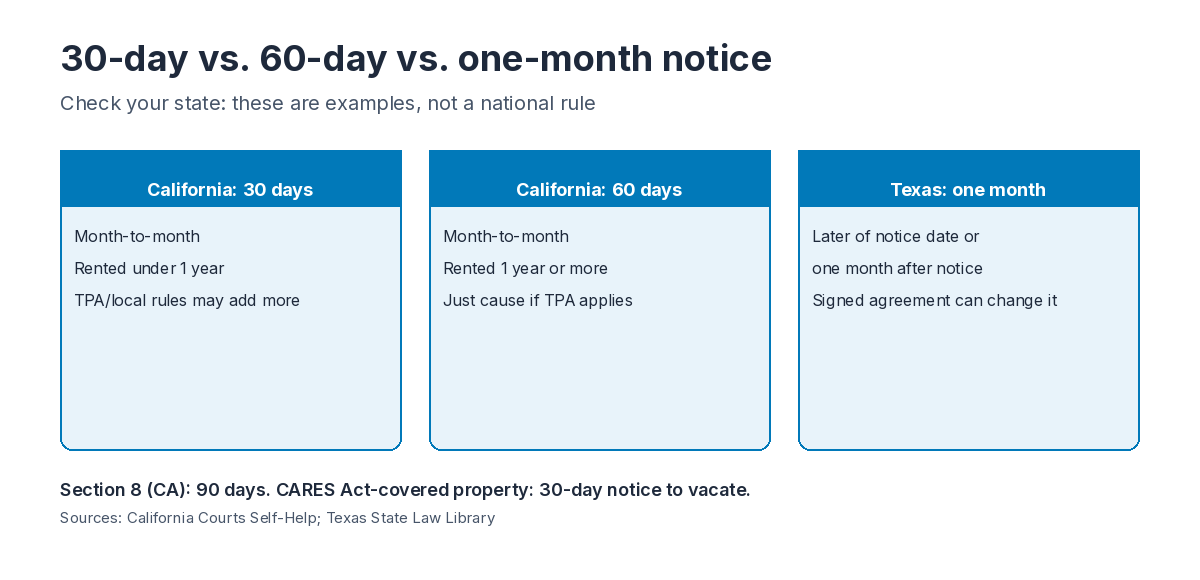
California (state-specific): California Courts’ guide to choosing the right eviction notice says a 30-day or 60-day notice to quit is used to end a month-to-month tenancy: 30 days if the tenant has rented for less than 1 year, and 60 days if the tenant has rented for 1 year or more.
Texas (state-specific): The Texas State Law Library’s Ending the Lease guide, summarizing Texas Property Code section 91.001, says a month-to-month tenancy ends on the later of the day stated in the notice or, for rental periods of at least one month, one month after the day notice is given. That is one month, not a fixed 30 days.
| Situation | Notice the source describes | Source |
|---|---|---|
| CA month-to-month, rented under 1 year | 30-day notice | California Courts |
| CA month-to-month, rented 1 year or more | 60-day notice | California Courts |
| CA, Tenant Protection Act applies (12+ months) | Just cause required; notice states the cause and relocation help or rent waiver | California Courts |
| CA, Section 8 subsidized housing | 90-day notice with just cause | California Courts |
| CARES Act-covered property (federal coverage) | 30-day notice to vacate; Section 8 follows the 90-day rules | California Courts |
| TX month-to-month | Later of the date in the notice or one month after notice, unless a signed agreement says otherwise | Texas State Law Library |
When do landlords use a notice to vacate instead of a pay-or-quit notice?
A notice to vacate ends a periodic tenancy or declines to continue it; a pay-or-quit notice is a different form used for unpaid rent.
California Courts’ guide to choosing the right eviction notice lists the unpaid-rent notice separately from the 30-day and 60-day notices to quit, so choose the form that matches your reason. A rent increase is also a different notice; see our guide to the rent increase notice.
What should a 30-day or 60-day notice include?
In California, the notice must include the tenant’s full name or names, the rental address, the end date, and how to pick up belongings left behind, plus extra items when the Tenant Protection Act applies.
According to California Courts’ guide to choosing the right eviction notice, a 30-day or 60-day notice must list:
- The tenant’s full name(s).
- The rental home address.
- The end date (30 or 60 days from when you give the notice).
- How to pick up belongings left behind.
If the Tenant Protection Act applies and the tenant has lived there more than 1 year, California Courts says the notice must also state the just cause and say whether you will give relocation assistance (1 month’s rent) or waive the last month’s rent, stating the amount if waived.
California Courts’ Give your tenant notice page notes that notices are not court forms, that a notice must meet California law and any city or county rules or you could lose your case, and that you should keep a copy. Outside California, use your own state court’s notice rules; this list is not a national template.
How much notice is required to end a month-to-month tenancy?
It depends on the state. California uses 30 or 60 days based on how long the tenant has rented, and Texas uses the later of the date in the notice or one month after notice is given.
The Texas State Law Library’s Ending the Lease guide adds that a different length of notice applies if both landlord and tenant have signed a statement agreeing to different terms, which could include no notice at all. For rental periods of less than one month, the library quotes the statute’s counting rule based on the number of days in the rent-paying period.
The same Texas guide says that for written leases that are not month-to-month, Texas law does not say how much notice must be given; the amount depends on the agreement.
For fixed-term leases in California, California Courts’ Give your tenant notice page says that if a lease ends and you do not extend it, you can start a case without notice, but do not take rent after the lease ends or you will create a month-to-month tenancy, which requires notice. The page warns this may not be enough in places with eviction control laws. For background on periodic tenancies, see month-to-month rentals.
Do just-cause or local eviction-control laws change a non-renewal notice?
Yes, in many California tenancies. California’s Tenant Protection Act generally requires just cause to end a tenancy once the tenant has lived in the unit for 12 months, and some cities and counties add rules.
California Courts’ guide to choosing the right eviction notice says the TPA applies to most residential tenants and points to Civil Code section 1946.2. The page groups just-cause reasons as at-fault (such as not paying rent, breaking the lease, illegal activity or causing serious damage) and no-fault (such as an owner or family member moving in, taking the unit off the rental market, major repairs or demolition, or following a law or government order).
For no-fault terminations, California Courts says the landlord must pay the tenant 1 month’s rent to help them move or waive the last month’s rent. The page warns that landlords who break the TPA can owe damages, attorney’s fees and up to triple damages for willful violations, and that local eviction-control laws can add rules.
California Courts’ Give your tenant notice page also says you cannot evict for discrimination or retaliation, including because a tenant reported repairs or code violations, and you cannot lock a tenant out or shut off gas, water or heat to make them move.
Do federal programs change the notice period?
Yes, for covered properties. California Courts describe a 90-day notice for Section 8 subsidized housing and a separate 30-day notice to vacate for properties covered by the federal CARES Act.
California Courts’ guide to choosing the right eviction notice says the CARES Act notice under 15 U.S. Code section 9058(c) applies if you take part in a covered housing program as defined by the Violence Against Women Act, take part in the rural housing voucher program under section 542 of the Housing Act of 1949, or have a federally backed mortgage or multifamily mortgage loan. If the tenant lives in Section 8 housing, the page says to follow the 90-day rules instead.
How should landlords deliver the notice and what should they keep?
Deliver the notice the way your state and local rules require, and keep a copy. Service methods are state-specific, so check your state’s rules before you serve it.
California Courts’ Give your tenant notice page says to keep a copy and warns that a notice that does not meet state and local rules could cost you the case. A practical step (a suggestion, not a legal rule) is to record the date, time and method of delivery. Put renewal and notice terms in your lease too; see our lease agreement checklist.
How does Apartment One fit in for landlords?
When a unit turns over, you can list it for free and receive pre-screened applicants, and you still make every leasing decision. For more on turnover, see how to reduce rental vacancy and free rental listing sites for landlords.
Apartment One is an online platform where renters complete a verified background and credit screening once, then get matched to rental properties they qualify for, while landlords list properties for free and receive pre-screened applicants.
Screening covers credit (FICO 9 from Experian), eviction and criminal records, and landlords can message applicants in-app.
The Tenant Fit Index (TFI) is Apartment One’s 0-100 score matching a renter to a property based on credit, income-to-rent ratio, eviction history, criminal history, and lifestyle preferences. The TFI is a tool used alongside written criteria, not a ranking or a decision-maker.
Apartment One is FCRA-compliant and follows GLBA and CCPA data handling. Data is encrypted, and payments are processed through Stripe.
List your rental for free and get pre-screened applicants.
Frequently asked questions
Can I refuse to renew a fixed-term lease without a 30-day notice?
In California, Courts say that if the lease ends and you do not extend it, you may start a case without notice, but do not take rent after the end date or you create a month-to-month tenancy. Local and Tenant Protection Act rules may still apply.
Is 30 days enough if the tenant has lived there two years in California?
No. California Courts say to give a 60-day notice if the tenant has rented for 1 year or more, and just-cause rules may also apply.
Does Texas always require 30 days?
No. Texas Property Code 91.001 uses the later of the date in the notice or one month after notice for rental periods of at least one month, unless a signed agreement sets different terms.
What if the property has a federally backed mortgage?
California Courts point to a 30-day CARES Act notice under 15 U.S.C. 9058(c) for covered properties. Section 8 housing uses the 90-day notice instead.
Is this legal advice?
No. This is general information. Talk to a housing attorney or your court’s self-help center before you serve a notice.
One Response