

To find apartments that accept Section 8, start with your public housing agency’s landlord list. Next, search platforms that support voucher listings. Ask landlords directly before you apply. Check whether your state or city bans source-of-income discrimination. Keep a screening report ready so you can apply quickly before your voucher expires.
Holding a Housing Choice Voucher or a HUD-VASH voucher is a big step. The search that follows can be stressful. Not every landlord accepts vouchers, and your voucher has a deadline. This guide explains how vouchers work and what the rules are. It also covers where to look and how to have your application ready.
This article is general information, not legal advice. Rules vary by state, city, and housing agency.
What is a Section 8 voucher, and what is HUD-VASH?
A Section 8 voucher is officially called a Housing Choice Voucher. It is federal rental assistance that helps an eligible household pay rent on a privately owned home. HUD-VASH is a version of that voucher for veterans that adds VA case management and support services.
Under 24 CFR 982.1, the public housing agency (PHA) contracts with the owner to make rent subsidy payments on behalf of the family.
The family pays the rest of the rent. You choose the home. The landlord must agree to take part, and the unit must meet program standards.
According to the U.S. Department of Veterans Affairs, HUD-VASH is a partnership between HUD and VA. It combines a HUD Housing Choice Voucher with VA case management and supportive services.
The VA states that since 2008, HUD has awarded more than 116,000 HUD-VASH vouchers. The program operates in all 50 states, Puerto Rico, Guam, and the U.S. Virgin Islands.
The VA explains that approved veterans can use the voucher with a landlord who accepts vouchers. Each participant is paired with a trained VA case manager.
Do landlords have to accept Section 8?
There is no general federal rule requiring most private landlords to accept Section 8 vouchers. However, many states and cities have source-of-income laws. Some of those laws make it illegal to turn someone away for paying with a voucher.
According to the Housing Solutions Lab at NYU’s Furman Center (updated July 2026), 19 states, the District of Columbia, Guam, and many localities had source-of-income laws as of 2026. Not all of those laws protect housing vouchers.
The Housing Solutions Lab notes that many of these laws treat federal rental assistance as a protected source of income. Under those laws, refusing a household because it uses a voucher is unlawful.
Because coverage differs so much, check both your state and your city. Your PHA, a fair housing group, or legal aid can tell you whether vouchers are protected locally. Even where they are protected, landlords can usually still apply their normal screening standards fairly.
How do you find apartments that accept Section 8?
Combine your PHA’s resources, your VA case manager’s contacts if you have HUD-VASH, and listing platforms with voucher-friendly filters. Then confirm directly with each landlord before you pay any fees.
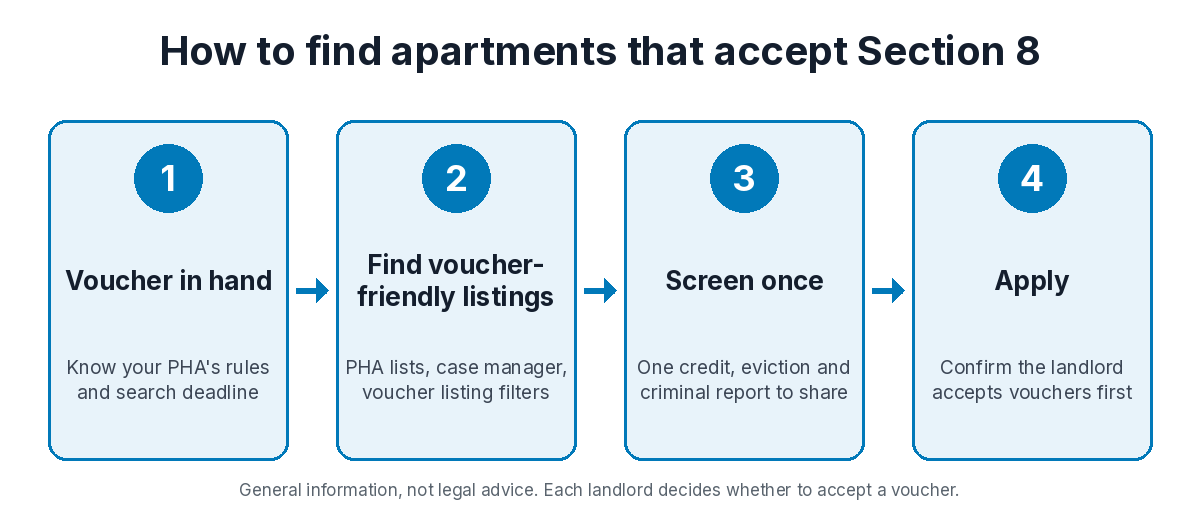
Start with your public housing agency
Many PHAs keep lists of landlords who participate in the voucher program or can point you to local listing services. Ask your PHA what resources it has and what your payment standard is. Also ask what paperwork a landlord will need from you.
Work with your VA case manager if you have HUD-VASH
HUD-VASH participants are paired with a VA case manager. Ask yours about local landlords who have rented to VASH participants before. You can also ask about help available during your search.
Search platforms that support voucher listings
Some rental platforms let landlords mark listings as voucher-friendly. Filtering for these saves time and application fees. Apartment One supports Section 8 housing and VASH-supportive housing listings, along with standard rentals and senior living.
Ask landlords directly, in writing
Before applying, ask: “Do you accept Housing Choice Vouchers?” Get the answer in writing, by text or email. That helps you track answers and avoid fees for units that won’t work. It also gives you a record if you believe you were treated unfairly.
Look beyond big listing sites
Smaller private landlords, local nonprofits, and community groups are often more flexible. Word of mouth, neighborhood groups, and local housing counselors can surface units that never appear on large sites.
Do Section 8 landlords still run a background check?
Yes, typically. Landlords who accept vouchers usually screen voucher holders like every other applicant. The unit itself also has to pass a PHA inspection.
Under 24 CFR 982.307, the owner is responsible for screening and selecting the family to occupy the unit.
A tenant screening commonly covers credit history, eviction records, and criminal background. Your voucher may cover a large share of the rent. Landlords still decide who to rent to based on their own written criteria. If credit is a concern, see our guide on how to get approved for an apartment with bad credit.
Under 24 CFR 982.305, the PHA may not approve the tenancy until it has inspected the unit and found that it passes housing quality standards.
24 CFR 982.405 also requires the PHA to inspect the unit before the initial lease term. That step can add time. Start your search early and keep your paperwork ready.
How does Apartment One help voucher holders?
Apartment One lists Section 8 and VASH-supportive housing. You can screen once, share the report, and see rentals that fit your profile. It is not a government agency or a public housing agency, and it does not issue vouchers.
Apartment One is an online platform where renters complete a verified background and credit screening once, then get matched to rental properties they qualify for, while landlords list properties for free and receive pre-screened applicants.
- Screen once: your screening uses real credit data (FICO 9 from Experian), plus eviction and criminal background reports. You can share the report with landlords instead of starting over for every application.
- Tenant Fit Index: The Tenant Fit Index (TFI) is Apartment One’s 0–100 score matching a renter to a property based on credit, income-to-rent ratio, eviction history, criminal history, and lifestyle preferences.
- Financial Stability Documents: if your credit is low, this option lets you show bank funds, which may help you qualify.
- Clear one-time pricing: Quick Screen is $35 one-time for a fast screening report. Tenant Plus is $60 one-time for a full screening profile, matched listings, TFI, and in-app applications and messaging.
- Compliance: screening is FCRA-compliant, and data handling follows GLBA and CCPA requirements.
Apartment One can’t guarantee that any landlord will accept your voucher or approve your application. Each landlord makes their own decision. Learn more on the renters page.
Have a Section 8 or VASH voucher? Screen once and see rentals that fit.
Frequently asked questions
Can a landlord deny me for having a voucher?
It depends on where you live. As of 2026, 19 states, D.C., Guam, and many localities have source-of-income laws. Not all of them protect vouchers. Check your state and city rules, or ask your PHA or a local fair housing group.
How long do I have to use my voucher?
Your search time is set by your public housing agency, so ask them. Begin your search as soon as you have your voucher. Keep your screening and documents ready.
Does Apartment One accept vouchers?
Apartment One lists Section 8 and VASH-supportive rentals. It doesn’t issue vouchers or decide whether a landlord accepts them. Each landlord makes that decision.
Are VASH vouchers only for veterans?
HUD-VASH is a VA and HUD program built for veterans, pairing a Housing Choice Voucher with VA case management. Ask your VA medical center or case manager about eligibility and how household members are included.
Do I still need a background check with Section 8?
Usually, yes. Under federal rules, screening is the owner’s responsibility. Landlords who accept vouchers typically screen like they do for other applicants, and the unit must pass a PHA inspection.