

A tenant background check for landlords usually covers credit history, eviction and rental history, and criminal records, plus your own checks of income and identity. Under federal law the report is a consumer report, so you need a permissible purpose, must use it only for housing, and must send an adverse action notice when it affects your decision.
Screening tenants protects your property, but it also comes with legal duties. This guide explains what a rental background check includes, why application fraud is on landlords’ minds, which Fair Credit Reporting Act (FCRA) rules apply, how to treat criminal history fairly, and a simple six-step screening process you can follow every time.
This is general information, not legal advice.
What does a tenant background check include?
A tenant background check typically includes a credit report, rental and eviction history, and criminal records. Most landlords also verify the applicant’s income and identity themselves.
According to the Federal Trade Commission’s guide for landlords (July 2023), tenant background checks can include rental and eviction history, credit history, or criminal records.
The FTC also says that tenant background check reports are consumer reports, so landlords who use them to make tenant decisions must comply with the FCRA.
Here is what each part tells you:
- Credit report. Shows payment history, debts, and collections, which help you judge how an applicant handles financial obligations.
- Eviction history check. Shows housing court records, such as past eviction filings.
- Criminal records. Shows reported criminal history, which must be used carefully (see below).
- Rental history. Previous landlords’ reports or references on payment and lease compliance.
- Income and identity verification. Pay stubs, bank statements, or employer confirmation, plus a government ID, usually checked by you rather than the screening company.
The FTC’s list of consumer reports also includes a risk score or recommendation from a tenant screening company based on criteria you have selected, and reports from reference-checking services that contact previous landlords or employers for you. Those are covered by the FCRA too.
Is tenant application fraud increasing?
Many landlords think so. Recent survey data shows that application fraud is a widespread worry, and that some of it is caught only after move-in.
According to Checkr’s State of Rental Fraud 2026 report, based on an August 2026 survey of 1,400 landlords and property managers, 82% are worried about fraud in their tenant applications.
The same Checkr survey found that 55% of landlords and property managers have caught or suspected that the person who moved in wasn’t the person who applied.
Checkr’s survey also found that 46% of landlords and property managers have lost at least $5,000 to a fraudulent or bad-fit tenant.
That is why verifying income and identity matters as much as running the report itself. Treat documents an applicant hands you as a starting point, and confirm them against independent sources where you can.
What FCRA rules do landlords have to follow?
Landlords must have a permissible purpose to get a tenant screening report, use it only for housing, and give an adverse action notice when the report plays any part in an unfavorable decision. The FTC enforces these rules.
Permissible purpose and consent
The FTC says landlords may get consumer reports on applicants and tenants who apply to rent housing or renew a lease, and may also get written permission from applicants to show they have a permissible purpose.
The FTC says you must certify to the company providing the report that you will use it only for housing purposes, and you may not use it for any other purpose.
Adverse action notices
An adverse action is any decision that is unfavorable to an applicant or tenant. The FTC’s examples include denying the application, requiring a co-signer, requiring a deposit that other applicants would not pay or a larger one, and charging higher rent than for another applicant.
According to the FTC, if you take an adverse action based partly or completely on a consumer report, the notice must include:
- the name, address, and phone number of the consumer reporting agency (CRA) that supplied the report;
- a statement that the CRA did not make the decision and cannot give specific reasons for it; and
- notice of the applicant’s right to dispute inaccurate or incomplete information, and to get a free report from the CRA if they ask within 60 days.
The FTC says the notice is required even if the report played only a small part in your decision.
The FTC notes that oral notices are allowed, but written notices are the best practice because they give you proof of FCRA compliance.
If you use a credit score in an adverse decision, the FTC says you must also disclose the score, a description of it (its source, date, and range), and the key factors that hurt it.
When you are done with a report, the FTC says you must securely dispose of it and any information you gathered from it, for example by shredding paper and making electronic files unreadable.
Enforcement is real
According to a U.S. Department of Justice announcement on August 12, 2026, consumer reporting company RentGrow Inc. agreed to a $2.25 million civil penalty and an injunction to resolve allegations that it violated the FCRA and the FTC Act in connection with the tenant screening reports it furnishes to landlords and property managers.
That case involved a screening company rather than a landlord, but it shows that federal regulators are actively enforcing tenant screening rules.
How should landlords use criminal history fairly?
Avoid blanket bans and judge every applicant against the same written criteria. Refusing everyone with any criminal record can create legal risk.
The FTC warns that a blanket policy of refusing to rent to anyone with a criminal record may violate the Fair Housing Act.
In practice, that means writing down your criteria before you list, applying them the same way to every applicant, and documenting how you reached each decision. If a criminal history report influences a denial, the FTC says you must send an adverse action notice, just as you would for a credit report.
Many states and cities have their own rules on when and how landlords may consider criminal records. Check your state and local law, or ask a local attorney, before you finalize your policy.
How do you screen tenants step by step?
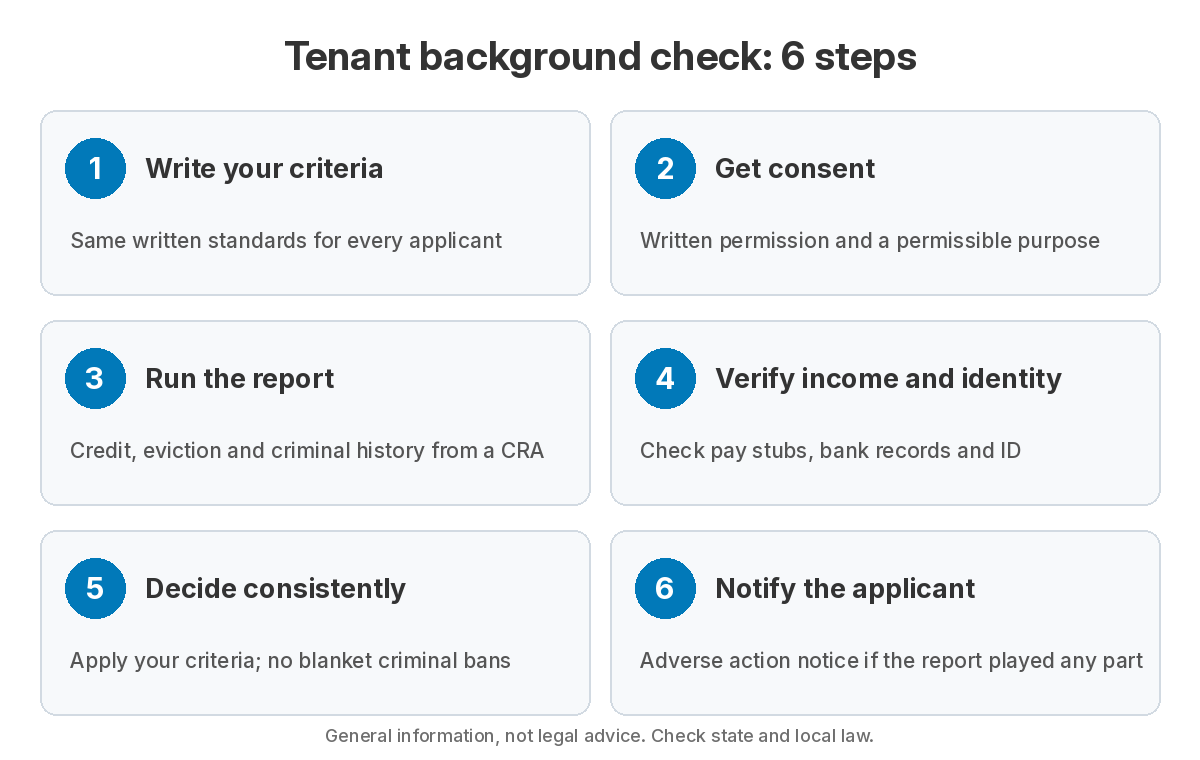
Set your criteria first, get the applicant’s consent, run the report, verify income and identity, decide consistently, and notify the applicant. Following the same order every time keeps your process fair and documented.
- Write your criteria. Decide your income, credit, and rental-history standards before you advertise, and apply them to every applicant.
- Get consent. Collect the applicant’s written permission so your permissible purpose is documented.
- Run the report. Order credit, eviction, and criminal history from a consumer reporting agency, and use it only for the housing decision.
- Verify income and identity. Confirm pay stubs, bank records, or employment, and check a government ID.
- Decide consistently. Compare the results to your written criteria. Do not use blanket criminal-record bans.
- Notify the applicant. If the report played any part in a denial or in less favorable terms, send an adverse action notice with the required details. Then dispose of the report securely when you no longer need it.
Want a renter’s view of the same process? Our post on fast online tenant screening explains how renters get their own reports, and our rental tenant screening page covers what Apartment One’s screening includes.
How does Apartment One screen applicants for landlords?
On Apartment One, renters complete their screening before they apply, so applicants reach you already screened, with a Tenant Fit Index score. Apartment One is an online platform where renters complete a verified background and credit screening once, then get matched to rental properties they qualify for, while landlords list properties for free and receive pre-screened applicants.
- Screening data. Renters are screened with FICO 9 credit data from Experian, plus eviction and criminal background reports.
- Tenant Fit Index score. The Tenant Fit Index (TFI) is Apartment One’s 0–100 score matching a renter to a property based on credit, income-to-rent ratio, eviction history, criminal history, and lifestyle preferences.
- Compliance and security. Screening is FCRA-compliant, data handling follows GLBA and CCPA, and sensitive screening data is encrypted.
- Free to list. Landlords list properties at no cost through the Property Partner program.
You still make every rental decision and remain responsible for your own legal duties, including consistent criteria and any required notices. If you are still choosing where to advertise, see our guide to free rental listing sites for landlords.
Skip running reports one by one. List free and receive applicants who are already screened.
Frequently asked questions
Do I need the applicant’s permission to run a background check?
You need a permissible purpose, which the FTC says landlords have when someone applies to rent or renew a lease. The FTC also says you may get written permission to show that purpose, and doing so is a good habit. State and local laws may add their own requirements.
What is an adverse action notice?
It is a notice you must give when information in a consumer report plays any part in denying an applicant or offering worse terms, such as a co-signer or higher deposit. According to the FTC, it must name the reporting agency and its contact details, state that the agency did not make the decision, and explain the applicant’s rights to dispute the report and get a free copy within 60 days.
Can I deny an applicant based on credit score alone?
This is general information, not legal advice. If a credit report or score contributes to a denial, you must send an adverse action notice. When a credit score is used, the FTC says you must also disclose the score and the key factors that hurt it. Apply the same standard to every applicant and check state and local rules.
Who pays for the background check on Apartment One?
Renters pay for their own screening, either Quick Screen at $35 one-time or Tenant Plus at $60 one-time. Landlords list properties free through the Property Partner program.
Can I refuse every applicant with a criminal record?
The FTC warns that a blanket policy of refusing to rent to anyone with a criminal record may violate the Fair Housing Act. Use consistent written criteria instead, and check your state and local law.
One Response