

A low credit score, a thin credit file, or no credit history at all can make apartment hunting feel like paying application fees just to collect rejections. The good news: credit is only one part of a rental decision, and you have more ways to strengthen your application than most renters realize. This guide explains what landlords actually check, six practical ways to get approved for an apartment with bad credit, and the rights you have if you’re turned down.
Why bad credit makes renting harder in 2026
If credit has been your biggest obstacle, you’re far from alone. In the National Low Income Housing Coalition’s 2025 National Renter Survey, 78.6% of renters who had moved in the past two years and faced difficulty renting because of a household characteristic said a low or no credit score was one of those difficulties. That was far ahead of the next most common issue, eviction history (15.7%).
Experian’s 2026 State of the U.S. Rental Market Report found that 56% of renters have credit scores below the prime range of 661–780, including 20% who are near prime (601–660) and 30% who are subprime (500–600), as reported by Multifamily Executive.
There is some movement in renters’ favor. TransUnion’s analysis of more than 2,400 properties found that tenant applications fell 10% year over year in the second half of 2025, and property managers responded by lowering their decision points (the score cutoffs that determine whether an applicant is accepted) by an average of 6 points. Standards still vary widely from property to property, which is why a targeted approach matters.
What landlords actually check
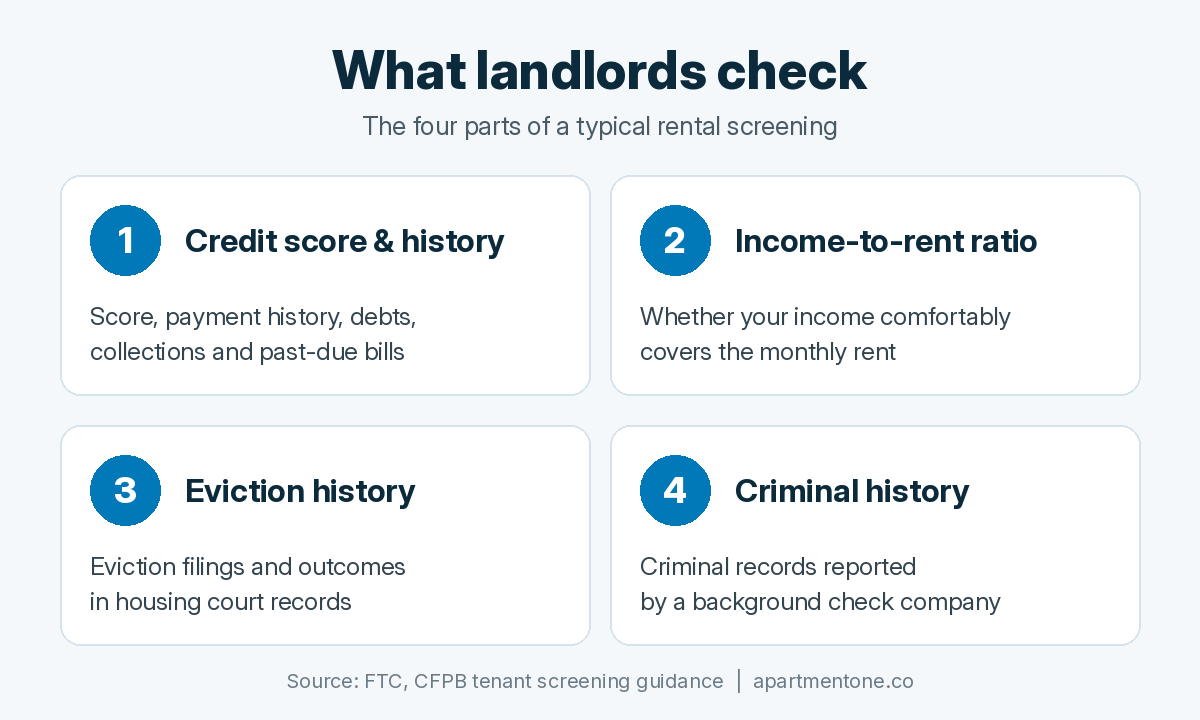
Most landlords and property managers use a tenant screening report, also called a rental background check, to decide whether to rent to someone, according to the Consumer Financial Protection Bureau (CFPB). The Federal Trade Commission notes these reports can include credit history, rental and eviction history, and criminal records.
Credit score and history
A credit check for an apartment looks at more than a single number. Most rental background checks include credit information, such as overdue bills, provided by credit reporting companies including Equifax, Experian, and TransUnion. Landlords want to see whether you’ve paid obligations on time and how much debt you’re carrying. A thin file isn’t the same as a bad one, but it gives a landlord less to go on.
Income-to-rent ratio
Landlords also want to know whether you can comfortably afford the rent. TransUnion notes that spending 30% of income on rent has traditionally been considered ideal, but rent growth has far outpaced income growth, making that benchmark harder to meet. Its analysis found that applicants with higher income-to-rent ratios can still be strong tenants if they maintain a solid credit or resident score.
Eviction and criminal history
Screening reports often include eviction records and criminal history. Accuracy matters here: the CFPB warns that a single eviction can show up multiple times at different stages of the process, and that sealed or expunged records should not appear on your report.
6 ways to get approved with bad or no credit
No strategy can guarantee approval, since every landlord sets its own criteria. These steps can make your application stronger and help you avoid paying for applications you’re unlikely to win.
1. Show proof of funds for rent
If your score doesn’t reflect your current finances, show what you do have. Bank statements and savings can demonstrate that you can cover rent even when your credit history is short or damaged. On Apartment One, the Financial Stability Documents option lets you show bank funds, which may help you qualify if your credit is low, giving landlords a fuller picture than a score alone.
2. Screen once and share your report
Paying for a new screening with every application adds up quickly. A shareable tenant screening report lets you complete a credit, eviction, and criminal check once and show it to the landlords you’re interested in. Apartment One’s Quick Screen ($35, one time) delivers a tenant screening report you can share, so you know what landlords will see before you apply.
3. Apply only to apartments you qualify for
The fastest way to waste money is to apply blindly. Instead, look for apartments you qualify for before you pay a fee. Apartment One’s Tenant Fit Index (TFI) is a 0–100 score that matches you to each property based on credit, income-to-rent ratio, eviction history, criminal history, and lifestyle preferences, so you can focus on the rentals where you’re a strong fit.
4. Add a co-signer, a bigger deposit, or a roommate
If your credit falls short of a landlord’s standard, a co-signer with stronger credit, a larger security deposit, or a roommate who shares the rent can lower the landlord’s risk. Know that if a landlord requires a co-signer or a larger deposit because of something in your report, the FTC says that counts as an adverse action, which triggers the notice rights explained below.
5. Consider private landlords, Section 8, or VASH housing
Screening standards differ between large management companies and individual owners, so it’s worth looking beyond the biggest complexes. You can browse private landlords near you, and if you have a Housing Choice Voucher or VASH voucher, learn more about Section 8 housing on Apartment One. Apartment One supports standard rentals, short-term rentals, senior living, VASH-supportive housing, and Section 8 listings.
6. Check your report for errors
A mistake on your report could be costing you approvals. The CFPB recommends checking for overdue bills that belong to someone else, debts shown as owed after you paid them, duplicate eviction or criminal entries, sealed or expunged records, and outdated information. If you find an error, dispute it in writing with both the screening company and the company that supplied the information, and include supporting documents such as proof of identity or dated proof of payment.
Your rights if you’re denied
The Fair Credit Reporting Act (FCRA) protects renters who are turned down based on a screening report.
- An adverse action notice. If a landlord denies you, requires a co-signer, or charges a higher deposit or rent based even partly on a consumer report, the FTC says they must notify you. The notice must include the name, address, and phone number of the company that supplied the report.
- A free copy of your report within 60 days. You’re entitled to a free copy of your report from the screening company the landlord used if you request it within 60 days, according to the CFPB.
- The right to dispute. You can dispute inaccurate or incomplete information. If a screening company doesn’t handle it properly, you can submit a complaint to the CFPB.
Regulators do enforce these rules. In August 2026, the Justice Department announced that tenant screening company RentGrow Inc. agreed to a $2.25 million civil penalty and an injunction. The government alleged it failed to maintain reasonable procedures to ensure report accuracy, failed to disclose report information to consumers on request, and failed to follow required procedures when consumers disputed their reports.
How Apartment One helps
Apartment One combines tenant screening and rental matching, so you don’t have to guess where you’ll fit. You complete one FCRA-compliant screening with real credit data (FICO 9 / Experian) plus eviction and criminal background reports, then see a personalized feed of listings matched to you with the Tenant Fit Index.
- Tenant Plus ($60, one time): a full screening profile, your matched-listing feed, your TFI, and in-app applications and messaging with landlords.
- Quick Screen ($35, one time): a fast credit, eviction, and criminal screening report when you need to verify quickly.
- Short-Term Rentals ($35/month): monthly re-screening and access to short-term and month-to-month listings for renters who move every one to three months.
Your data is handled under GLBA and CCPA requirements, sensitive screening information is encrypted, and payments are processed securely through Stripe. Learn more about rental tenant screening.
Screen once, then see the rentals you already qualify for.
FAQ
What credit score is needed to rent an apartment?
There’s no single credit score needed to rent an apartment. Each landlord or property manager sets its own decision point, and TransUnion found that many lowered those cutoffs by an average of 6 points in late 2025. For context, Experian defines prime credit as 661–780, and 56% of renters fall below that range, so you can rent with a low credit score, especially if you can show steady income or proof of funds.
Can I rent an apartment with no credit history?
Yes, renting with no credit is possible, though a thin file gives landlords less information. Strengthen your application with bank statements or other proof of funds, a co-signer or larger deposit, and a clean screening report you can share. Focusing on apartments for bad credit or no credit, where you meet the criteria, helps you avoid wasted application fees.
3 Responses