

Positive rent reporting sends a tenant’s on-time rent payments to consumer reporting agencies so they can show up on credit files. Landlords offer it to attract and keep reliable renters, and in Maryland it is now required: housing providers must offer the option, with fees capped, starting with leases from October 1, 2026.
General information, not legal or credit advice. Maryland’s offer requirement is state-specific. Credit reporting rules and outcomes vary; talk to counsel and your reporting partner before you launch a program.
What is positive rent reporting?
It is a program, usually run through a rent payment app or reporting service, that reports complete and timely rent payments to one or more consumer reporting agencies.
The CFPB explains in its Ask CFPB answer on rent and credit that the three nationwide consumer reporting agencies, Experian, Equifax and TransUnion, use rental payment information and related debt collection information, though how each handles it varies. The CFPB notes that specialty consumer reporting agencies also collect rental information.
The CFPB’s tip to renters reads: “Positive rental payments can help build your credit. If you’d like to have rental payments reported to credit reporting agencies, ask your landlord if they participate in a rental reporting program (often through a rental payment app). Be sure to consider any fees that might be charged for these services.”
For the renter side of this topic, see does paying rent build credit.
Why do landlords offer positive rent reporting?
Landlords offer it mainly as a renter benefit that may help with attracting applicants and encouraging on-time payment. Survey data cited by Fannie Mae points in that direction.
Fannie Mae’s positive rent payment reporting page says that, according to a TransUnion survey, 58% of renters were more likely to rent from someone who reports rent payments. Fannie Mae also says that, with rent reporting, 82% of renters say they are more motivated to make timely payments.
Those are survey responses, not guaranteed results. Whether a program changes payment behavior at your property depends on your tenants, the program and how you present it.
For other retention and leasing ideas, see how to reduce rental vacancy and how to find good tenants.
What does Maryland’s 2026 positive rent reporting law require?
Maryland housing providers must offer tenants the option to have positive rental payment information reported to consumer reporting agencies, on a set timeline, at least once a year, with fees capped. This applies in Maryland only.
According to the Maryland Department of Housing and Community Development (DHCD) notice (September 22, 2026), SB 335/HB 315 (Chapters 773 and 772) require housing providers to offer tenants the option of reporting positive rental payment information to consumer reporting agencies. DHCD says positive rental payment information includes only complete and timely payments.
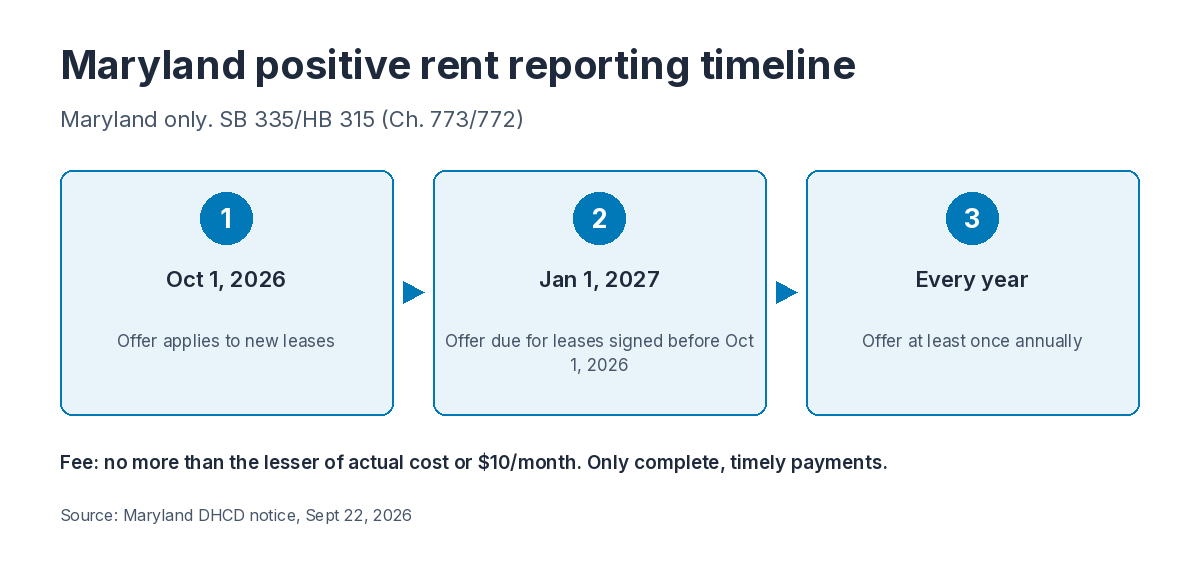
The DHCD notice gives the timeline:
- New leases: the offer applies to leases entered into on or after October 1, 2026.
- Existing leases: for leases signed before October 1, 2026, providers must make the offer by January 1, 2027.
- Ongoing: providers must offer the option at least once each year.
How much can Maryland landlords charge for rent reporting?
In Maryland, any fee charged to a tenant for rent reporting may not exceed the lesser of the actual cost or $10 per month.
That cap is stated in the Maryland Department of Housing and Community Development (DHCD) notice. Confirm with counsel and your reporting vendor how the fee is calculated and disclosed, and whether you choose to absorb the cost.
DHCD’s notice also describes other 2026 Maryland housing laws, including protections for tenants with housing subsidies. For more on that topic, see source of income discrimination.
| Maryland item | What DHCD says |
|---|---|
| Who | Housing providers in Maryland |
| What | Offer tenants the option to report positive rental payment information |
| Counts as positive | Only complete and timely payments |
| New leases | On or after Oct 1, 2026 |
| Earlier leases | Offer by Jan 1, 2027 |
| Frequency | At least once each year |
| Fee cap | Lesser of actual cost or $10 per month |
Should landlords outside Maryland offer rent reporting?
Outside Maryland it is generally optional under the sources reviewed here, so treat it as a business decision. Check your own state and city for any new rules.
Questions to weigh (general practice):
- Tenant demand: would your renters use it, especially those building credit?
- Cost: will you charge a fee, absorb it, or bundle it?
- Opt-in: how tenants enroll and opt out, in writing.
- Accuracy: how payment data is checked before it is sent and how disputes are handled.
- Negative data: whether the program also reports late payments, and how that is disclosed.
How do you set up a positive rent reporting program?
Pick a reporting partner, write a short tenant notice, decide on fees, and make the offer at signing and at least yearly.
- Choose a partner. Ask which consumer reporting agencies it reports to and whether it reports positive data only.
- Decide on fees. In Maryland, stay within the DHCD cap; elsewhere, keep it simple and disclosed.
- Write the offer. Put it in the lease packet or an addendum, with enrollment steps.
- Track the dates. In Maryland, log offers for new leases and for pre-October 2026 leases by January 1, 2027.
- Repeat yearly. Calendar the annual offer.
Rent reporting does not replace your screening process. Keep using the same written criteria for every applicant; see tenant screening criteria.
What should landlords tell tenants about rent reporting?
Tell tenants plainly what is reported, to which agencies, what it costs, and how to enroll or opt out, so they can decide with the facts in hand.
The CFPB advises renters to consider any fees that might be charged for rent reporting services, so expect questions about cost. A short written notice can answer the common ones:
- Which consumer reporting agencies receive the data.
- Whether only on-time payments are reported, or late payments too.
- The monthly fee, if any (in Maryland, within the DHCD cap).
- How to enroll, how to stop, and who to contact about an error.
Tenants should also know that results vary. Reporting a payment history does not promise any particular change to a credit score, because each agency and scoring model treats rental data in its own way.
How does Apartment One help landlords?
Apartment One lets you list free and receive pre-screened applicants. It is not a rent reporting service.
Apartment One is an online platform where renters complete a verified background and credit screening once, then get matched to rental properties they qualify for, while landlords list properties for free and receive pre-screened applicants.
Screening covers credit (FICO 9 from Experian), eviction and criminal records, and landlords can message applicants in-app.
The Tenant Fit Index (TFI) is Apartment One’s 0-100 score matching a renter to a property based on credit, income-to-rent ratio, eviction history, criminal history, and lifestyle preferences. The TFI is a tool used alongside written criteria, not a ranking or a decision-maker.
Apartment One is FCRA-compliant and follows GLBA and CCPA data handling. Data is encrypted, and payments are processed through Stripe.
List your rental for free and receive pre-screened applicants.
Frequently asked questions
Is positive rent reporting required for landlords?
In Maryland, housing providers must offer tenants the option starting with leases on or after October 1, 2026. Under the sources reviewed here, it is optional elsewhere; check your state and city.
What is Maryland’s fee cap for rent reporting?
DHCD says any fee may not exceed the lesser of the actual cost or $10 per month.
When must Maryland landlords offer rent reporting on existing leases?
For leases signed before October 1, 2026, DHCD says the offer must be made by January 1, 2027, and at least once each year after that.
Do renters want rent reporting?
Fannie Mae, citing a TransUnion survey, says 58% of renters were more likely to rent from someone who reports rent payments.
Does rent reporting replace tenant screening?
No. It reports payments after move-in. Keep using the same written screening criteria for every applicant.