

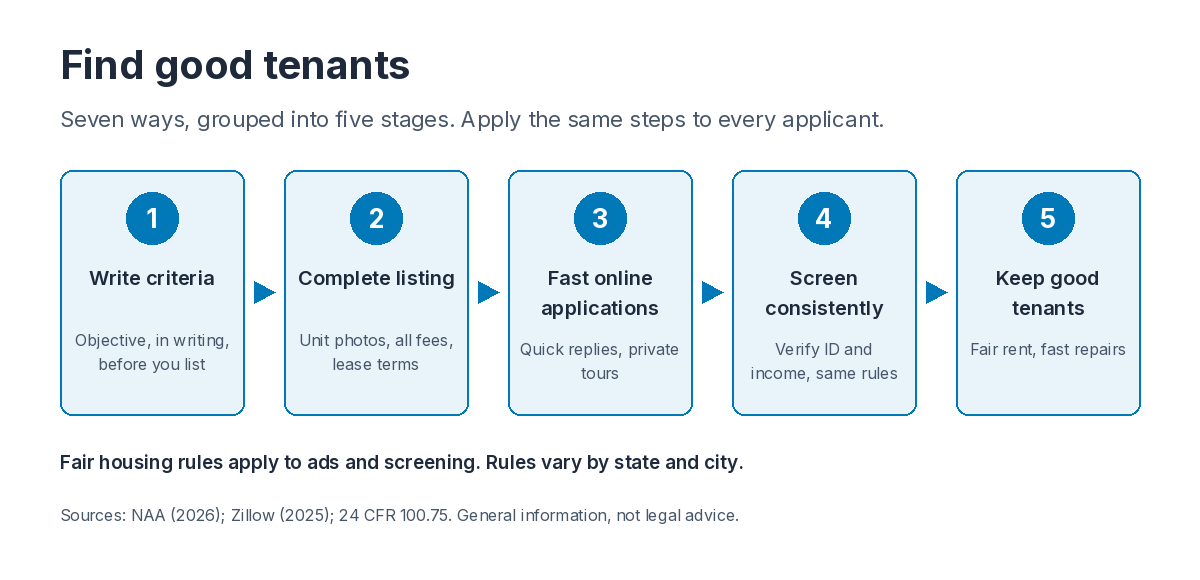
How to find good tenants: write objective screening criteria first. Then attract qualified renters with a complete listing that shows real unit photos, every fee and your requirements. Respond quickly, take applications online, verify income and identity, and screen every applicant the same way. Then keep good tenants with fair rent and reliable maintenance.
This is general information, not legal advice; fair housing and screening rules vary by state and city.
How to find good tenants: what makes a good tenant?
A good tenant meets your written criteria. They can afford the rent, pay on time, have a verifiable rental history and follow the lease. Define it with objective standards you apply to everyone, never with personal traits or impressions.
Writing standards down is the foundation, because it turns “good” into something you can check. Our guide to tenant screening criteria shows how to set income, credit, rental history and criminal history standards.
Way 1: Why should you write your criteria before you list?
Written criteria let you treat every applicant the same way, which is fairer and easier to defend. They also tell renters upfront whether they qualify, so fewer weak applications reach you.
A screening-criteria guide from the California Apartment Association, posted by the San Francisco Apartment Association, says landlords should write their criteria before offering a unit. The same guide says to apply the criteria consistently to all applicants. It adds that consistent application, including renting to the first applicant who qualifies, will help protect against discrimination claims.
Some cities spell this out. The City of Seattle’s screening guidance tells landlords to give applicants their screening criteria in writing.
Way 2: What should your listing include to attract qualified renters?
Include real photos of the specific unit, a floor plan, every fee, the lease terms and your screening requirements. Complete listings help qualified renters pick you and help unqualified renters move on.
A 2026 National Apartment Association survey found that the average renter plans to research 10 properties and seriously consider three. The same NAA survey found that 99% of renters agree unit-specific information is important.
| What renters want in a listing | % of renters | Source |
|---|---|---|
| Unit-specific photos | 77% | NAA, 2026 |
| Unit-specific floor plans | 67% | NAA, 2026 |
| Unit-specific 3D tours | 35% | NAA, 2026 |
| Listings should clearly list all fees (agree) | 94% | Zillow, 2025 |
| Seeing lease terms, rent and fees is essential (recent renters) | 59% | Zillow, 2025 |
| A private tour is essential (recent renters) | 55% | Zillow, 2025 |
Source: National Apartment Association, May 29, 2026; Zillow Consumer Housing Trends Report 2025.
Missing unit photos can cost you good applicants. The NAA survey found that half of respondents call a listing with no photos of the specific unit a deal-breaker.
Fees matter just as much. Zillow’s 2025 renter report found that 94% of renters agree rental listings should clearly list all fees. For where to post once your listing is ready, see our guide to free rental listing sites for landlords.
Way 3: What can’t you say in a rental ad?
You can’t publish anything that shows a preference, limitation or discrimination based on a protected class. Describe the property and your objective criteria, not the kind of person you want.
Under 24 CFR 100.75, it is unlawful to publish a rental ad that indicates a preference, limitation or discrimination based on a protected class. The protected classes in 24 CFR 100.75 are race, color, religion, sex, handicap, familial status and national origin. That means phrases like “ideal for young professionals” or “no kids” don’t belong in a listing.
Some cities and states go further. The City of Seattle’s screening guidance says landlords cannot advertise “no criminal record.” In Maryland, the state’s Department of Housing and Community Development says the Fair Chance Housing Act bars advertising that you won’t consider applicants with criminal histories. According to Maryland DHCD, the law took effect October 1, 2026 for providers with five or more units.
Rules vary, so check your state and city. Our guide to questions landlords can’t ask covers the same rules for conversations and applications.
Way 4: Why do speed and online applications matter?
Qualified renters compare only a few places seriously, so a slow reply can lose them. Online applications make it easy for them to say yes while your unit is still on their short list.
Zillow’s 2025 renter report found that online applications became more common among recent renters.
Tours matter too. Zillow’s 2025 report found that 55% of recent renters said taking a private tour was essential. Offer showings at set times, answer questions within a day, and send the application link with your reply.
The applicant pool may be smaller than you’re used to. A TransUnion analysis of more than 2,400 properties found that tenant applications fell 10% year over year in the second half of 2025. If vacancy is your bigger problem, see our guide on how to reduce rental vacancy.
Way 5: How should you verify income and identity?
Verify income from the source and confirm that the person applying is the person moving in. Skipping this step is how application fraud turns into a problem after move-in.
Checkr’s 2026 Rental Fraud Report found that 48% of landlords and property managers have evicted a tenant after finding application fraud. The same Checkr report found that 42% discovered the person who moved in wasn’t the person who applied and was approved.
Match the ID on the application to the person at the lease signing and the move-in. For checking pay stubs and employers, see our guide on how to verify tenant income.
Way 6: How do you screen every applicant fairly?
Run the same screening for everyone and judge each result against the same written criteria. Document your decision so you can show it followed your policy.
Consistency doesn’t have to mean rigid rules that miss strong tenants. A TransUnion analysis found that a rental-specific risk score, not just a credit score, can help find strong tenants in a smaller pool. The same TransUnion analysis found that applicants above the 30% income-to-rent benchmark can still be strong tenants with a solid credit or resident score.
If you set a policy like that, put it in your written criteria and apply it to everyone. Under the federal Fair Credit Reporting Act, denying or adding conditions based on a report triggers an adverse action notice. Our guide to tenant background checks for landlords covers the FCRA rules.
Way 7: How do you keep good tenants once you find them?
Keep rent fair, fix things quickly and be easy to work with. Keeping a good tenant saves you the cost and risk of finding a new one.
Zillow’s 2025 renter report found that tenured renters most often stayed because their rental costs were a good deal (75%). Quiet neighbors (71%) came next, according to the same Zillow report.
Price renewals with the market in mind; our guide on how much rent to charge can help. Respond to maintenance requests promptly and keep communication in writing.
How does Apartment One help landlords find pre-screened tenants?
Apartment One is an online platform where renters complete a verified background and credit screening once, then get matched to rental properties they qualify for, while landlords list properties for free and receive pre-screened applicants.
The Tenant Fit Index (TFI) is Apartment One’s 0-100 score matching a renter to a property based on credit, income-to-rent ratio, eviction history, criminal history, and lifestyle preferences.
You list free with Property Partner and receive pre-screened applicants, each with a TFI for your property. Screening covers FICO 9 credit from Experian, eviction records and criminal records. The TFI is a tool to use alongside your own written criteria. It doesn’t replace your policy or make the decision for you. Reports are shareable, and in-app messaging lets you ask applicants questions. Apartment One is FCRA-compliant and follows GLBA and CCPA data handling. Data is encrypted, and payments are processed through Stripe.
Good tenants start with clear criteria and a complete listing. List your rental free on Apartment One and review pre-screened applicants against your own criteria.
Frequently asked questions
What’s the best way to find good tenants?
Write objective screening criteria, post a complete listing with real unit photos and all fees, respond quickly, take applications online, and screen every applicant the same way against your criteria.
What should I look for in a tenant?
Look only at objective criteria you apply to everyone: income relative to rent, verifiable rental history, and screening results judged under your written policy. Never judge by protected traits.
Can I advertise “no criminal record” in my rental listing?
Not in Seattle, where the city says landlords cannot advertise “no criminal record.” Maryland’s Fair Chance Housing Act, effective October 1, 2026, prohibits providers with five or more units from advertising that they won’t consider applicants with criminal histories. Elsewhere, check your state and local law.
How many properties do renters compare?
A 2026 National Apartment Association survey found that the average renter plans to research 10 properties and seriously consider three.
Does it cost anything to list on Apartment One?
No. Listing on Apartment One is free for landlords.
2 Responses