

To verify tenant income, ask every applicant for the same documents, such as recent pay stubs, bank statements or an offer letter, and then confirm them against an independent source. Compare names, dates and deposits across documents, and check employment directly with written consent. Apply one written income standard to every applicant.
Knowing how to verify tenant income has never mattered more. Editing software and online “template farms” make fake pay stubs easy to produce. This guide covers which documents to request, how to check each one, and the red flags that point to fraud.
This article is general information, not legal advice. Screening rules vary by state and city.
Why should landlords learn how to verify tenant income?
Income is the document landlords trust least. Fake pay stubs and bank statements are now a top fraud concern.
Checkr’s 2026 rental fraud report (September 10, 2026) surveyed 1,400 landlords and property managers from August 13 to 18, 2026.
In Checkr’s survey, 37% named fake or altered pay stubs and bank statements as their biggest fraud concern. Only 24% named concealed criminal or eviction history.
Checkr also found that 67% of respondents had run into a fraudulent application. The same share said fraud had become harder to detect than a year earlier.
Snappt, a document fraud detection company, publishes quarterly data from properties that use its service. Its Q3 2026 State of Applicant Trust report found an average fraud rate of 3.27% across 533,833 applicants evaluated.
Earlier in the year, Multifamily Executive reported on August 12, 2026 that Snappt found fraud in 3.8% of more than 700,000 applicants in the first half of 2026. That’s roughly 1 in 26.
Income is one part of a full screen. Our tenant background check guide for landlords covers credit, eviction and criminal checks.
What counts as proof of income for renters?
Common proof of income includes pay stubs, bank statements, tax returns and offer letters. Ask every applicant for the same set so your process stays consistent.
Here’s how the most common documents compare:
| Document | What it shows | How to check it |
|---|---|---|
| Pay stubs (recent) | Current gross pay and employer | Match pay dates and amounts to bank deposits |
| Bank statements | Deposits, balances and savings | Prefer a direct bank connection over an uploaded PDF |
| Offer letter | Future salary and start date | Confirm with the employer using a number you find yourself |
| Tax returns or 1099s | Self-employed or gig income | Compare to recent bank deposits |
| Benefit letters | Social Security, VA or other fixed income | Match the monthly amount to deposits |
Put your list in your written screening criteria. That way every applicant knows what to bring, and you treat everyone the same.
How do you spot fake pay stubs?
Check the math, the details and the deposits. Pay stubs are the most commonly faked income document.
Snappt’s Q3 2026 report found that pay stubs made up 69% of edited documents. Their edit rate was 3.93%, or 30,071 of 765,527 submitted.
Snappt’s report also breaks fraud down by type. Template farms, which sell mass-produced fake documents online, made up 41.35% of fraud. Simple PDF editing made up 28.18%.
When you review a pay stub, look for these issues:
- Year-to-date totals that don’t add up across stubs
- Taxes or deductions that look too round or don’t change
- Mismatched fonts, spacing or blurry logos
- An employer name you can’t find online
- Pay dates that fall on weekends or don’t match deposits
The strongest check is the bank statement. Real pay should show up as real deposits on the same dates.
How do you verify bank statements?
Connected bank data is far harder to fake than an uploaded PDF. If you can, ask applicants to link their account directly through a secure service.
Snappt’s Q3 2026 report found an edit rate of 2.08% for bank statements, or 10,218 of 490,438 submitted.
The gap between upload and connection is wide. In the same report, applications using document upload only had a 4.67% edit rate, compared with 0.07% for connected-only verification.
Snappt also notes that many applicants still prefer to upload. So offer both options, and look more closely at uploaded files.
On an uploaded statement, check that the name and address match the application. Then confirm that the balances add up and the deposits line up with the pay stubs.
Can you trust an offer letter as proof of income?
Treat an offer letter as a starting point, not proof. Confirm it directly with the employer before you rely on it.
Snappt’s Q3 2026 report says it verified 2,450 offer letters directly with employers. It caught 134 that had been altered, a 5.2% failure rate.
Look up the company’s main phone number or HR contact yourself. Don’t rely on the number printed on the letter, since a fake letter can list a fake contact.
Get the applicant’s written consent before you contact an employer. Then ask only to confirm the job, start date and pay.
Not sure what else is off-limits? See our guide to questions landlords can’t ask.
How do you verify self-employed or gig income?
Ask for tax returns, 1099s and several months of bank statements. Look for steady deposits rather than a single month’s total.
Self-employed income can swing from month to month. A reasonable approach is to average deposits over a longer period, such as six to twelve months.
Gig workers can often download earnings summaries from their apps. Compare those summaries to bank deposits, just as you would a pay stub.
For contract or 1099 workers, ask for a letter from a client or a recent invoice history if your criteria allow it. Treat these like an offer letter, and confirm the client exists before you rely on it.
Savings can help too. An applicant with strong bank funds but uneven income may still be a good fit, depending on your criteria.
What income-to-rent ratio should landlords require?
Many landlords ask for gross monthly income of about 2.5 to 3 times the rent. Pick one standard, write it down and use it for every applicant.
A consistent written policy protects you and is fair to applicants. Note any exceptions, such as co-signers or proof of savings, in the same document.
Income rules can work differently for voucher holders. Maryland’s Department of Housing and Community Development says landlords there generally can’t refuse a subsidy holder based on income.
DHCD adds that Maryland landlords may verify that the applicant can pay the portion of rent the subsidy doesn’t cover. Check your own state and city rules too.
Considering voucher tenants? Read our guide on how to become a Section 8 landlord.
What are the red flags of income fraud?
Watch for documents that don’t match each other or the applicant’s story. A single mismatch can be an error, but several together deserve a closer look.
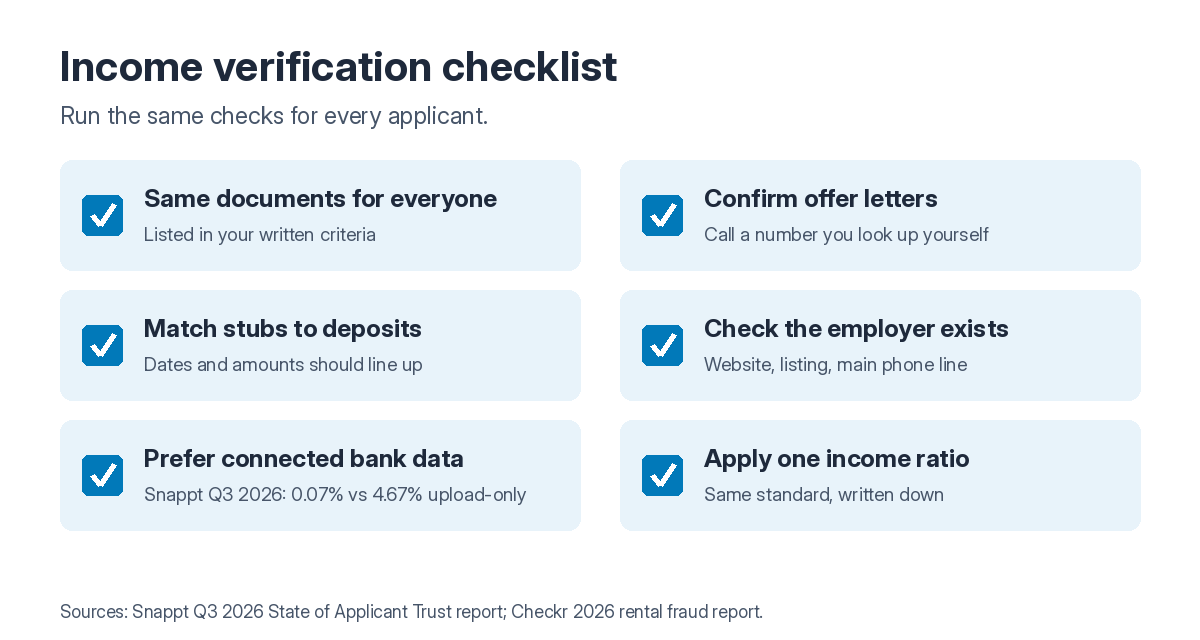
- Deposits don’t match pay stubs. Amounts or dates differ between documents.
- The employer can’t be found. No website, no listing or a phone number that goes nowhere.
- Only PDFs, never a connection. The applicant refuses every direct verification option.
- Perfectly round numbers. Real pay usually has cents and changing deductions.
- Pressure to skip steps. The applicant pushes you to approve fast.
- A real employer, but no real job. Snappt calls this “inception fraud.”
Snappt’s Q3 2026 report describes inception fraud as real pay stubs from real companies where the applicant doesn’t actually work there. It made up 4.21% of fraud cases.
Faster, cleaner checks also help you fill units sooner. Our guide on how to reduce rental vacancy explains why faster verification can mean faster move-ins.
How does Apartment One help landlords with income screening?
Apartment One gives you pre-screened applicants whose Tenant Fit Index includes income-to-rent ratio. You still review documents and make the final call.
Apartment One is an online platform where renters complete a verified background and credit screening once, then get matched to rental properties they qualify for, while landlords list properties for free and receive pre-screened applicants.
The Tenant Fit Index (TFI) is Apartment One’s 0-100 score matching a renter to a property based on credit, income-to-rent ratio, eviction history, criminal history, and lifestyle preferences.
Screening covers FICO 9 credit from Experian, eviction records and criminal records. Renters can also add Financial Stability Documents, which let them qualify on bank funds when income alone looks thin.
Listing as a Property Partner is free. Apartment One doesn’t replace your own document review, so keep checking pay stubs, statements and offer letters against your written criteria. See plan details on our pricing page.
Spend less time chasing paperwork. List free on Apartment One and receive pre-screened applicants, each with a Tenant Fit Index score, which factors in income-to-rent ratio.
Frequently asked questions
Can a landlord call my employer?
Many landlords confirm employment with the employer, usually with the applicant’s written consent. To avoid fake contacts, look up the employer’s number yourself rather than using one on the document.
How many pay stubs should a landlord ask for?
There’s no single rule. Many landlords ask for the most recent two to three months of pay stubs. Whatever you choose, put it in writing and ask every applicant for the same number.
Can landlords ask for bank statements?
Yes, many do. A direct bank connection is harder to fake than an uploaded PDF. Snappt’s Q3 2026 data found a 0.07% edit rate for connected-only verification versus 4.67% for upload only.
Is the 3x rent rule legal?
Generally, yes, when you apply it the same way to everyone. Some states and cities limit how you apply income rules to voucher holders, so check local law. This isn’t legal advice.
Is listing on Apartment One free for landlords?
Yes. Landlords list properties for free as Property Partners and receive pre-screened applicants, each with a Tenant Fit Index score.
2 Responses