

To become a Section 8 landlord, contact your local public housing agency (PHA). Next, choose a voucher holder using your normal rental criteria and complete their Request for Tenancy Approval. Your unit must then pass the PHA’s inspection. Finally, sign the lease and the HAP contract. The PHA pays its share monthly, and the tenant pays the rest.
Learning how to become a Section 8 landlord is mostly about knowing the order of the steps. You keep your own tenant screening. The PHA adds a rent review and an inspection, then pays its share of the rent directly to you. This guide walks through each step, what inspectors check and how rent is set and paid.
This is general information, not legal advice. Program rules vary by PHA.
What is a Section 8 (Housing Choice Voucher) landlord?
A Section 8 landlord is a private owner who rents to a household that holds a Housing Choice Voucher. The PHA pays part of the rent to the owner, and the family pays the rest.
According to HUD’s handout “Interested in Becoming a Housing Choice Voucher (HCV) Landlord?”, the landlord’s role is to lease decent, safe and sanitary housing to a tenant at a reasonable rent.
You still own and manage the property. Learn how voucher listings work on our Section 8 housing page.
How to become a Section 8 landlord: what are the steps?
HUD lists four steps: contact your PHA, select a tenant, pass the inspection, then sign the lease and HAP contract. Each PHA runs its own local process, so ask yours for the details.
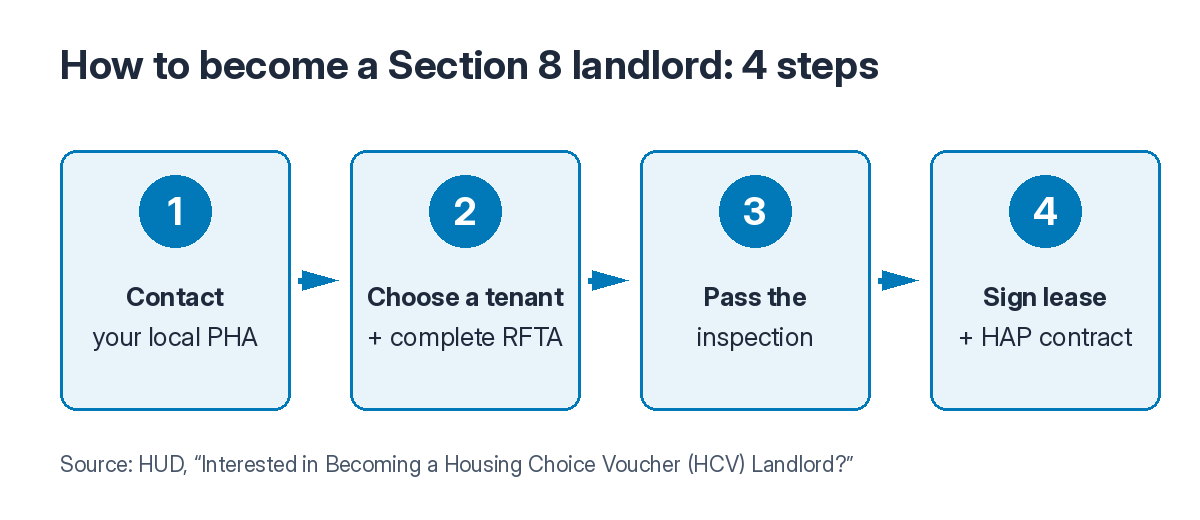
- Contact your local PHA. HUD’s handout says the PHA may explain the local process and how to post vacant units. You can find your PHA through HUD’s PHA contact list.
- Select a tenant. Choose a voucher holder based on your own rental criteria. Then fill out the voucher holder’s Request for Tenancy Approval (RFTA) form.
- Pass the inspection. An inspector checks that the unit meets the program’s housing quality standards.
- Sign the lease and HAP contract. You and the tenant sign a lease, and you submit it to the PHA. The PHA then sends you a housing assistance payments (HAP) contract to sign.
Want a wider pool of applicants while you wait on paperwork? Compare free rental listing sites for landlords.
What does a Section 8 inspection check?
The inspection checks that the unit is decent, safe and sanitary. HUD’s handout lists 13 housing quality standards (HQS) performance areas that apply at move-in and throughout the tenancy.
HUD’s HCV landlord handout lists these 13 areas:
- Sanitary facilities
- Food preparation and refuse disposal
- Space and security
- Thermal environment
- Illumination and electricity
- Structure and materials
- Interior air quality
- Water supply
- Lead-based paint
- Access
- Site and neighborhood
- Sanitary conditions
- Smoke detectors
The standard itself is changing. HUD Notice PIH 2026-18 (issued July 15, 2026) extends the compliance date for NSPIRE, HUD’s new inspection standard, in voucher programs to February 1, 2027.
That notice tells PHAs to update their inspection standards by that date. Your PHA may still use HQS or may have already moved to NSPIRE. Ask which one applies before you schedule.
How is Section 8 rent set and paid?
The PHA must find your proposed rent reasonable before it approves the tenancy. Once the HAP contract is signed, the PHA pays its share each month and the tenant pays the remainder.
HUD’s HCV landlord handout says the proposed rent must be reasonable compared with similar units in the market and not higher than what unassisted tenants on the premises pay.
Under 24 CFR 982.507, the PHA compares the rent with comparable unassisted units, considering location, quality, size, unit type, age, amenities, services, maintenance and utilities.
The same rule says the PHA must redetermine the reasonable rent before any increase in the rent to owner.
Payment follows the HAP contract. HUD’s handout says that once the contract is executed, you begin receiving monthly housing assistance payments from the PHA and the rest of the rent from the tenant. Your PHA can tell you how and when payments arrive.
Under 24 CFR 982.452, the owner collects the tenant contribution, meaning the part of the rent not covered by the housing assistance payment, along with any security deposit.
Can Section 8 landlords still screen tenants?
Yes. Federal rules make tenant screening and selection the owner’s responsibility, so you can apply your normal rental criteria.
Under 24 CFR 982.452, the owner performs all management and rental functions, including selecting a voucher holder and deciding if the family is suitable for tenancy.
That rule also makes the owner responsible for maintaining the unit to HQS and complying with equal opportunity requirements.
Under 24 CFR 982.307, the owner is responsible for screening and selecting the family, and the PHA must tell the owner so.
The same rule lists factors an owner may consider, such as payment of rent and utility bills, caring for a unit and premises, and respecting other residents’ rights to peaceful enjoyment of their housing.
It also lists drug-related or other criminal activity that threatens the health, safety or property of others, and compliance with other essential conditions of tenancy.
Apply the same written criteria to every applicant. Background checks carry their own rules, covered in our guide to FCRA rules for tenant background checks.
Do I have to accept Section 8 vouchers?
It depends on where your rental is. Some states and cities ban source-of-income discrimination, and many of those laws cover vouchers.
The Housing Solutions Lab’s “Source of income laws” page (updated July 31, 2026) reports that as of 2026, 19 states, the District of Columbia, Guam and many localities have laws against source-of-income discrimination.
The same page notes that many of these laws treat vouchers as protected, while some states and localities explicitly exclude them.
Check your state and city law, or ask your PHA, before you write a listing that mentions vouchers.
How do you list a Section 8 rental on Apartment One?
Create a free Property Partner listing and mark it as accepting Housing Choice Vouchers. Eligible renters can then filter for voucher-accepting properties.
Apartment One is an online platform where renters complete a verified background and credit screening once, then get matched to rental properties they qualify for, while landlords list properties for free and receive pre-screened applicants.
The Tenant Fit Index (TFI) is Apartment One’s 0-100 score matching a renter to a property based on credit, income-to-rent ratio, eviction history, criminal history, and lifestyle preferences.
On our Section 8 housing page, landlords can mark a listing as supporting the Housing Choice Voucher Program. Renters can filter their search to show only voucher-accepting properties.
You set your own screening and eligibility criteria. Applicants arrive pre-screened with FICO 9 credit from Experian, eviction data and criminal data, each with a TFI score. You can talk with them through in-app messaging, and screening data is encrypted and handled under FCRA, GLBA and CCPA. HUD-VASH listings are supported too.
Apartment One is not affiliated with HUD or any PHA. Inspections, RFTAs and HAP contracts stay between you, the tenant and your PHA. To see the renter side, read how voucher holders search for apartments.
Ready to rent to voucher holders? List your unit free and mark it Section 8-friendly.
Frequently asked questions
How long does it take to become a Section 8 landlord?
It depends on your PHA and how quickly it can schedule the inspection. Ask your PHA how long its RFTA review, inspection and HAP contract steps usually take.
Who pays the security deposit?
Under federal rules, the owner collects any security deposit from the family. Set and handle it within your state’s law, and ask your PHA about any local rules.
Can I charge Section 8 tenants more than other tenants?
No. HUD says the PHA must find the rent reasonable compared with similar units and not higher than what unassisted tenants on the premises pay.
What happens if my unit fails inspection?
Generally, you make the required repairs and the PHA re-inspects the unit. Ask your PHA for its repair deadlines and re-inspection process.
Is listing a Section 8 unit on Apartment One free?
Yes. Property Partner listings are free, and you can mark your listing as accepting Housing Choice Vouchers.
4 Responses