

Charge what comparable rentals near you have actually leased for, not what your mortgage requires. Pull three to five recent comps with the same beds, baths and size. Adjust for condition and amenities, and check your break-even cost. Then watch inquiries in the first two weeks and adjust if the unit sits.
How much rent should I charge? It’s the first question most new landlords ask, and the answer comes from your local market, not a formula. This guide walks through a five-step pricing method, current 2026 rent data, break-even math and rent increase limits.
This article is general information, not legal or financial advice. Rent rules vary by state and city.
How much rent should I charge for my rental?
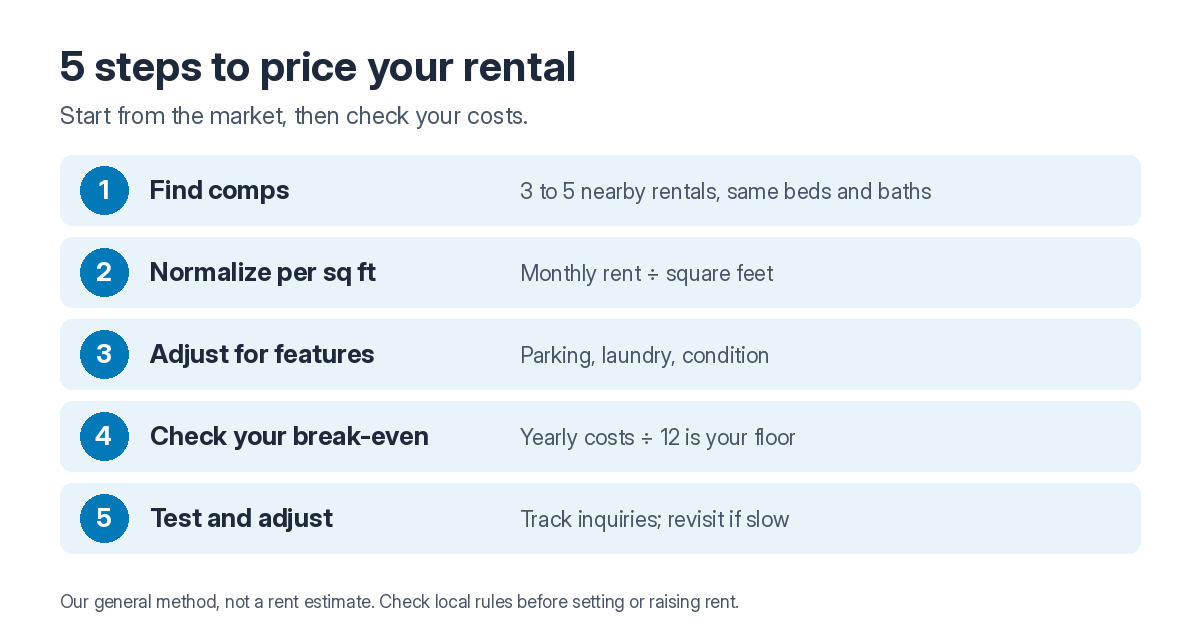
Charge close to what similar rentals nearby have leased for, then adjust for your unit’s features. Here’s a five-step method you can repeat at every vacancy:
- Find comps. Pick three to five rentals near you with the same beds and baths and a similar size. Recently leased units are best.
- Normalize per square foot. Divide each comp’s monthly rent by its square footage so you can compare units of different sizes.
- Adjust for features. Move your number up or down for things like parking, laundry and condition.
- Check your break-even. Make sure the rent covers your yearly costs, or know how much you’ll cover yourself.
- Test and adjust. List the unit, track inquiries and showings, and revisit the price if interest is slow.
Where do you find rental comps?
Start with listings near you, then check your numbers against local experts and public data. Good places to look include:
- Listing sites. Filter by neighborhood, beds and baths. Where a site shows recently rented units, use those over active listings.
- Local property managers and leasing agents. They see which prices actually lease and which units sit.
- HUD Fair Market Rents. HUD publishes Fair Market Rents each year for metro areas and nonmetro counties, and the FY 2027 schedule is posted. By HUD’s definition, they’re estimates of 40th percentile gross rents for standard quality units.
- Metro rent reports. Apartment List and Zillow both publish monthly rent data for large metro areas.
Leased rents tell you more than asking rents. An asking price only shows what an owner hoped to get.
Fair Market Rents matter most if you plan to rent to voucher holders. HUD says they’re used to determine payment standard amounts for the Housing Choice Voucher program.
What’s the average rent in 2026?
National rent was roughly $1,388 to $1,932 a month in September 2026, depending on the source. The two biggest monthly reports measure different things.
Apartment List reported on September 29, 2026 that the national median rent was $1,388 in September. That’s down 0.1% from August and down 0.4% from a year earlier.
The same Apartment List National Rent Report put the September 2026 median at $1,220 for a 1-bedroom and $1,374 for a 2-bedroom.
Zillow’s September 2026 Rent Report, published October 15, 2026, put the typical U.S. asking rent at $1,932. That’s up 2.7% from a year earlier.
Zillow put typical single-family asking rent at $2,266 in September 2026, up 3.1% year over year. Multifamily asking rent was $1,762, up 2.2%.
| Source | What it measures | Sept 2026 | Year over year |
|---|---|---|---|
| Apartment List | Median lease price, all unit sizes | $1,388 | -0.4% |
| Zillow, all rentals | Typical asking rent | $1,932 | +2.7% |
| Zillow, single-family | Typical asking rent | $2,266 | +3.1% |
| Zillow, multifamily | Typical asking rent | $1,762 | +2.2% |
Why the gap? Apartment List says its rents reflect transacted prices for rented units, not list prices for vacant units. Zillow’s figures are typical asking rents.
National numbers don’t price your unit. Your local comps do.
How do you calculate rent per square foot?
Divide each comp’s monthly rent by its square footage, average the results, then multiply by your unit’s size. Here’s a worked example with made-up round numbers:
| Example comp | Monthly rent | Square feet | Rent per sq ft |
|---|---|---|---|
| Comp A | $1,500 | 1,000 | $1.50 |
| Comp B | $1,400 | 875 | $1.60 |
| Comp C | $1,560 | 1,040 | $1.50 |
The average is about $1.53 per square foot. For a 950-square-foot unit, that’s 950 × $1.53, or about $1,455 a month.
This example is for illustration only, not market data. Per-square-foot math works best when your comps are similar in type, age and location.
What features let you charge more, or less?
Features renters value can push your price above the per-square-foot number, and drawbacks can pull it below. Compare your unit with what each comp offers.
Features that often support a higher rent:
- In-unit washer and dryer
- Off-street parking or a garage
- An updated kitchen or bathroom
- A private yard or outdoor space
- A pet-friendly policy
Things that often call for a lower rent:
- Dated finishes or appliances
- No parking where most comps include it
- No laundry in the unit or building
These are judgment calls, not fixed dollar amounts. Let the comps guide how big each adjustment should be.
How do you figure your break-even rent?
Add up a year of ownership costs and divide by 12. That monthly number is your break-even rent:
Break-even rent = (mortgage + property taxes + insurance + HOA fees + expected repairs + expected vacancy cost) ÷ 12
Use annual amounts for each item. For expected vacancy cost, estimate how many months the unit might sit empty and multiply by the rent you’d lose.
Break-even is your floor, not your price. Renters compare your unit with other rentals, not with your costs. If the market won’t support your break-even, you’ll need to cover the gap or rethink the plan.
Should you price high and lower later, or price at market?
In our view, pricing at market is usually the safer choice, especially in the off-season. Every empty month costs you a full month of rent.
Units took an average of 34 days to lease after listing in September 2026, according to Apartment List.
Apartment List describes fall and winter as the slow season. Fewer renters move then, it says, so property owners “offer modest discounts” to fill vacant units.
Concessions are common right now. Zillow found that 39.6% of rentals on Zillow offered concessions in September 2026.
Is a concession better than a lower list price? Here’s our suggestion. A one-time concession, such as a free week, keeps the stated rent higher for future renewals. A lower price may show up in more renters’ search filters. Weigh both against your local market.
For more ways to cut downtime, see our guide on how to reduce rental vacancy.
How much can you raise rent?
It depends on your state, your city and your lease. Some places cap yearly rent increases, and others leave it to the lease and notice rules.
Oregon is one example of a statewide cap. Oregon’s Office of Economic Analysis lists a 10% maximum allowable rent increase for covered tenancies in 2027. The limit was 9.5% in 2026.
Check your own state and city rules before you set a renewal increase. This isn’t legal advice.
Does the rent you charge affect who qualifies?
Yes. Many landlords set a minimum income-to-rent ratio, so a higher rent raises the income an applicant needs.
There’s no single national standard. Pick a ratio, put it in your written criteria and apply it to every applicant the same way.
Our guide on how to verify tenant income covers which documents to request and how to check them.
For the renter’s side of the math, see how much rent renters can afford.
How does Apartment One help you fill a well-priced unit?
Apartment One helps you find qualified renters once your price is set. It doesn’t set, recommend or estimate rent.
Apartment One is an online platform where renters complete a verified background and credit screening once, then get matched to rental properties they qualify for, while landlords list properties for free and receive pre-screened applicants.
The Tenant Fit Index (TFI) is Apartment One’s 0-100 score matching a renter to a property based on credit, income-to-rent ratio, eviction history, criminal history, and lifestyle preferences.
Listing as a Property Partner is free. Applicants are pre-screened with FICO 9 credit from Experian, eviction records and criminal records, and each comes with a Tenant Fit Index score. Use that score alongside your own written criteria.
You can message applicants in the app. Apartment One also supports Section 8 and VASH rentals. Our guide on how to become a Section 8 landlord explains the voucher process.
Apartment One is FCRA-compliant, follows GLBA and CCPA data handling, takes payments through Stripe and encrypts data. Compare other options in our guide to free rental listing sites for landlords, or see the pricing page.
Priced it right? Now find the right renter. List free on Apartment One and receive pre-screened applicants, each with a Tenant Fit Index score.
Frequently asked questions
Should my rent cover my mortgage?
Not necessarily. Renters compare your unit with other rentals, not with your costs. Use your break-even rent as a floor and your local comps to set the price.
How often should I re-check my rent price?
Re-check it at every vacancy and before every renewal. Pull fresh comps each time, since local rents can move in either direction.
Is it better to offer a concession or lower the rent?
It depends on your market. A one-time concession keeps the stated rent higher, while a lower rent may draw more interest. Zillow found that 39.6% of rentals on Zillow offered concessions in September 2026.
Can I charge a voucher holder more than other tenants?
The housing agency checks your rent first. Under 24 CFR 982.507, it must decide whether the rent is reasonable compared with rent for other comparable unassisted units. Our guide on how to become a Section 8 landlord explains the process.
Does it cost anything to list on Apartment One?
No. Landlords list properties for free through the Property Partner program.
3 Responses