

Security deposit laws vary by state. Official state sources show California (for most landlords) and New York cap deposits at one month’s rent. New Mexico does too for leases under one year. Return deadlines also vary: 30 days in New Mexico and Texas, 14 days in New York and 21 days in California, with itemized deductions.
Security deposit laws decide how much you can collect, what you can keep and how fast the rest goes back. Deposits are a real cost for renters. A Zillow survey cited by Harvard’s Joint Center for Housing Studies (March 2026) found renters who paid a deposit paid a median of $795. This guide uses examples from official state sources to show how the rules differ and what to check.
This is general information, not legal advice; check your state and local law.
What do security deposit laws say about how much you can charge?
It depends on your state, and some states set no single number for every landlord. Here’s how four states handle the cap and the return deadline, based on official state sources:
| State | Cap | Return deadline | Source |
|---|---|---|---|
| New Mexico | One month’s rent for leases under one year; on an annual lease, a deposit over one month requires paying the tenant annual interest | Itemized list within 30 days after the lease ends or the tenant leaves, whichever is later | NM Stat. § 47-8-18 (NM RLD) |
| California | One month’s rent; up to two months for certain small landlords, but not if the tenant is a service member | 21 days | Cal. Civil Code § 1950.5 |
| New York | One month’s rent | 14 days for non-regulated units, with an itemized statement | NY Attorney General |
| Texas | Check the Texas Property Code, Chapter 92 | On or before the 30th day after the tenant surrenders the unit; no duty until the tenant gives a written forwarding address | Texas State Law Library |
California’s small-landlord exception in Civil Code § 1950.5 covers landlords who are natural persons or LLCs whose members are all natural persons. Under § 1950.5, they must own no more than two residential rental properties with no more than four units in total. In California, landlords must return the deposit, minus any lawful deductions, within 21 days after the tenant moves out, under Civil Code §1950.5(h).
Other examples: Arizona caps security, “however denominated, including prepaid rent,” at one and a half months’ rent under A.R.S. § 33-1321. Michigan caps deposits at one and a half months’ rent under MCL 554.602.
Laws change, and cities can add rules, so check your current state statute and local ordinances. Many caps are tied to monthly rent, so see our guide on how much rent to charge.
What can you deduct from a security deposit?
Generally, unpaid rent and damage beyond normal wear and tear, but never normal wear and tear itself. New Mexico’s § 47-8-18(C) bars keeping any deposit for normal wear and tear. It allows deductions for unpaid rent, utilities, repairs and legitimate damages.
Other states say the same. California’s § 1950.5(e) bars claims for ordinary wear and tear. The Texas State Law Library notes that Texas landlords can’t keep a deposit for normal wear and tear.
Some states also set documentation rules. California’s § 1950.5(g) requires photos at the start of tenancies beginning on or after July 1, 2025. It has also required photos after move-out and after repairs since April 1, 2025. Arizona’s § 33-1321 requires landlords to give tenants a move-in form.
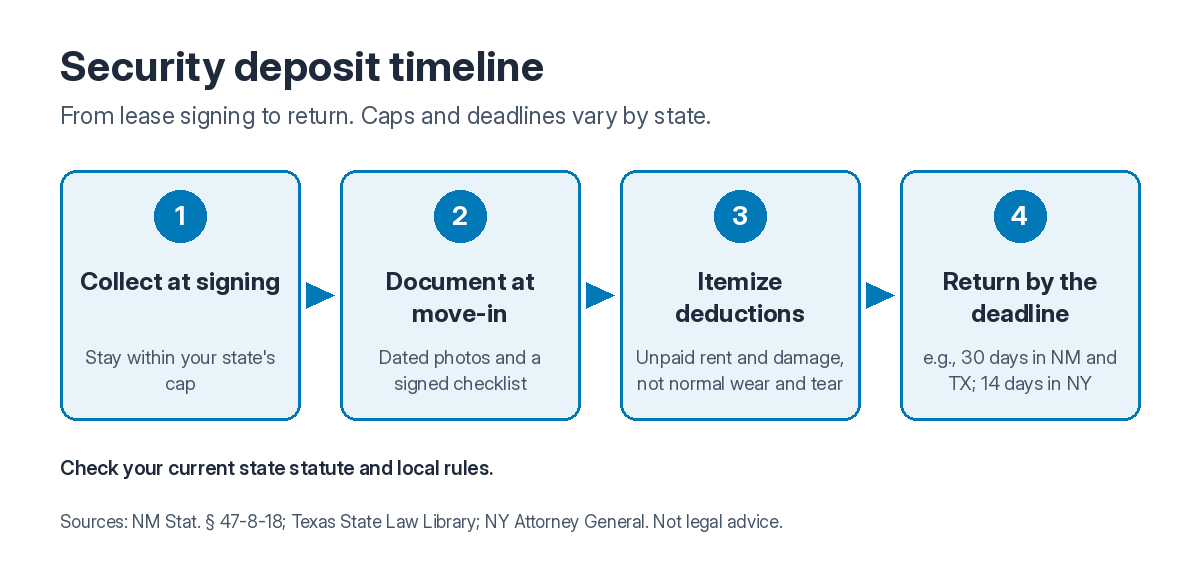
Even where your state doesn’t require them, these best practices make deductions easier to support:
- Take dated move-in photos of every room, appliance and existing flaw.
- Use a move-in checklist and have both you and the tenant sign it.
- Repeat the walkthrough at move-out using the same checklist.
- Keep receipts and invoices for every repair you deduct.
These are best practices, not legal requirements in every state.
How fast do you have to return a security deposit?
Return deadlines are where landlords most often get into trouble. Under New Mexico’s § 47-8-18, you must send an itemized written list of deductions, with the balance, within 30 days. The clock starts when the lease ends or the tenant leaves, whichever is later. New Mexico’s statute says mailing it to the tenant’s last known address counts as compliance.
Missing that deadline is costly. Under New Mexico’s § 47-8-18(D), an owner who fails to comply forfeits the right to withhold any of the deposit. The owner is also liable for court costs and reasonable attorneys’ fees. Section 47-8-18(E) adds a $250 civil penalty for bad faith.
In Texas, the State Law Library says the refund is due on or before the 30th day after the tenant surrenders the unit. But the landlord has no duty to refund or itemize until the tenant gives a written forwarding address, per the library. Per the library, a landlord acting in bad faith can owe three times the amount wrongfully withheld.
In New York, the Attorney General’s tenants’ rights guide says landlords of non-regulated units must return the deposit within 14 days of move-out. Without an itemized statement in that time, the AG says, the full deposit must be returned. The NY AG adds that a willful violation can cost up to twice the deposit. In Arizona, § 33-1321 allows 14 days, excluding weekends and holidays.
What’s the difference between a security deposit, an application fee and a holding deposit?
They serve different purposes, and mixing them up causes disputes. The Texas State Law Library draws the line using Texas Property Code definitions:
| Payment | What it’s for | Refundable? |
|---|---|---|
| Application fee | Offsets the cost of screening an applicant | No |
| Application (holding) deposit | Paid with an application to hold the unit | Yes, if the applicant is rejected |
| Security deposit | Secures the tenant’s performance under the lease | Yes, minus lawful deductions |
Source: Texas State Law Library (Tex. Prop. Code §§ 92.102, 92.351). Other states define these differently.
Holding deposits draw enforcement attention. In September 2026, the New York Attorney General announced a $352,250 settlement with Brooklyn High Rise LLC. The AG said the firm illegally charged $500 to $750 “good faith deposits” to hold apartments, and an estimated 300 applicants never got them back. For application fee caps, see our guide to rental application fees.
Can you charge a higher deposit to applicants with bad credit?
You may be able to within your state’s cap, but it triggers federal notice rules. According to the FTC’s guide for landlords, requiring a deposit you don’t require of other applicants, or a larger deposit, is an adverse action. The FTC says you must give an adverse action notice even if the consumer report played only a small part in the decision.
The FTC’s own example: offering an applicant with a bankruptcy on their report the unit with a double deposit requires a notice. Per the FTC, the notice must include the screening company’s name, address and phone number. It must also state that the company didn’t make the decision and explain the right to dispute the report and get a free copy within 60 days.
The safest approach is to write your deposit rule into your tenant screening criteria and apply it to everyone. Our tenant background check guide covers the rest of the FCRA process.
Can you charge last month’s rent plus a security deposit?
Not in New York. The NY Attorney General says that because of the one-month limit, a landlord can’t ask for last month’s rent and a security deposit.
In New Mexico, § 47-8-18(B) says last month’s prepaid rent isn’t counted as part of the deposit. In Arizona, § 33-1321 counts prepaid rent toward the one-and-a-half-month cap. Elsewhere, check your state’s statute.
Do pet deposits count toward the deposit cap?
In some states they can. California’s § 1950.5(b) defines security as any payment, fee, deposit or charge. Check your state’s definition before adding a separate pet deposit.
How does Apartment One help landlords set deposits consistently?
Apartment One is an online platform where renters complete a verified background and credit screening once, then get matched to rental properties they qualify for, while landlords list properties for free and receive pre-screened applicants.
The Tenant Fit Index (TFI) is Apartment One’s 0-100 score matching a renter to a property based on credit, income-to-rent ratio, eviction history, criminal history, and lifestyle preferences.
As a Property Partner, you list for free and receive pre-screened applicants with FICO 9 credit from Experian, eviction records and criminal records. Use the TFI as one tool to review applicants against your own written criteria, including your standard deposit. It isn’t a substitute for your policy.
Apartment One is FCRA-compliant and follows GLBA and CCPA data handling, and data is encrypted. For voucher holders, our guide on how to become a Section 8 landlord explains the voucher process.
Set one deposit standard, write it into your criteria, and apply it to every applicant. List your rental free on Apartment One and review pre-screened applicants against your own criteria.
Frequently asked questions
Can a landlord keep a deposit for normal wear and tear?
No, not in New Mexico, California or Texas. New Mexico’s § 47-8-18(C) bars keeping any deposit for normal wear and tear. California’s § 1950.5(e) bars claims for ordinary wear and tear, and the Texas State Law Library says the same for Texas.
What happens if I miss the security deposit return deadline?
In New Mexico, missing the 30-day deadline means you forfeit the right to withhold any of the deposit, under § 47-8-18(D). You’re also liable for court costs and reasonable attorneys’ fees. Other states have their own penalties.
Is a security deposit the same as an application fee?
No. Under the Texas definitions summarized by the Texas State Law Library, an application fee is nonrefundable and offsets screening costs. A security deposit secures the lease and is refundable minus lawful deductions.
Do I need a lease clause about the security deposit?
As a best practice, yes. State the amount, the deductions you may take and how and when you’ll return it. This is a best practice, not a legal requirement in every state.
Does it cost anything to list on Apartment One?
No. Listing as a Property Partner on Apartment One is free for landlords.
This is general information, not legal advice; check your state and local law.
7 Responses