

There is no single U.S. deadline for getting a security deposit back. To improve your chances, document the unit at move-in and move-out, give your landlord a forwarding address in writing, ask for an itemized statement of any deductions, and compare each deduction against your state’s normal wear-and-tear rule.
General information, not legal advice. Security deposit deadlines, deduction rules, and extra damages vary by state and your facts. Check your state law or a local legal-aid attorney before you act.
How long does a landlord have to return a security deposit?
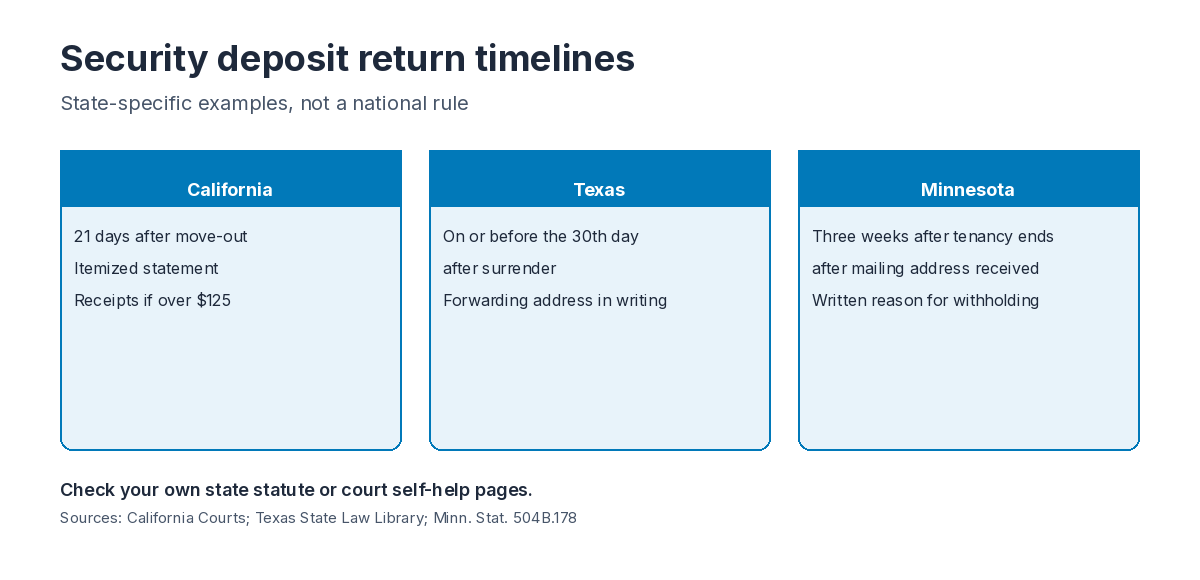
It depends on your state. California, Texas and Minnesota, three examples below, each set a different timeline, and none of them is a national rule.
California (state-specific): California Courts’ guide to security deposits says that after a tenant moves out, the landlord has 21 days to return all of the deposit, or return it minus deductions with an itemized statement listing what was deducted and why. The guide points to California Civil Code section 1950.5 for the statute.
The California Courts guide adds that if deductions are for more than $125, the landlord must attach copies of invoices or receipts; if the landlord or an employee did the work, the statement must describe the work, how long it took and the hourly rate, and rates must be reasonable. If repairs cannot be finished within 21 days for a good reason, the landlord can send a good-faith estimate and then must send receipts within 14 days of finishing the repairs.
Texas (state-specific): The Texas State Law Library’s security deposit refunds guide quotes Texas Property Code section 92.103, which says the landlord shall refund a security deposit on or before the 30th day after the date the tenant surrenders the premises.
Minnesota (state-specific): Minnesota Statutes section 504B.178 requires the landlord, within three weeks after the tenancy ends and after receiving the tenant’s mailing address or delivery instructions, to return the deposit with interest or give a written statement showing the specific reason for withholding any of it. The statute shortens that to five days if the tenant leaves because of a legal condemnation not caused by the tenant.
| State | Return timeline | What the landlord must send | Source |
|---|---|---|---|
| California | 21 days after move-out | Deposit, or balance plus itemized statement; invoices or receipts if deductions exceed $125 | California Courts |
| Texas | On or before the 30th day after surrender | Refund; written description of deductions (after tenant gives a forwarding address) | Texas State Law Library |
| Minnesota | Three weeks after tenancy ends, after landlord has your mailing address | Deposit with interest, or written statement of the specific reason | Minn. Stat. 504B.178 |
What can a landlord legally deduct from a security deposit?
In all three example states, a landlord can deduct for unpaid rent and for damage beyond normal wear and tear, but not for normal wear and tear itself.
California: California Courts’ guide to security deposits says a landlord can deduct for cleaning only to make the unit as clean as when the tenant moved in, for repairing damage other than normal wear and tear caused by the tenant or guests, and for restoring or replacing furniture or other items only if the rental agreement included them and the damage is not normal wear and tear. The guide says a landlord can generally keep part of the deposit for rent owed, with exceptions such as ending a lease early because of violence under Civil Code section 1946.7.
Texas: The Texas State Law Library’s security deposit refunds guide quotes section 92.104, which lets a landlord deduct damages and charges the tenant is legally liable for under the lease, but says a landlord may not keep any portion of a deposit to cover normal wear and tear. The library quotes section 92.001(4), which defines normal wear and tear as deterioration that results from the intended use of a dwelling, including breakage or malfunction due to age or deteriorated condition, but not deterioration from negligence, carelessness, accident or abuse.
Minnesota: Minnesota Statutes section 504B.178 limits withholding to amounts reasonably necessary to cover unpaid rent or other funds due under an agreement, or to restore the premises to their condition at the start of the tenancy, ordinary wear and tear excepted. In a dispute, the statute puts the burden of proving the reason for withholding on the landlord.
For the landlord side of these rules, see our companion guide to security deposit laws.
How should you document the unit so you can get your deposit back?
Record the condition of the unit when you move in and again when you move out, and keep everything in writing. Evidence makes it easier to show that a problem was already there or is normal wear and tear.
In California, California Courts’ guide to security deposits says that after a tenant gives notice, the landlord must tell the tenant in writing about the right to ask for a pre-inspection, so the tenant can fix problems before moving out. That is a California rule; other states may not offer it.
A practical checklist (suggestions, not legal requirements):
- Take dated photos or video of every room at move-in and move-out, including floors, walls, appliances and fixtures.
- Keep your lease, move-in inspection report and any repair requests.
- Ask for a pre-move-out inspection if your state or lease offers one.
- Clean the unit and return all keys, and note the date you returned them.
- Give your forwarding address in writing, and keep a copy.
Our move-in inspection checklist walks through what to record at the start of a lease.
What if the landlord misses the deadline or makes deductions you dispute?
Start with a dated demand letter and keep a copy. If that does not work, small claims or justice court is the usual next step, and some states allow extra damages.
California: California Courts’ guide to security deposits says that if the landlord does not return the entire deposit within 21 days or you disagree with the deductions, you can write a letter asking for the deposit back and keep a copy. If you cannot agree, you can sue for the deposit plus up to two times its amount in damages, which a judge may award if the landlord kept the deposit in bad faith. The guide says you can sue for up to $12,500 in small claims court.
Texas: The Texas State Law Library’s security deposit refunds guide quotes section 92.107: the landlord is not obligated to return the deposit or send a written description of damages until the tenant gives a written forwarding address, but a tenant who does not give one keeps the right to a refund. The library says section 92.109 lets a tenant sue to recover three times the portion of the deposit wrongfully withheld, plus other fees.
Minnesota: Under Minnesota Statutes section 504B.178, a landlord who fails to provide the required statement on time is liable for a penalty equal to the portion withheld, in addition to the portion wrongfully withheld, plus interest. Bad-faith retention can add punitive damages of up to $500 per deposit.
Does every state follow the same security deposit timeline?
No. Return deadlines, the documents a landlord must send, and the damages a tenant can recover all vary by state, so use the table above only as examples.
To find your rule, look up your state’s security deposit statute or your state court’s self-help pages, and check any city rules. Do not assume another state’s timeline applies to you.
If you are leaving before the lease ends, read how to break a lease first, since early move-outs can affect what you owe. A refundable holding deposit is a different payment; see holding deposits.
How does Apartment One fit in for renters?
Apartment One lets you screen once and share one report with landlords for your next rental. For more first-time tips, see how to rent your first apartment.
Apartment One is an online platform where renters complete a verified background and credit screening once, then get matched to rental properties they qualify for, while landlords list properties for free and receive pre-screened applicants.
Screening covers credit (FICO 9 from Experian), eviction and criminal records. Quick Screen is $35 one-time for a screening report only, and Tenant Plus is $60 one-time for screening plus access to matched property listings. Pricing can vary by state.
The Tenant Fit Index (TFI) is Apartment One’s 0-100 score matching a renter to a property based on credit, income-to-rent ratio, eviction history, criminal history, and lifestyle preferences. The TFI is a tool used alongside written criteria, not a ranking or a decision-maker.
Apartment One is FCRA-compliant and follows GLBA and CCPA data handling. Data is encrypted, and payments are processed through Stripe.
Screen once, then apply with a shareable report.
Frequently asked questions
Is normal wear and tear a legal deduction?
No, not under the California, Texas and Minnesota sources cited here. Each limits deductions to damage beyond normal or ordinary wear and tear, unpaid rent, and similar charges.
Do I have to give a forwarding address?
In Texas, the landlord is not obligated to send the refund or a written description of deductions until you give a written forwarding address, but you do not lose your right to a refund.
What if deductions are more than $125 in California?
California Courts say the landlord must attach invoices or receipts, or, if the landlord did the work, describe the work, the time it took and a reasonable hourly rate.
Can I use my deposit as last month’s rent?
There is no national yes. In Minnesota, statute 504B.178 subdivision 8 says a tenant may not withhold the last rent payment on the grounds that the deposit should cover it, except in the limited situations the statute lists.
Is this legal advice?
No. This is general information. Check your state law or talk to a local legal-aid or tenant attorney before you act.