

A holding deposit on an apartment is money you pay to take a unit off the market while the landlord finishes your application or before you sign the lease. Whether it is refundable depends on your written agreement and state or local law. Holding deposit apartment rules vary, so get the terms in writing before you pay.
General information, not legal advice.
What is a holding deposit?
A holding deposit is a payment that reserves an apartment for you for a set time, usually between the application and the lease signing. In return, the landlord agrees to stop showing the unit or stop taking other applicants.
Some landlords call it a reservation fee or a deposit to hold an apartment. The name matters less than the terms: how much you pay, how long the unit is held, and what happens to the money if you sign, back out or are turned down.
A holding deposit is separate from your security deposit and your application fee, though it is often credited toward one of them when you move in.
Is a holding deposit refundable?
Sometimes. It depends on why the deal falls through, what your written agreement says and the law where you rent. Where there is a specific rule, it usually protects you when the landlord backs out and lets the landlord keep the money when you do.
In Oregon, ORS 90.297 lets a landlord take a deposit to secure signing a rental agreement only after approving your application, and the landlord must give you a written statement of the rent, fees, deposits and the conditions for refunding or keeping the deposit.
Under ORS 90.297, if the lease is signed, the landlord must apply the deposit to money owed under the lease or refund it. If you fail to sign as agreed, the landlord may keep it. If the landlord fails to go through with it, the deposit must be returned within four days.
The same Oregon statute says an applicant can recover the deposit or fee charged plus $150 if the landlord doesn’t comply.
In Seattle, the city’s Renting in Seattle holding deposit page says a landlord cannot keep a holding deposit if you fail the application screening or the unit fails a housing inspection. But if you change your mind about renting the unit, you will likely forfeit it.
Many places don’t have a rule this specific, so the written agreement is what protects you. Check your state and local law, and don’t pay until the refund terms are on paper.
How is a holding deposit different from an application fee or security deposit?
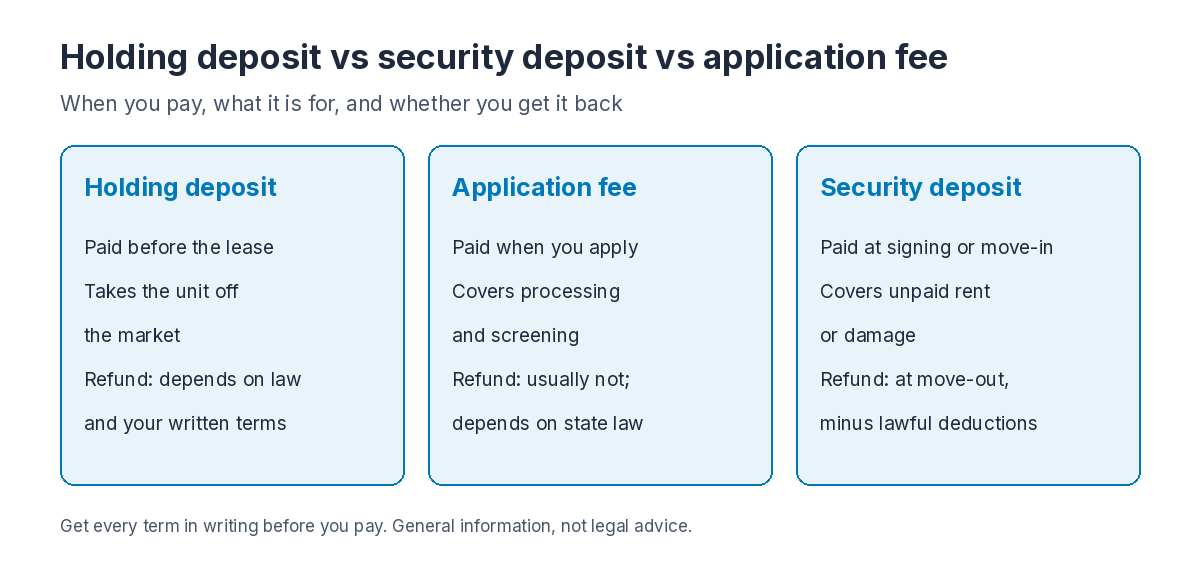
A holding deposit reserves the unit, an application fee pays for processing and screening your application, and a security deposit protects the landlord against unpaid rent or damage during the lease. Each is paid at a different stage and refunded under different rules.
| When you pay | What it’s for | Refundable? | |
|---|---|---|---|
| Holding deposit | After you apply or are offered the unit, before the lease | Takes the unit off the market | Depends on state law and your written agreement |
| Application fee | When you apply | Processing and screening | Usually not; depends on state law |
| Security deposit | At lease signing or move-in | Unpaid rent or damage | Returned at move-out minus lawful deductions; depends on state law |
Our guide to rental application fees covers what landlords charge to apply. For move-in deposits, see our guide to security deposit laws.
What are the holding deposit apartment limits on how much a landlord can charge?
It depends on where you rent. In Seattle, the city’s Renting in Seattle guidance says a landlord may charge up to 25% of one month’s rent as a holding deposit, with a written receipt that clearly describes the terms.
The Oregon statute doesn’t set a dollar amount, but it does require the written statement of terms described above.
Outside places with a specific rule, we don’t have a verified typical amount to share. Compare what the landlord asks with the monthly rent, and ask how the amount was set. A large deposit for a short hold is worth questioning.
Whatever the amount, make sure you know exactly where it goes if you sign. Ideally it is credited to your first month’s rent or your security deposit, and that is written down.
What should you get in writing before you pay?
Get the amount, how long the unit is held, when the deposit is refunded or kept, and how it is credited if you sign, all in writing before you pay. A signed receipt or short agreement protects both you and the landlord.
- Amount: The exact amount and what it is called.
- Hold period: The date the hold ends.
- Refund terms: What happens if you are denied, if you back out and if the landlord backs out.
- Credit at signing: Whether it goes toward rent or the security deposit.
- Receipt: A dated receipt with the landlord’s or company’s name.
- Payment method: A traceable method, such as a check or card, rather than cash or a gift card.
If a landlord won’t put the terms in writing, treat that as a reason to slow down. Keep copies of every message and receipt until the deposit is credited or returned.
If this is your first lease, our guide to how to rent your first apartment walks through each step.
How do you avoid holding-deposit scams?
Never pay a holding deposit before you have seen the unit in person or by live video and confirmed that the person you are paying actually controls it. Pressure to pay right away, by wire, gift card or payment app, is a common warning sign.
Our guide to rental scams explains how to spot fake listings and verify a landlord before you send money.
How can you avoid holding places you won’t qualify for?
Screen once before you start putting holds on apartments, so you can focus on rentals that fit your profile. That lowers the chance of paying to hold a unit and then being turned down, though no screening guarantees approval.
Apartment One is an online platform where renters complete a verified background and credit screening once, then get matched to rental properties they qualify for, while landlords list properties for free and receive pre-screened applicants.
Your screening covers credit (FICO 9 from Experian), eviction and criminal records, and you can share your report with landlords. See apartments you qualify for before you pay to hold one.
The Tenant Fit Index (TFI) is Apartment One’s 0-100 score matching a renter to a property based on credit, income-to-rent ratio, eviction history, criminal history, and lifestyle preferences. The TFI is a tool used alongside each landlord’s written criteria, not a ranking or a decision-maker.
Quick Screen is $35 one-time for a screening report only, and Tenant Plus is $60 one-time for screening plus access to matched property listings. Pricing can vary by state.
Apartment One is FCRA-compliant and follows GLBA and CCPA data handling. Data is encrypted, and payments are processed through Stripe.
Before you pay to hold a unit, screen once and see the rentals you qualify for.
Frequently asked questions
Do I get my holding deposit back if I’m denied?
In Seattle, the city says a landlord cannot keep a holding deposit if you fail the application screening. Elsewhere, it depends on your written agreement and state or local law, so get the refund terms in writing first.
What if I change my mind?
You may lose the deposit. Seattle’s guidance says you will likely forfeit it if you change your mind, and Oregon law lets a landlord keep it if you don’t sign as agreed. Check your written terms.
Does the holding deposit go toward rent?
Often, if you sign. In Oregon, the landlord must apply it to money owed under the lease or refund it. Elsewhere, get the credit written into your receipt or agreement.
Is a reservation fee the same thing?
Usually it is another name for a holding deposit. What matters is the written terms: the amount, the hold period and when it is refunded or kept.
Can a landlord take holding deposits from multiple applicants?
Ask before you pay. A holding deposit should take the unit off the market for you, so get written confirmation that the landlord will stop accepting other applicants during your hold.
One Response