

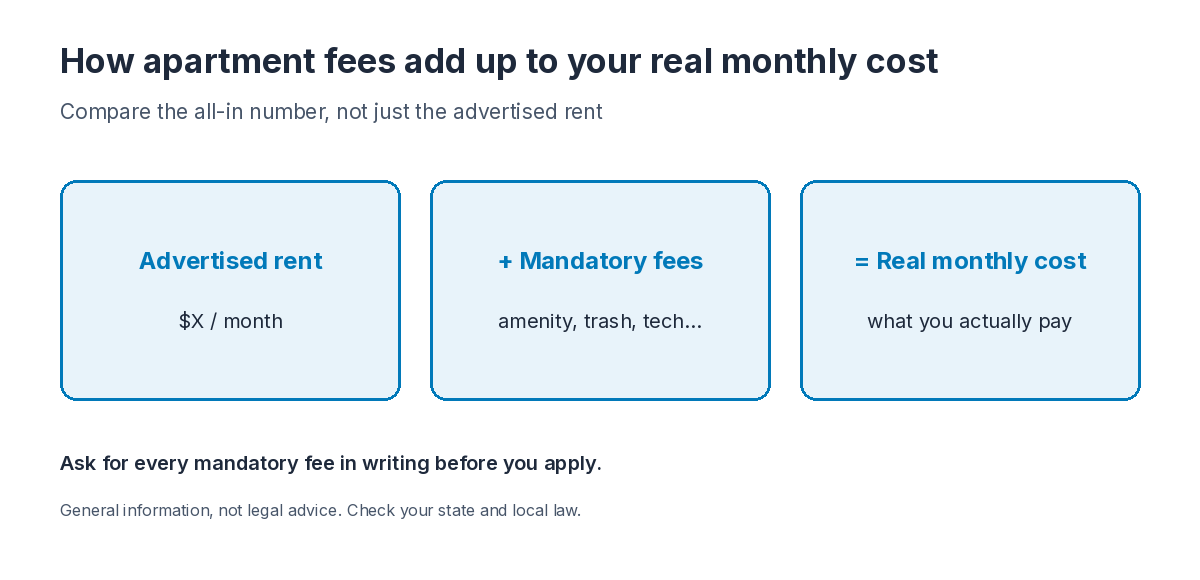
Apartment junk fees are mandatory or hard-to-avoid charges on top of the advertised rent, such as amenity, trash, tech or admin fees. Some states now require landlords to show the total monthly price up front. Ask for every fee in writing before you apply, then compare the all-in cost across listings.
General information, not legal advice. Check your state and local law.
What are apartment junk fees?
Apartment junk fees are charges that raise what you pay each month beyond the rent in the listing, and that you often cannot reasonably avoid. Common examples include amenity fees, valet trash, tech or package fees, admin fees, pet rent, parking and utility billing fees.
A one-time move-in cost, such as a security deposit or holding deposit, is different. This guide covers recurring and mandatory fees that sit next to rent on your monthly bill. For deposits, see our guide to holding deposits on apartments. For the fee you pay to apply, see rental application fees.
Not every fee is illegal. The problem is when the listing shows a low rent and the lease or portal adds charges you never saw in the ad.
Are hidden rental fees legal?
It depends on your state and on how the fee was advertised. There is no final federal rule that bans apartment junk fees yet, but the FTC has started a rulemaking and has settled cases against large rental companies.
In a Federal Register advance notice of proposed rulemaking published March 13, 2026, the Federal Trade Commission proposed to start a rulemaking on unfair or deceptive rental housing fee practices, such as advertising rent that leaves out mandatory fees or charging fees without express informed consent. Comments closed April 13, 2026.
That FTC notice is a proposal, not a final federal rental fee rule.
The same Federal Register notice describes two FTC orders. In FTC and State of Colorado v. Greystar, a stipulated final order entered December 12, 2025, Greystar was ordered to most prominently advertise the total rent including all mandatory fees and to pay $23 million in consumer redress plus $1 million to Colorado. The FTC alleged Greystar misrepresented the true cost of renting and excluded mandatory fees from advertised rent.
In an earlier case against Invitation Homes, according to the same notice, a stipulated final order entered September 27, 2024 ordered the company to advertise total rent including mandatory fees and pay $48 million in consumer redress. The FTC alleged Invitation Homes excluded mandatory monthly fees from advertised rent and failed to disclose all mandatory fees.
Those orders bind the companies named in them. Your rights as a renter still come mainly from your state and local law.
Which states make landlords show the total monthly price?
Colorado and Minnesota both require landlords to disclose the full price that includes nonoptional fees, and Virginia limits fees charged just to pay rent. Other states may have their own rules, so check yours.
In Colorado, according to the Colorado Division of Real Estate summary of HB25-1090, the law took effect January 1, 2026. “Total Price” includes all amounts that must be paid to use the property and are not reasonably avoidable.
The same Colorado summary says a lease may not require a markup on a service the landlord is billed for beyond 2% of the bill or $10 per month, but not both.
In Minnesota, Minnesota Statutes section 504B.120 requires a landlord to disclose all nonoptional fees in the lease. The sum of rent and all nonoptional fees must be described as the “Total Monthly Payment” on the first page of the lease.
The same Minnesota statute says ads must disclose nonoptional fees with the rent and whether utilities are included, and a landlord who violates the section is liable for treble damages (and the court may award reasonable attorney fees).
In Virginia, Virginia Code section 55.1-1204(J) says a landlord may not charge a fee for collecting or processing rent or other payments unless the landlord offers an alternative payment method that does not include additional fees.
These three examples are not a full list. Check your state attorney general or consumer protection office for local rules.
How do you find the real monthly cost before you apply?
Ask for a written list of every mandatory fee, then add those fees to the advertised rent and compare that total across listings. Do this before you pay an application fee.
- Ask for a written fee schedule that covers amenity, trash, tech, admin, pet, parking, utility billing and payment processing fees.
- Ask which fees are required to live in the unit and which you can opt out of.
- Ask whether utilities are included in rent.
- Ask how and when each fee can change during the lease.
- Read page one of the lease for a total monthly payment or total price line, where your state requires one.
- Screenshot the listing so you can compare it with the lease later.
| Fee type | Usually one-time or monthly | Ask this before you sign |
|---|---|---|
| Amenity / community fee | Monthly | Is it required for every resident? |
| Trash or valet trash | Monthly | Is it separate from city trash service? |
| Tech or package fee | Monthly | Can I opt out if I don’t use the service? |
| Admin or lease fee | One-time or monthly | Is it required, and when is it due? |
| Pet rent | Monthly | Is it separate from a pet deposit? |
| Parking | Monthly | Is a space included in rent? |
| Utility billing / admin | Monthly | What is the fee on top of the utility bill? |
| Payment processing | Per payment | Is there a free way to pay rent? |
Once you know the all-in cost, check that it still fits your budget with our guide to how much rent you can afford. If a listing looks flexible on price, our guide on how to negotiate rent covers what to ask for.
Apply only where you are likely to qualify, so you are not paying application fees over and over. See apartments you qualify for.
What can you do if a fee wasn’t disclosed?
Ask the landlord in writing to explain the fee and remove or disclose it, keep the ad and lease, and contact your state consumer protection office or attorney general if the fee still looks wrong. Outcomes vary, and this guide cannot promise a refund.
- Send a short written question naming the fee, the amount and where you first saw (or didn’t see) it.
- Keep screenshots of the listing, the fee schedule and the lease page that lists monthly charges.
- Check whether your state has a total-price or nonoptional-fee rule like Colorado or Minnesota.
- Contact your state attorney general or consumer protection office for next steps in your area.
How does Apartment One fit in?
Apartment One helps you screen once and focus on rentals you qualify for, so you spend less on applications while you compare the real monthly cost of each place. You still decide which fees you will accept.
Apartment One is an online platform where renters complete a verified background and credit screening once, then get matched to rental properties they qualify for, while landlords list properties for free and receive pre-screened applicants.
Screening covers credit (FICO 9 from Experian), eviction and criminal records. You can share your report with landlords instead of paying for a new check with every application.
The Tenant Fit Index (TFI) is Apartment One’s 0-100 score matching a renter to a property based on credit, income-to-rent ratio, eviction history, criminal history, and lifestyle preferences. The TFI is a tool used alongside each landlord’s written criteria, not a ranking or a decision-maker.
Quick Screen is $35 one-time for a screening report only, and Tenant Plus is $60 one-time for screening plus access to matched property listings. Pricing can vary by state.
Apartment One is FCRA-compliant and follows GLBA and CCPA data handling. Data is encrypted, and payments are processed through Stripe.
Know your real monthly cost, then apply only where you qualify. Screen once and see your matches.
Frequently asked questions
Is an amenity fee legal?
It depends on your state and whether the fee was disclosed. In Colorado, unavoidable fees are part of the Total Price that must be shown, so ask how the amenity fee was included in the advertised price.
What is a Total Monthly Payment on a lease?
In Minnesota, Minnesota Statutes section 504B.120 requires rent plus all nonoptional fees to be described as the Total Monthly Payment on the first page of the lease.
Can a landlord charge a fee to pay rent online?
Some states limit that. In Virginia, a landlord may not charge a fee to collect or process rent unless an alternative payment method with no fee is offered.
Is there a federal law against apartment junk fees?
Not a final one yet. In March 2026 the FTC proposed a rulemaking on unfair or deceptive rental housing fee practices; that notice is a proposal, not a final rule.
Are late fees junk fees?
Late fees are a separate kind of charge, usually tied to paying rent after the due date, and state limits vary. Check your state late fee rules before you sign.