

Yes, you can often negotiate rent in 2026, especially on a new lease in the off-season or in a market where landlords are offering move-in specials. Here is how to negotiate rent: ask politely, compare nearby listings, know what you want, and get every agreed concession written into your lease.
Can you negotiate rent in 2026?
Often, yes, because many landlords are still competing for renters. According to the Apartments.com Q3 2026 RentPulse report, the national concession rate rose to 4.2%, 0.6 percentage points higher than a year earlier.
The same Apartments.com report defines the concession rate as “the difference between advertised rent and what renters actually pay after specials are applied.” In other words, many renters already pay less than the listed price.
According to the Apartment List National Rent Report, 32% of multifamily properties were offering concessions worth one month of free rent or more in October 2026, four percentage points higher than a year earlier.
Rents have also cooled a little. The Apartments.com October 2026 rent report says the national average rent fell 0.15% to $1,749 in October, a second straight monthly decline, while annual rent growth was 1.6%.
Vacancy matters too, because empty units cost landlords money. The Census Bureau reports a national rental vacancy rate of 7.6% in the third quarter of 2026, up from 7.1% a year earlier.
Not every market is soft, though. The Apartments.com RentPulse report also says national vacancy in the properties it tracks fell to 7.8%, its lowest level since late 2023. These sources measure different things, so treat them as signs of leverage, not a promise that any landlord will say yes.
This guide is about new leases and move-in deals. If you are renewing, the same habits help: ask early, know local rents and get any change in writing.
When do renters have the most leverage?
You usually have the most leverage when a unit has sat empty for a while, when it is the slower leasing season, and when your local market has plenty of concessions. Each of these makes a landlord more willing to trade price or perks for a signed lease.
- Off-season timing: Signing outside your area’s busiest moving months may mean fewer renters competing for each unit.
- Units that have been listed a while: Check how long a listing has been posted. An older listing often means a landlord who wants to fill it.
- New buildings: Properties still leasing up often advertise move-in specials.
- Markets with deep discounts: Some cities are offering much more than others.
According to the Apartments.com Q3 2026 RentPulse report, the markets with the deepest discounts were Naples, FL (12.9%), Fort Myers, FL (11.5%), Sarasota, FL (10.5%), Austin, TX (9.9%) and Savannah, GA (9.6%).
If you live somewhere else, look at local listings. Count how many advertise free weeks, reduced deposits or waived fees. That tells you more about your leverage than any national number.
What is net effective rent, and why does it matter?
Net effective rent is your average monthly cost after a concession is spread across the whole lease. It matters because it lets you compare a free month at one building with lower base rent at another on equal terms.
Example (made-up round numbers, not data): A unit lists at $1,500 a month on a 12-month lease with one month free. You pay $1,500 x 11 = $16,500 over the year. Divide by 12 and the net effective rent is $1,375 a month.
Now compare a second example unit at $1,400 a month with no special. Its effective rent is $1,400, so the first unit is cheaper over this lease. But check what happens at renewal. Some landlords base the next increase on the full base rent, not the effective rent, so the first unit could start year two at $1,500.
Ask three questions about any special:
- Is the free time taken up front, at the end, or spread across the lease?
- What happens to the concession if I break the lease early?
- Will my renewal offer be based on the base rent or the effective rent?
Before you commit, make sure the total still fits your budget. Our guide to how much rent you can afford walks through the numbers.
What can you ask for besides lower rent?
You can ask for free weeks, waived fees, included parking, a longer lease at the same rate or a flexible move-in date. Landlords sometimes find these easier to give than a lower base rent, because the advertised price stays the same.
| What to ask for | Why a landlord might agree | What to check |
|---|---|---|
| Lower base rent | Fills the unit faster | Shows in every month and at renewal |
| Free weeks or a free month | Keeps the advertised rent unchanged | When it applies and if it is clawed back on early move-out |
| Waived fees | Small cost to the landlord | Which fees: application, admin, amenity or pet |
| Parking or storage | Often has spare spaces | Written into the lease, with any monthly cost |
| Longer lease at the same rate | Less turnover and vacancy | Your plans: a longer lease is harder to leave |
| Move-in date | Avoids a gap between tenants | Prorated first month in writing |
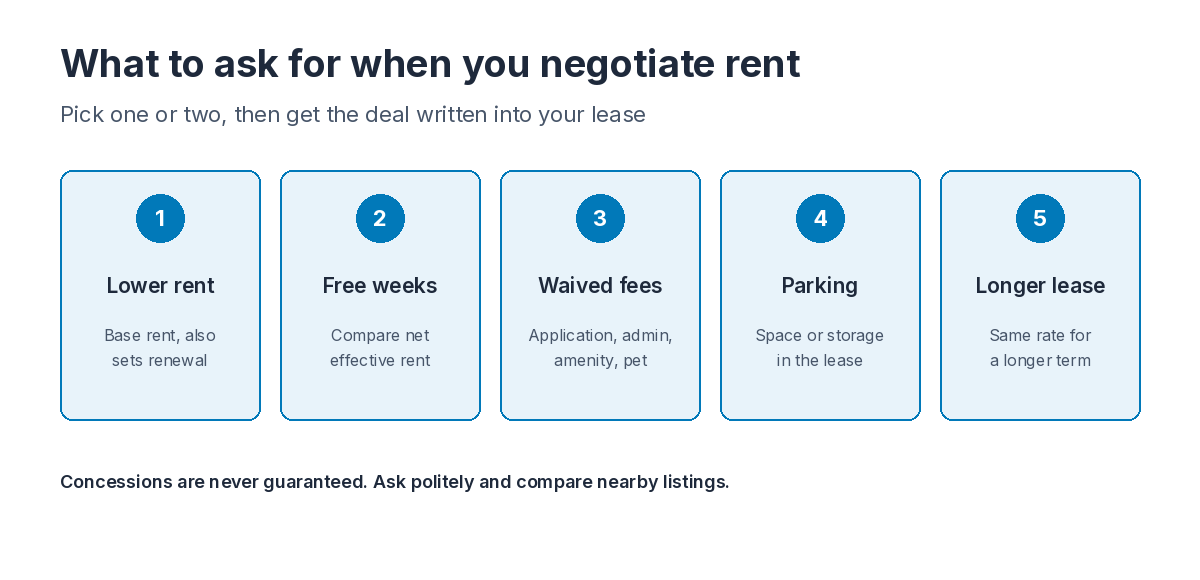
Pick one or two priorities instead of asking for everything. A focused request is easier for a leasing agent to approve or take to an owner.
How to negotiate rent: what should you say?
Ask politely, show you are a serious applicant, point to comparable listings and make one clear request. Then get whatever you agree on written into the lease before you sign.
- Do your homework: Save two or three comparable listings nearby with their prices and specials.
- Show you are ready: Have your income documents and screening report ready to share.
- Make one clear ask: Name the specific concession you want.
- Offer something back: A quick signing, a longer lease or a flexible move-in date.
- Get it in writing: Confirm the final terms in the lease, not just in a message.
Here is a simple rent negotiation script you can adapt:
“I really like this unit, and I’m ready to sign this week. I’ve seen similar apartments nearby listed for less, and a couple are offering a free month. If you can do [your ask, such as two weeks free or a waived admin fee], I can submit my application today. Is that something you can approve?”
If the answer is no, ask what is possible: “Is there any flexibility on fees, parking or the move-in date?” Stay friendly either way. A leasing agent may not control price but can often pass a request to the owner.
Once you agree, read the lease line by line with our lease agreement checklist. If this is your first place, our guide to how to rent your first apartment covers the full process.
How can a ready-to-go screening help?
Having your screening done before you tour helps you act quickly and shows a landlord you are a serious applicant. It does not guarantee a discount or an approval, but it can make your “ready to sign this week” offer believable.
Apartment One is an online platform where renters complete a verified background and credit screening once, then get matched to rental properties they qualify for, while landlords list properties for free and receive pre-screened applicants.
You screen once, covering credit (FICO 9 from Experian), eviction and criminal records, and share your report with landlords. If your credit is thin, Financial Stability Documents let you show bank funds. You can also see apartments you qualify for.
The Tenant Fit Index (TFI) is Apartment One’s 0-100 score matching a renter to a property based on credit, income-to-rent ratio, eviction history, criminal history, and lifestyle preferences. The TFI is a tool used alongside each landlord’s written criteria, not a ranking or a decision-maker.
Quick Screen is $35 one-time for a screening report only, and Tenant Plus is $60 one-time for screening plus access to matched property listings. Pricing can vary by state.
Apartment One is FCRA-compliant and follows GLBA and CCPA data handling. Data is encrypted, and payments are processed through Stripe.
Show up ready: screen once, share your report, and see rentals you qualify for.
Frequently asked questions
Is it rude to negotiate rent?
No. Asking politely about price or specials is a normal part of renting, and many landlords expect it. Keep it friendly, make one clear request and accept a no gracefully.
What’s a reasonable amount to ask for?
There is no standard amount. Look at what comparable listings near you are offering, such as free weeks or waived fees, and ask for something similar.
Can you negotiate rent at a big apartment complex?
Often, yes. Even if base rent is firm, a large property may have room on specials, fees, parking or move-in dates. Ask the leasing office what specials are available.
Should you take a free month or lower rent?
Compare the net effective rent over the lease, then think about renewal. Lower base rent usually helps more at renewal, because some landlords base increases on the base rent. Ask how renewals are priced.
Do concessions show up in the lease?
They should. Ask for every concession, including free time, waived fees and parking, to be written into the lease or a signed addendum before you sign.