

Finding apartments I qualify for, as most renters phrase it, starts with each landlord’s written screening criteria. Get the criteria before you pay a fee and compare it to your income, credit and rental history. Check your own credit reports first, fix any errors, and apply only where you clearly meet the criteria.
Screening rules vary by state and city; this is general information, not legal advice.
How do I find apartments I qualify for before applying?
Ask for the landlord’s written screening criteria and compare it to your own numbers before you pay anything. The checks fall into a few areas, and each takes minutes per listing.
| Requirement | What to ask | What to check on your side |
|---|---|---|
| Income | What minimum income do you require, and how do you count it? | Your gross monthly income and the proof you can show |
| Credit | What credit standards do you use? | Your free credit reports, checked for errors |
| Rental and eviction history | What rental history do you need, and how far back do you look? | Past addresses, landlord contacts and any court records |
| Criminal history | What is your written criminal history policy? | What a background check may show about you |
| Documents | Which documents do you need with the application? | ID, pay stubs, bank statements or offer letters, ready to send |
| Occupancy and pets | How many occupants and which pets do you allow? | Your household size and any pets |
A checklist of practical steps, not legal requirements.
Budget matters too. Zillow’s 2025 renter survey found that 93% of renters consider staying within their initial budget “essential,” more than any other factor Zillow asked about.
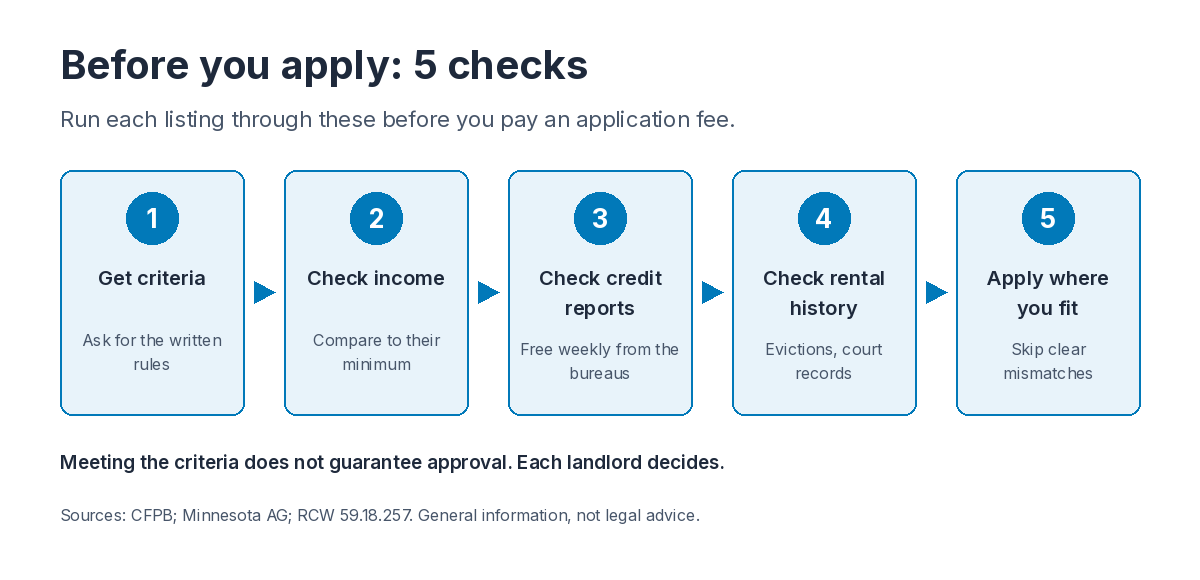
Do landlords have to tell you their screening criteria?
In some places, yes. Elsewhere, you can still ask, and many landlords will share their criteria.
In Minnesota, Minnesota Statutes section 504B.173 says a landlord who accepts a screening fee must first disclose in writing the criteria the rental decision will be based on. Under the same statute, that disclosure must include the name, address and phone number of any tenant screening service the landlord will use. Section 504B.173 says the fee must be returned if you are rejected for any reason not listed in that disclosure. Minnesota landlords must notify a rejected applicant within 14 days and identify the criteria the applicant failed to meet, according to section 504B.173.
In Seattle, the city’s Renting in Seattle guidance tells landlords to put their screening criteria in writing. The same Seattle guidance says that information should include the name and address of the consumer reporting agency the landlord uses. The city also says landlords can charge only the actual cost of screening.
When you ask for criteria, ask in writing, by email or through the listing’s messaging, so you have a record. Useful questions include which screening company the landlord uses, whether a co-signer is accepted, and whether they take a reusable screening report.
Rules vary, so check your state and city. Knowing your rights matters. In September 2026, the New York Attorney General announced a $352,250 settlement with Brooklyn High Rise. The New York Attorney General said 203 tenants were illegally denied housing based on court history.
How much income do you need to qualify for an apartment?
It depends on the landlord’s written criteria, so ask before you apply. Many landlords set a minimum income as a multiple of the monthly rent. Our guide on how much rent you can afford explains the 3x rent rule and the 30% rule.
If your income is irregular or you don’t have pay stubs, ask which other documents the landlord accepts. On Apartment One, Financial Stability Documents let you show bank funds, which may help if your credit is low. Our guide to renting without proof of income covers other options.
Should you check your credit and background before you apply?
Yes. Checking first lets you find and fix errors before a landlord sees them.
The CFPB says you can get free weekly credit reports from Equifax, Experian and TransUnion at AnnualCreditReport.com. After an adverse action notice, the CFPB says you can request a free report from the named company within 60 days.
Tenant screening companies are separate from the credit bureaus. The CFPB’s list of consumer reporting companies says they can report credit history, eviction records, rent payments and criminal background data, among other things. The CFPB notes that most won’t have a file on you unless you’ve applied for rental housing. The CFPB advises checking your credit report for errors in advance.
How many apartments should you apply to?
Apply only where you meet the criteria, because each extra application can mean another fee. Zillow’s 2025 renter survey found that the typical (median) recent renter submitted two applications.
The same Zillow survey found that 20% of recent renters submitted no applications in 2025, up from 14% in 2024. Zillow found that 19% of Black and 16% of Hispanic recent renters submitted five or more applications, compared with 8% of white renters.
The market context is shifting, too. A TransUnion analysis found that rental applications fell 10% year over year in the second half of 2025. For fee limits and reusable reports, see our guide to rental application fees.
What if you don’t meet every requirement?
You may still have options, but nothing guarantees approval. Some landlords offer conditional approval, such as with a co-signer or a larger deposit, and each landlord decides.
- For low or thin credit, see how to get approved for an apartment with bad credit.
- For a past eviction, see how to rent an apartment with an eviction.
- For a criminal record, see how to rent an apartment with a criminal record.
If a landlord approves you only on conditions, such as a co-signer, a larger deposit or higher rent, ask why. The CFPB says that when you are rejected or conditionally accepted based on a screening report, the landlord must give you an adverse action notice naming the screening company. That tells you which company to ask for your free report.
It also helps to be upfront. If you know a landlord will see a late payment or an old court case, a short written explanation with proof of steady income or recent on-time payments gives them context before they decide.
If this is your first lease, our guide on how to rent your first apartment walks through the whole process.
How does Apartment One match you to apartments you qualify for?
Apartment One is an online platform where renters complete a verified background and credit screening once, then get matched to rental properties they qualify for, while landlords list properties for free and receive pre-screened applicants.
The Tenant Fit Index (TFI) is Apartment One’s 0-100 score matching a renter to a property based on credit, income-to-rent ratio, eviction history, criminal history, and lifestyle preferences.
You screen once, with FICO 9 credit from Experian, eviction records and criminal records, then share one report with landlords. In-app messaging lets you ask questions before you apply. Each landlord still sets its own criteria and makes the final decision.
Quick Screen costs $35, one-time, and Tenant Plus costs $60, one-time. Our pricing page has the details.
Stop paying fees to find out you didn’t qualify. Screen once with Apartment One and share one report with landlords.
Frequently asked questions
Can I ask a landlord for their screening criteria before I apply?
Yes, you can always ask. In Minnesota, a landlord who accepts a screening fee must disclose the criteria in writing first, under Minnesota Statutes section 504B.173. Seattle’s Renting in Seattle guidance also tells landlords to put their screening criteria in writing.
How many applications does the typical renter submit?
Two. Zillow’s 2025 renter survey found that the typical (median) recent renter submitted two applications.
Where can I check my credit report for free?
The CFPB says you can get free weekly reports from Equifax, Experian and TransUnion at AnnualCreditReport.com.
Does qualifying guarantee I’ll be approved?
No. Meeting a landlord’s criteria doesn’t guarantee approval. The landlord makes the final decision.
How much does it cost to screen on Apartment One?
Quick Screen costs $35, one-time, and Tenant Plus costs $60, one-time. See our pricing page for details.
2 Responses