

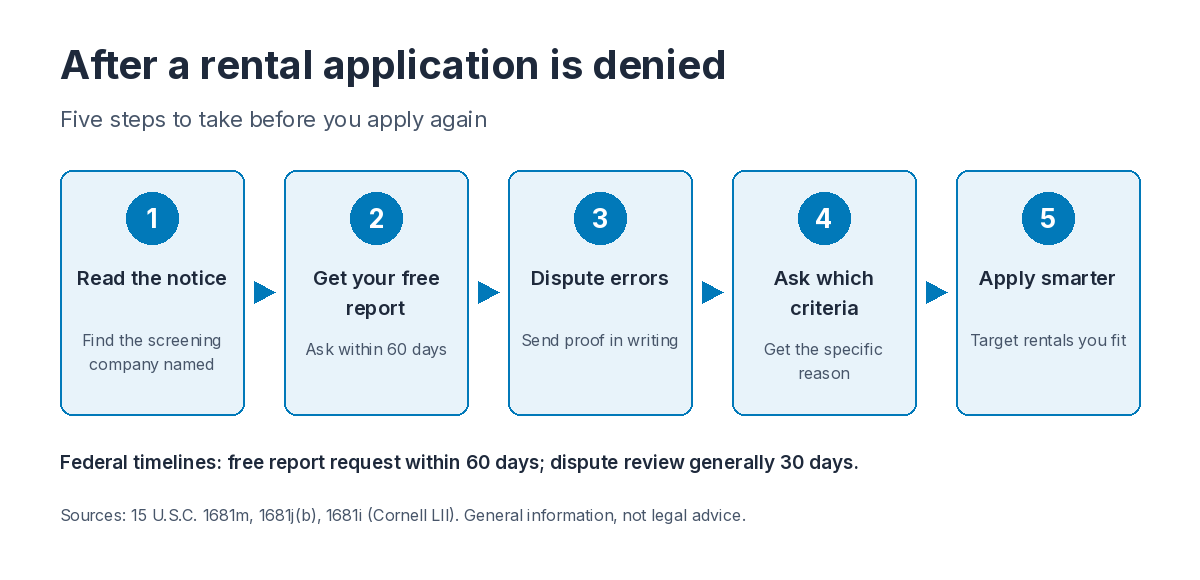
Had a rental application denied? If a screening or credit report was used, 15 U.S.C. 1681m says the landlord must name the company that supplied it. Under 15 U.S.C. 1681j, you can get that report free if you ask within 60 days. Then dispute errors, ask which criteria you missed, and apply where you meet the requirements.
General information, not legal advice. State and local rules may add protections.
Why was my rental application denied?
Most denials come down to how your application compared with the landlord’s written screening criteria. The reason is usually in your report, your income, or missing paperwork.
Common reasons include:
- Income that falls short of the landlord’s income-to-rent requirement
- A credit history that doesn’t meet the landlord’s standard
- An eviction record, or a court record that looks like one
- Criminal history, where local law allows landlords to consider it
- An incomplete application or missing documents
- Information the landlord couldn’t verify, such as employment or past rentals
For a closer look at each record type, see our guide to what a background check for an apartment shows. If a record was the issue, our guide to renting an apartment with a criminal record covers next steps.
What should you do in the first 48 hours after a denial?
Read the notice, request your free report, and ask which criteria you missed before you apply anywhere else. A short pause now can save you another fee.
- Read the notice. When a landlord denies you based in whole or in part on a consumer report, 15 U.S.C. 1681m(a) requires notice that names the reporting company and gives its address and phone number. Our adverse action notice guide for landlords lists everything the notice should include.
- Request your free report. Under 15 U.S.C. 1681j(b), the company must give you your file free if you ask within 60 days of receiving the notice. Ask in writing and keep a copy.
- Ask which criteria you missed. The same federal rule, 15 U.S.C. 1681m(a)(3), says the notice must state that the reporting company didn’t make the decision and can’t tell you the specific reasons. So ask the landlord directly. In Minnesota, Minn. Stat. 504B.173 requires a landlord who took a screening fee to tell you the criteria you failed within 14 days of rejecting you.
- Keep your receipts. Save your application, fee receipt and any messages. In some states you may be owed a refund; Minn. Stat. 504B.173 requires Minnesota landlords to return the fee if you’re rejected for a reason not in their written criteria. Our guide to rental application fees covers what landlords can charge.
- Don’t panic-apply. Applying to several places at once can mean several fees and the same result. Fix what you can first, then target rentals whose criteria you meet.
What rights do you have when a landlord denies you?
If a consumer report played any part in the denial, federal law gives you the right to a notice, a free copy of the report and a chance to dispute it. 15 U.S.C. 1681m(a)(4) requires the notice to tell you about your right to a free copy and your right to dispute inaccurate or incomplete information.
Some states add more. Here are three examples.
| State | What the law adds | Source |
|---|---|---|
| Minnesota | Landlords who took a screening fee must notify you within 14 days of a rejection and identify the criteria you didn’t meet. They can’t deny you based on a pending eviction case or an expunged or non-public court file. | Minn. Stat. 504B.173 |
| Maryland | From October 1, 2026, a provider with five or more units that withdraws a conditional offer over criminal history must give the reason and let you request a reassessment. | Maryland DHCD |
| New York | Denying an application based on past housing court records has been illegal since 2019. In September 2026, the Attorney General announced a $352,250 settlement with a Brooklyn landlord over this practice. | New York Attorney General |
In that New York case, the New York Attorney General found 203 tenants were illegally denied housing based on court history.
How do you dispute an error on your tenant screening report?
Contact the screening company named on your notice, explain what’s wrong, and send copies of your proof. The company then has a set time to reinvestigate.
Under 15 U.S.C. 1681i, the company generally has 30 days from receiving your dispute to reinvestigate and correct or delete the item. The same law allows up to 15 more days if you send relevant information during those 30 days. Section 1681i(a)(6) requires the company to send you written results within 5 business days after it finishes.
A few habits help:
- Point to the exact item and say why it’s wrong.
- Attach court dismissals, paid receipts or ID that shows a mix-up.
- Keep copies of everything you send and the date you sent it.
- Once the report is fixed, send the corrected version to the landlord and ask them to take another look.
Can you ask the landlord to reconsider?
Yes, you can always ask. Whether the landlord has to reconsider depends on where you live and why you were denied.
In Maryland, the Maryland DHCD says the Fair Chance Housing Act lets you request a reassessment when a provider withdraws a conditional offer over criminal history. Elsewhere, a polite written request that addresses the specific concern can still work. Options to offer include:
- A co-signer or guarantor who meets the landlord’s income or credit standard
- A larger security deposit, where your state’s deposit limits allow it
- Proof of funds, such as bank statements showing savings
- Context for a record, such as a dismissed case or a paid-off debt
Our guide to getting approved for an apartment with bad credit covers these options in more depth. For proof of funds, Apartment One’s Financial Stability Documents let you qualify on bank funds when your credit is low. The landlord still makes the final call.
When could a denial be illegal discrimination?
A denial may be illegal if it was because of who you are rather than what your screening showed. The Fair Housing Act, at 42 U.S.C. 3604, bars refusing to rent because of race, color, religion, sex, familial status or national origin.
Section 3604(f) also bars denying housing because of a disability, which the statute calls a handicap. Familial status covers households with children under 18.
If you believe a denial was discriminatory, 42 U.S.C. 3610 lets you file a complaint with HUD no later than one year after the practice occurred or ended. Write down dates, names and what was said while it’s fresh.
How do you avoid another denial and another application fee?
Know your own screening results before you apply, and apply where you already meet the landlord’s criteria. That cuts down on fees spent on applications that don’t fit.
Apartment One is an online platform where renters complete a verified background and credit screening once, then get matched to rental properties they qualify for, while landlords list properties for free and receive pre-screened applicants. The Tenant Fit Index (TFI) is Apartment One’s 0-100 score matching a renter to a property based on credit, income-to-rent ratio, eviction history, criminal history, and lifestyle preferences. The TFI is a tool used alongside each landlord’s written criteria, not a ranking or a decision-maker.
You can share your report with landlords instead of starting over each time. Quick Screen is $35 one-time for a screening report only, and Tenant Plus is $60 one-time for screening plus access to matched property listings. Pricing can vary by state, so check Apartment One’s pricing page. Our guide to finding apartments you qualify for walks through the process.
Apartment One is FCRA-compliant and follows GLBA and CCPA data handling. Data is encrypted, and payments are processed through Stripe. Each landlord still makes its own decision.
Tired of paying for applications that don’t fit? Screen once with Apartment One, share your report, and see rentals matched to your profile.
Frequently asked questions
Do landlords have to tell you why you were denied?
Not always. If a consumer report was used, 15 U.S.C. 1681m(a) requires a notice naming the reporting company and explaining your rights. Some states go further: Minn. Stat. 504B.173 requires Minnesota landlords who took a screening fee to identify the criteria you didn’t meet.
Does a denied application hurt your credit?
This guide doesn’t speak to how any specific screening affects your credit file. The best way to know what was reported is to look: 15 U.S.C. 1681j(b) lets you get a free copy of the report if you ask within 60 days of a denial notice.
How long after a denial can I reapply?
That depends on the landlord’s own policy, so ask. It usually makes sense to reapply once you’ve fixed the issue, for example with a corrected report, a co-signer or proof of funds.
Can I get my application fee back?
Only where your state’s law or the landlord’s policy says so. In Minnesota, Minn. Stat. 504B.173 requires landlords to return the screening fee if you’re rejected for a reason not in their written criteria.
What if the notice names a company I never heard of?
Landlords often use screening companies you haven’t dealt with before. 15 U.S.C. 1681m(a) requires the notice to include the company’s name, address and phone number, so use those details to request your free report. The CFPB’s list of consumer reporting companies has a Tenant screening section that can help you identify the company.
One Response