

A background check for apartment rentals, or tenant screening report, can show credit, evictions, criminal records and sex offender registry results. It can also cover rental, income and identity checks. Most negative items are limited to seven years, though criminal convictions have no federal limit. Zillow says renters typically hear back one to three business days after applying.
This is general information, not legal advice; state and local rules may be stricter.
What shows up on a background check for apartment rentals?
A background check for an apartment can include your credit report, rental and eviction history, criminal history and more. What a landlord actually sees depends on the screening company and the report the landlord orders.
According to the CFPB, a tenant screening report may include any or all of these items.
| Item | What it shows | Notes |
|---|---|---|
| Credit reports | Credit activity, such as payment history and overdue bills | Comes from credit reporting companies |
| Rental history | Past rentals, including eviction actions and lawsuits | Should show the final outcome of each case |
| Employment verification | Whether your job details check out | Not every report includes it |
| Criminal history | Arrests and convictions | Sealed or expunged records shouldn’t appear |
| Sex offender registries | Registry search results | Not every report includes it |
| National terrorist watchlist | Watchlist search results | Not every report includes it |
| Risk score or recommendation | A score or recommendation based on criteria the landlord selects | The landlord still makes the decision |
Source: CFPB, What is a tenant screening report?
The CFPB’s list of consumer reporting companies says screening companies can also supply rent payment history and identity, income and employment checks. The same CFPB list says most screening companies won’t have a file on you unless you’ve applied for rental housing.
If you have an eviction on your record, our guide on renting with an eviction covers your options. For criminal records and fair-chance rules, see how to rent an apartment with a criminal record. Landlords can find the screening rules in our guide to tenant background checks for landlords.
How far back does an apartment background check go?
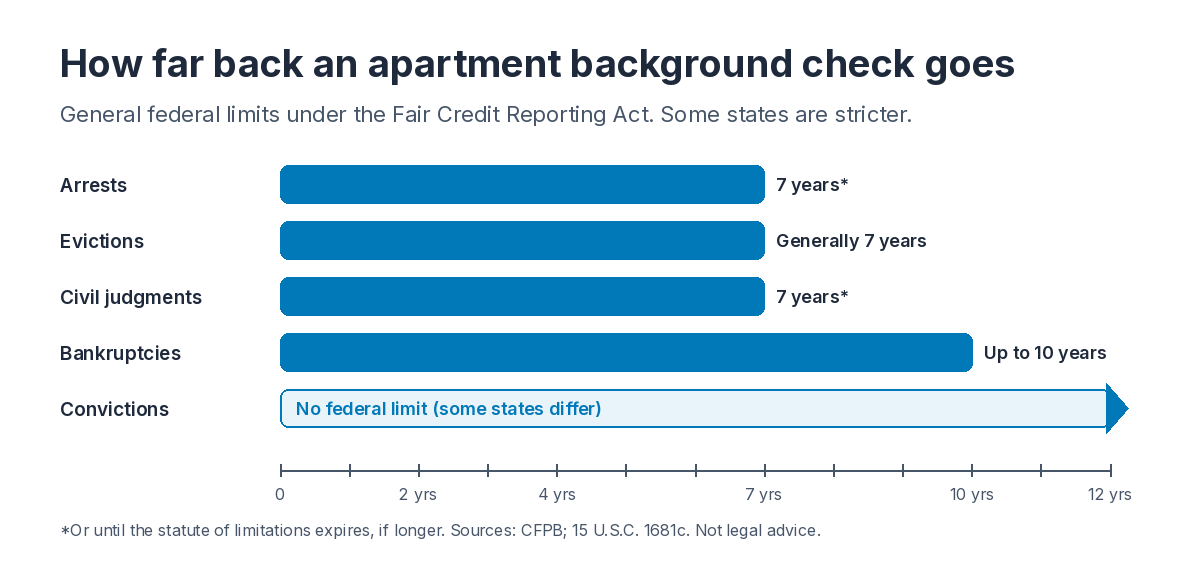
Under federal law (15 U.S.C. 1681c), most negative information can be reported for seven years and bankruptcies for up to 10. The CFPB says criminal convictions have no federal time limit, though some states have different rules.
| Record | Federal limit | Source |
|---|---|---|
| Evictions and other negative information | Generally 7 years | CFPB |
| Arrests | 7 years from the date of entry, unless a longer statute of limitations applies | CFPB; 15 U.S.C. 1681c |
| Criminal convictions | No federal time limit (some states differ) | CFPB; 15 U.S.C. 1681c |
| Civil judgments | 7 years or until the statute of limitations expires, whichever is longer | CFPB; 15 U.S.C. 1681c |
| Bankruptcies | Up to 10 years | 15 U.S.C. 1681c |
| Sealed or expunged records | Shouldn’t appear | CFPB |
Sources: CFPB, Review your rental background check; 15 U.S.C. 1681c.
The CFPB says federal law generally bans negative information like evictions from your report after seven years. The CFPB’s rental background check guide says convictions have no federal time limit, though some states differ. Under 15 U.S.C. 1681c, bankruptcy cases can be reported for up to 10 years.
Some states go further. Minnesota’s Minn. Stat. 504B.173 bars landlords from denying an application based on a pending eviction action. The same statute also bars denials based on expunged or non-public court files, or evictions that didn’t end in a writ of recovery. Under Minn. Stat. 504B.241, Minnesota screening services must check court records online no more than 24 hours before issuing a report.
State enforcement backs these rules up. In September 2026, the New York Attorney General announced a $352,250 settlement after finding 203 tenants were illegally denied housing based on court history.
How long does an apartment background check take?
It typically takes one to three business days, though some landlords respond the same day. Timing depends on the landlord and the screening company, so it isn’t guaranteed.
Zillow says renters typically hear back about an apartment approval one to three business days after submitting a rental application. Zillow adds that it can take longer if the landlord needs more information or the check is delayed.
Common causes of delay include missing documents, income that takes time to verify and references who are slow to respond. To avoid them, send complete documents with your application and tell your references to expect a call.
Is a background check the same as a credit check?
No. A credit check is usually one part of a tenant screening report, which also covers other records.
The CFPB says tenant screening reports are different from credit reports. A credit report covers your credit activity, such as loan payments, according to the CFPB. The CFPB’s rental background check guide says most rental background checks include credit information from the big credit bureaus.
For score questions, see our guide on whether a rental credit check hurts your credit. If your credit needs work, see how to get approved for an apartment with bad credit.
Can you see your apartment background check before a landlord does?
You can see much of it. Check your credit reports for free and review what public records may show before you apply. Our guide on how to find apartments you qualify for shows how to compare your record with a landlord’s screening criteria.
The CFPB says you can get free credit reports from Equifax, Experian and TransUnion once a week at AnnualCreditReport.com. The CFPB’s list of consumer reporting companies covers tenant screening companies. It suggests checking your credit report for errors in advance.
Look for mistakes the CFPB flags in its rental background check guide. Examples include one eviction listed several times or a dismissed case not marked “dismissed.” Another is a paid debt still shown as owed.
What happens if your background check gets you denied?
You must get an adverse action notice, and you can get a free copy of the report and dispute errors. The notice names the screening company that supplied the report.
The FTC says landlords must give notice when they reject an applicant based partly or completely on a consumer report. Per the FTC, raising the rent or deposit or requiring a co-signer for that reason also counts, and notice can be written, electronic or oral. The FTC also says the notice is required even if the report played only a small part in the decision.
According to the FTC, the notice must name the company that supplied the report, with its address and phone number. The FTC says it must state the company didn’t make the decision and can’t give reasons. The same FTC guidance says it must explain your rights to dispute and to a free report requested within 60 days.
That 60-day free copy right comes from 15 U.S.C. 1681j. The CFPB says the screening company generally has 30 days to investigate a dispute, and 45 days in some cases. Under 15 U.S.C. 1681i, the 30-day period can be extended by up to 15 days if you send more information during it.
Errors do happen. In August 2026, the Justice Department announced a $2.25 million civil penalty against screening company RentGrow over alleged accuracy and dispute failures.
To dispute, the CFPB suggests contacting the screening company and the source of the information. Describe the error in writing and include supporting documents.
How does Apartment One’s screening work for renters?
Apartment One is an online platform where renters complete a verified background and credit screening once, then get matched to rental properties they qualify for, while landlords list properties for free and receive pre-screened applicants.
The Tenant Fit Index (TFI) is Apartment One’s 0-100 score matching a renter to a property based on credit, income-to-rent ratio, eviction history, criminal history, and lifestyle preferences.
You screen once, with FICO 9 credit from Experian, eviction records and criminal records. Then you see your TFI for each property. Then you share one report instead of paying for a new check each time. Financial Stability Documents let you show bank funds, and in-app messaging lets you ask landlords questions.
Quick Screen costs $35, one-time, and Tenant Plus costs $60, one-time. Apartment One is FCRA-compliant and follows GLBA and CCPA data handling. Data is encrypted, and payments are processed through Stripe. Each landlord still makes its own decision.
Know what landlords will see before they see it. Screen once with Apartment One and share one report when you apply.
Frequently asked questions
How far back does an apartment background check go?
The CFPB says negative items like evictions are generally limited to seven years. Under 15 U.S.C. 1681c, bankruptcies can be reported for up to 10 years. The CFPB says criminal convictions have no federal time limit, though some states may have different rules.
How long does an apartment background check take?
Zillow says renters typically hear back one to three business days after applying. It can take longer if the landlord needs more information.
Do apartment background checks show arrests?
They can. The CFPB says arrests can stay on a report for seven years from the date of entry, unless a longer statute of limitations applies. State rules may be stricter.
Can I get a free copy of my tenant screening report?
Yes. If a landlord denies you or offers worse terms because of the report, you can get a free copy from the company named in the notice if you ask within 60 days.
What should I do if my background check has an error?
Dispute it in writing with the screening company and include supporting documents. The CFPB says the company generally has 30 days to investigate, and 45 days in some cases.
One Response