

Usually not. Most rental credit checks show up as soft inquiries, which don’t affect your credit score, according to TransUnion and Zillow. Some landlords do run hard inquiries. myFICO says a single new hard inquiry often lowers a FICO Score by less than five points. Ask which type a landlord uses before you apply.
Does a rental credit check hurt your credit? It’s one of the most common worries for apartment hunters, especially if you plan to apply to several places. This guide explains soft and hard inquiries, how long they last and how to limit credit pulls while you search.
If this is your first rental, start with our guide on how to rent your first apartment.
This article is general information, not financial or legal advice.
What’s the difference between a soft and a hard credit inquiry?
A hard inquiry can lower your credit score, while a soft inquiry can’t. The Consumer Financial Protection Bureau (CFPB) defines an inquiry as a request to look at your credit report. Housing is one of the purposes it lists, along with credit, employment and insurance.
Hard inquiries “will impact your credit score,” the CFPB says. That’s because most scoring models look at how recently and how often you apply for credit.
Soft inquiries “will not affect your credit scores,” according to the CFPB. Only you can see them, when you review your own credit report.
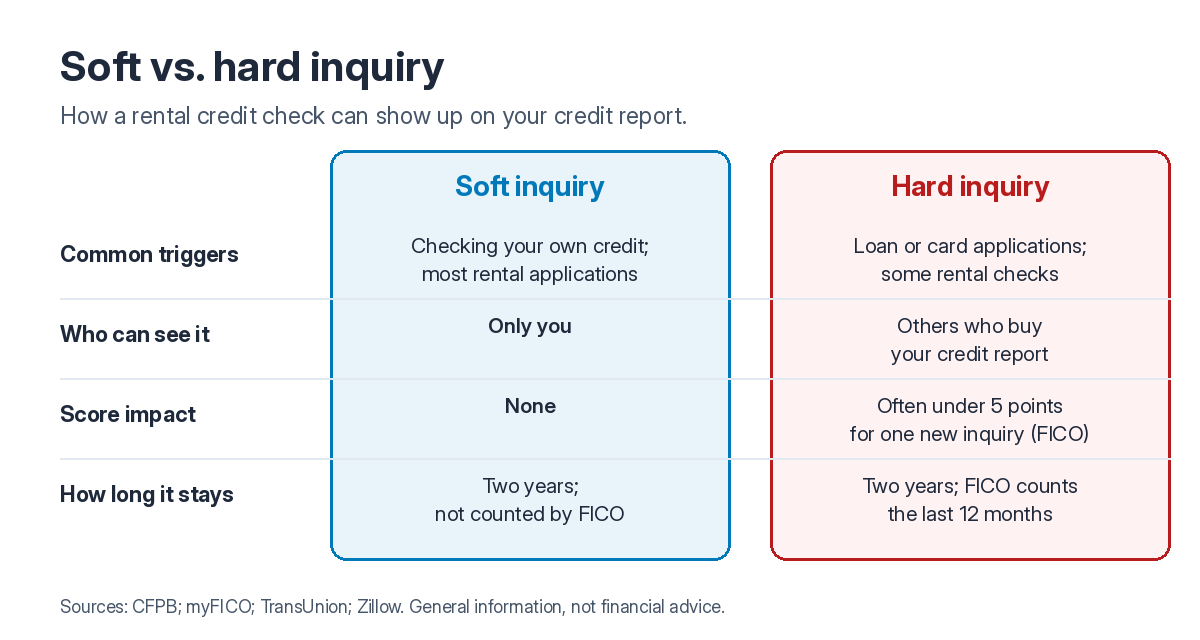
Timing matters too. myFICO says both types of inquiries stay on your credit report for two years. FICO Scores don’t consider soft inquiries, and only hard inquiries from the last 12 months can affect them.
| Soft inquiry | Hard inquiry | |
|---|---|---|
| Common triggers | Checking your own credit; most rental applications (TransUnion, Zillow) | Applying for a loan or credit card; some rental checks |
| Who can see it | Only you (CFPB) | Others who buy your credit report (CFPB) |
| Score impact | None (CFPB) | Often less than 5 points for one new inquiry (myFICO) |
| How long it stays | Two years; not counted by FICO (myFICO) | Two years; FICO counts the last 12 months (myFICO) |
Do landlords do a hard or soft credit check?
Most landlord credit checks show up as soft inquiries, but some can be hard. TransUnion says rental applications “typically” appear on your TransUnion credit report as soft inquiries, which don’t impact your score.
Still, TransUnion says a rental credit check “may result in a hard inquiry depending on the credit reporting agency and landlord.”
myFICO puts it in similar terms. Landlord checks generally don’t affect FICO Scores, “but some of them might.”
In a July 30, 2025 guide, Zillow called hard inquiries for apartment rentals “fairly rare.”
You can’t choose the inquiry type, but you can ask about it. Before you pay a fee, ask the landlord which type of check they run and which company runs it.
How many points does a hard inquiry take off?
Usually only a few. myFICO says one new hard inquiry generally has a minor effect, “often a decrease of less than five points.”
The effect also fades with time. Hard inquiries can affect FICO Scores only for 12 months, according to myFICO.
Other habits carry more weight. According to myFICO, paying on time, keeping utilization low and using your accounts matter more than new inquiries.
Does a rental credit check hurt your credit if you apply to multiple apartments?
Not if every landlord runs a soft check. Zillow says you could apply to 20 apartments that use soft inquiries, and your score shouldn’t change.
Hard checks work differently. TransUnion suggests you “bunch” your applications together. Some scoring models count several hard inquiries for one type of application as a single inquiry. They have to happen within a short time span.
Don’t count on that for rentals, though. Zillow notes that this grouping typically applies to loan-related credit checks and is less common in rental screening.
So the best protection is to ask first. Then apply only where you meet the landlord’s written criteria.
How long does a rental credit check stay on your report?
Two years. myFICO says both hard and soft inquiries stay on your credit report for two years.
Only hard inquiries count toward FICO Scores, and only for the first 12 months, according to myFICO.
Lenders and other buyers of your credit report won’t see a soft inquiry. The CFPB says soft inquiries are shown only to you.
What else in a tenant screening affects you more than the inquiry?
What your report says usually matters more than the check itself. Most rental background checks include credit information, such as overdue bills, says the CFPB’s rental background check guide.
The CFPB tells renters to look for common errors. Examples include overdue bills that belong to someone else and debts that were paid off but still show as owed.
Rental background checks can also include eviction and criminal records. The CFPB’s checklist covers those too, such as an eviction that was dismissed but isn’t marked “dismissed.”
Worried about low credit? Read our guide on how to get approved for an apartment with bad credit.
If an eviction is holding you back, see how to rent an apartment with an eviction.
How can you limit credit pulls while apartment hunting?
Plan your search so your credit gets checked as few times as possible. These five steps help:
- Check your own reports first. You can check each bureau’s report free once a week at AnnualCreditReport.com, says the Federal Trade Commission (FTC). The CFPB says your own requests are soft inquiries.
- Ask about the inquiry type. Ask each landlord whether the credit check is soft or hard, and which company runs it.
- Apply only where you meet the criteria. Read the written income, credit and rental history requirements before you pay.
- Keep your applications close together. If any checks are hard, TransUnion says bunching them can limit the impact.
- Screen once and share one report. Ask each landlord whether they’ll accept a report you already have, since some run their own check.
Application fees add up as well. Our guide to rental application fees covers typical costs and how to avoid paying for one screening after another.
What are your rights if a credit check leads to a denial?
You have the right to be told and to see the report. The CFPB says landlords must tell you if your report led them to deny you or charge a higher deposit or fee.
According to the CFPB, the landlord must also name the company that created the report and give its address and phone number.
You can get a free copy of that report if you ask within 60 days. Both the CFPB and the FTC confirm this right.
Found an error? The CFPB says to dispute it with the screening company and with the business that supplied the information. Describe the error in writing and include copies of supporting documents.
How does Apartment One’s screening work?
Apartment One lets you complete one screening and share the report with landlords.
Apartment One is an online platform where renters complete a verified background and credit screening once, then get matched to rental properties they qualify for, while landlords list properties for free and receive pre-screened applicants.
The Tenant Fit Index (TFI) is Apartment One’s 0-100 score matching a renter to a property based on credit, income-to-rent ratio, eviction history, criminal history, and lifestyle preferences.
Screening covers FICO 9 credit from Experian, eviction records and criminal records. Quick Screen costs $35 one-time and gives you a credit, eviction and criminal report. Tenant Plus costs $60 one-time and adds a full renter profile, your Tenant Fit Index and in-app messaging.
If your credit is low, Financial Stability Documents let you show your bank funds as well. Learn more about our tenant screening report or compare plans on the pricing page.
Apartment One is FCRA-compliant and follows GLBA and CCPA data handling. Payments run through Stripe, and your data is encrypted.
Tired of paying for a new screening every time you apply? Screen once with Apartment One and get one report you can share with landlords.
Frequently asked questions
Does a rental background check show up on my credit report?
The credit check part can show up as an inquiry. TransUnion says rental applications typically appear on its reports as soft inquiries. The CFPB says soft inquiries are visible only to you.
Will checking my own credit before I apply lower my score?
No. The CFPB says requests for your own credit reports are soft inquiries, which will not affect your credit scores.
Can a landlord run my credit without permission?
A landlord needs a permissible purpose to get your consumer report. The FTC says landlords may get reports on rental applicants. Landlords may also get written permission from applicants to show a permissible purpose.
How many apartment applications is too many?
There’s no set number. Ask each landlord which type of credit check they run, and apply only where you meet the written criteria.
How much does Apartment One cost for renters?
Quick Screen costs $35 one-time, and Tenant Plus costs $60 one-time. Both are one-time payments, not subscriptions.
One Response