

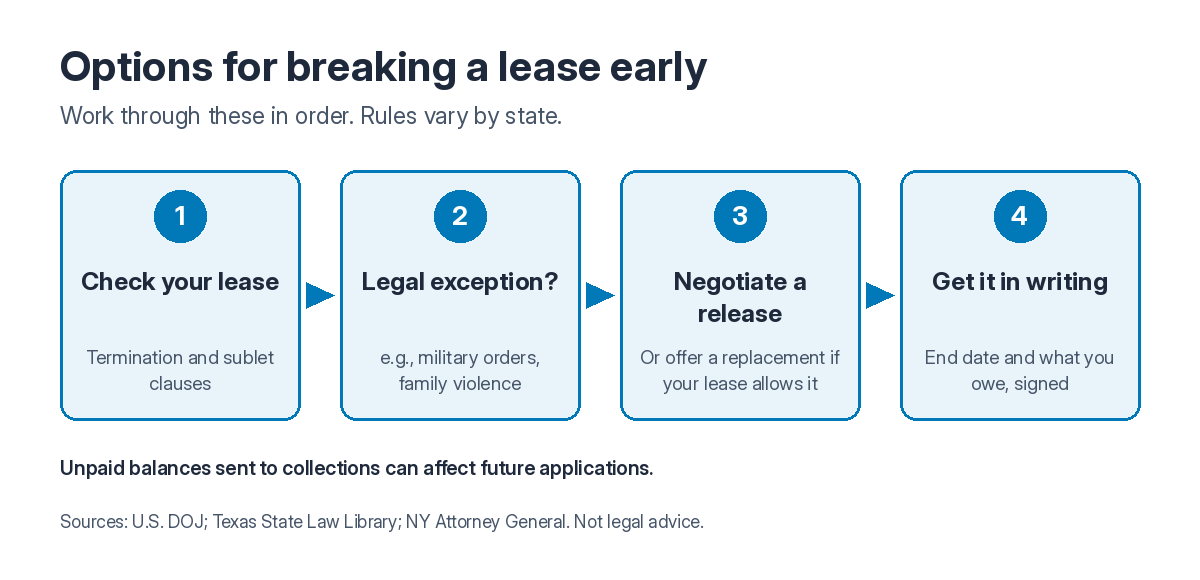
To learn how to break a lease safely, start with your lease’s early-termination clause, then check whether a legal exception covers you, such as military orders or family violence. If neither applies, ask your landlord for a written release. Pay what you agree to owe, because unpaid balances sent to collections can follow you to your next rental application.
This is general information, not legal advice. Lease-termination rules depend on your lease and on federal, state and local law. For help with your situation, contact a local legal aid office or a tenant attorney.
How to break a lease legally: what are your options?
You can end a lease early, but it usually has a cost unless your lease or a law says otherwise. The Texas State Law Library explains that a Texas tenant who leaves early for a reason not covered by statute keeps owing rent until the lease ends or a new tenant is found. Other states follow their own rules, so treat any example in this guide as a starting point.
A lease is a contract. Breaking it early is different from being evicted, but both can create a debt that affects your next application if you don’t settle it.
What should you check in your lease first?
Read your lease before you talk to your landlord. Look for these clauses and note the exact wording:
- Early-termination clause: whether the lease lets you leave early, and what notice and payment it requires.
- Notice requirements: how and to whom notice must be sent, such as in writing or through a portal.
- Reletting or re-rental fees: any fee for finding a new tenant.
- Subletting and assignment: whether you can bring in a replacement, and whether the landlord must approve.
- Military clause: extra rights for servicemembers, which are common near military bases.
- Concessions: whether a move-in discount must be repaid if you leave early.
The Texas State Law Library notes that a lease may set the exact fees a landlord can charge when it ends early. That is why the clause matters more than any general rule.
When can you break a lease without penalty?
Some situations give tenants a legal right to end a lease early. The table shows examples from official sources, not a complete list.
| Situation | Federal or state example | What you need |
|---|---|---|
| Military service | Federal SCRA: lease signed before entering service, or PCS or deployment orders for at least 90 days | Written notice plus a copy of orders or a commanding officer’s letter |
| Family violence | Texas Property Code § 92.016; New York domestic violence rule | Written notice (30 days in both examples) and documentation |
| Sexual abuse or stalking | Texas Property Code § 92.0161 | Documentation and 30 days’ written notice |
| Age 62+ or disability, moving to care or senior housing | New York | Written notice and proof of the move |
| Unit is unsafe or unlivable | Varies by state | Ask legal aid before you stop paying or move out |
Sources: U.S. Department of Justice; Texas State Law Library; New York Attorney General.
For servicemembers, the U.S. Department of Justice says the SCRA also covers retirement or separation orders, and notice may be sent electronically, by mail or by hand. The same DOJ page says that for monthly rent, the lease ends 30 days after the next rent payment is due. DOJ also treats demands to repay rent concessions as an early-termination fee that violates the SCRA. Military OneSource suggests contacting your installation legal office with questions.
In New York, the Attorney General’s tenant guide says a domestic violence victim must send notice at least 30 days before leaving and provide documents within 25 days of sending it. The same guide covers tenants 62 or older, or living with a disability, who move to an adult care facility, a residential health care facility or senior housing.
Rules vary by state. If you think a legal exception applies, contact legal aid or a tenant attorney before you move.
Does your landlord have to re-rent the unit?
In some states, yes. The Texas State Law Library explains that Texas Property Code § 91.006 requires a landlord to mitigate damages by trying to find a new tenant. A lease clause that waives this duty is void. The library also notes that courts generally allow a “reasonable” reletting fee.
New York has a similar rule. The New York Attorney General says a landlord must make a good-faith effort to fill the vacancy. Once a new tenant pays equal or higher rent, your lease is considered terminated. Don’t assume every state works this way, so check your state’s rules.
How do you negotiate a lease release with your landlord?
These are practical steps, not legal requirements. They often make the conversation easier:
- Give notice early. The more lead time your landlord has, the easier it is to re-rent.
- Offer a solution. Propose a move-out date and offer to help find a replacement, if your lease allows it.
- Ask about the costs. Ask what you would owe, including any fee in your lease.
- Get it in writing. Ask for a signed release that states the end date and what you owe.
- Keep records. Save emails, payment receipts and move-out photos.
Subletting is not automatic. The Texas State Law Library says Texas tenants can’t sublet without the landlord’s permission.
Will breaking a lease hurt your credit or rental history?
It can, if an unpaid balance goes to collections or court. Experian says landlords don’t report broken leases to the credit bureaus. Instead, a landlord usually affects your credit report by sending unpaid debt to a collection agency.
The Texas State Law Library warns that collections or a lawsuit “can make it more difficult to rent in the future.” Tenant screening reports can reach beyond credit, too. The FTC says screening reports can describe rental history based on reports from previous landlords or housing court records.
So the safest path is a written agreement and a paid balance. If a past lease already led to a court case, see our guide to renting with an eviction.
What happens to your security deposit when you break a lease?
Your landlord may deduct amounts allowed by your state’s law and your lease, then return the rest. In New Mexico, § 47-8-18 of the state’s Owner-Resident Relations Act requires an itemized written list of deductions and the balance within 30 days after the tenancy ends. For other states, see our guide to security deposit laws.
The Texas State Law Library says a Texas landlord doesn’t have to refund the deposit until you give a written forwarding address. Use this move-out checklist wherever you live:
- Give your forwarding address in writing.
- Clean the unit and take dated photos or video of every room.
- Return all keys and ask for a receipt.
- Ask for a move-out inspection if your landlord offers one.
Where should you live next if your plans are uncertain?
If you don’t know how long you’ll stay in your next city, a flexible lease can help you avoid breaking another one. Our guide to month-to-month rentals covers how those leases work.
Apartment One also offers Short-Term Rentals for $35 per month, with monthly re-screening. If this is your first apartment on your own, our guide on how to rent your first apartment walks through the basics.
How does Apartment One help when you’re moving on short notice?
Apartment One is an online platform where renters complete a verified background and credit screening once, then get matched to rental properties they qualify for, while landlords list properties for free and receive pre-screened applicants.
The Tenant Fit Index (TFI) is Apartment One’s 0-100 score matching a renter to a property based on credit, income-to-rent ratio, eviction history, criminal history, and lifestyle preferences.
When you’re moving fast, you screen once and share one report with landlords instead of paying for a new screening every time you apply. Your screening covers FICO 9 credit from Experian, eviction records and criminal records. Financial Stability Documents let you show bank funds, which may help if your credit is low. Apartment One doesn’t remove or hide past rental history, and each landlord makes its own decision.
Quick Screen costs $35, one-time, and Tenant Plus costs $60, one-time, according to our pricing page. You can also browse rentals from our renters page. Wondering how a rental screening affects your credit? Read does a rental credit check hurt your credit.
Moving sooner than planned? Screen once with Apartment One and share one report with your next landlord. Need something flexible? Try Short-Term Rentals with monthly re-screening.
Frequently asked questions
How much does it cost to break a lease?
It depends on your lease, your state and whether a legal exception applies. Check your lease for an early-termination clause or reletting fee. The Texas State Law Library notes that a Texas reletting fee must be reasonable.
Do I have to pay rent for the rest of the lease?
Not always. In Texas and New York, landlords must try to re-rent the unit, which can reduce what you owe. Until a new tenant moves in or your lease ends, you may still owe rent, so get any agreement in writing.
Will a broken lease show up on a background check?
It can. The FTC says tenant screening reports can include rental history from previous landlords or housing court records. Experian says collections, not the broken lease itself, are the main way it reaches your credit report.
Can I break a lease if I’m buying a house?
Buying a home isn’t one of the legal exceptions covered in this guide. You would usually rely on your lease’s early-termination clause or a written agreement with your landlord, so ask early.
How much does Apartment One cost for renters?
Quick Screen costs $35, one-time, and Tenant Plus costs $60, one-time. Short-Term Rentals cost $35 per month, with monthly re-screening.
2 Responses