

If you think you have bed bugs, do not panic or self-treat with foggers. Confirm the infestation with physical signs or a professional, tell your landlord in writing right away with dates and photos, and follow the treatment prep instructions. Who pays and what your landlord must do depend on your state, city and lease.
General information, not legal or medical advice. Landlord duties for bed bugs depend on your state, city, and lease. Check local housing rules or a legal-aid office, and use licensed pest professionals.
How do you know if you have bed bugs in your apartment?
Look for physical signs on bedding and furniture. Bites alone are a poor indicator.
The EPA page on how to find bed bugs (updated September 8, 2026) says it is best to find an infestation early because treating a minor one is far less costly and easier than treating a widespread one. Other insects, such as carpet beetles, can be mistaken for bed bugs.
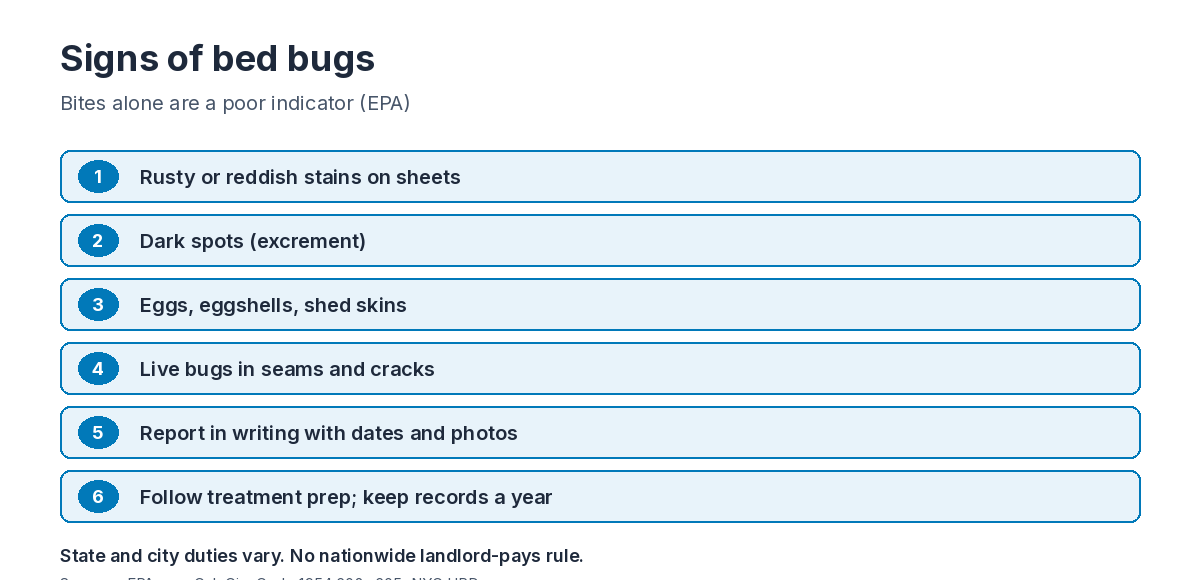
According to the EPA, bites on the skin are a poor indicator of a bed bug infestation, because bites can look like other insect bites, rashes or hives, and some people do not react at all. Look for rusty or reddish stains on sheets or mattresses from crushed bed bugs; dark spots of excrement; eggs and eggshells (about 1mm, pale yellow) and shed skins; and live bed bugs.
Where do bed bugs hide in an apartment?
They hide in cracks and seams near where people sleep, and in heavier infestations they spread to furniture and walls.
The EPA says that around the bed they hide near the piping, seams and tags of the mattress and box spring and in cracks on the bed frame and headboard. Heavier infestations can be in chair and couch seams, curtain folds, drawer joints, electrical receptacles and appliances, under loose wallpaper, and where wall meets ceiling. The EPA’s line: “If a crack will hold a credit card, it could hide a bed bug.”
Should you tell your landlord about bed bugs?
Yes. Notify your landlord in writing as soon as you suspect them, so nearby units can be checked and treatment can start.
The EPA DIY bed bug control page says that if an expert confirms bed bugs, notify your landlord if you live in an apartment, that units near yours should be inspected, and that landlords may have a responsibility to participate in treatment depending on local housing codes and laws. Keep records of dates and exact locations through the whole process, and keep checking for at least a year.
On the landlord side, EPA guidance for landlords advises emphasizing quick reporting and says “Don’t blame the tenant for the problem, since often there is no fault involved,” because a culture of blame can delay reporting.
A short written report you can adapt (suggestion, not a legal form):
On [date], I found [stains / dark spots / insects] at [location in the unit]. I am reporting a suspected bed bug infestation and ask you to arrange an inspection. I can be reached at [phone/email]. Photos are attached.
Does your landlord have to treat bed bugs?
It depends on your state and city. EPA notes that 21 states have some bed bug law or regulation, mostly aimed at hotels and landlords. California and New York City examples below are labeled state- or city-specific.
The EPA bed bug laws page (updated January 6, 2026) says EPA regulates bed bug pesticides, but its jurisdiction does not include the reporting and management regulations states have. It says 21 states have some level of law or regulation that applies to bed bugs, nine of them enacted since 2005, with requirements focused mostly on hotels and landlords or other property managers.
California (state-specific): Civil Code section 1954.602 says a landlord shall not show, rent or lease to a prospective tenant any vacant dwelling unit the landlord knows has a current bed bug infestation. The section does not impose a duty to inspect without notice, but an infestation evident on visual inspection counts as notice. Section 1954.603 requires a written bed bug notice (at least 10-point type) before creating a new tenancy, covering general information, the importance of cooperation and prompt written reporting, and how to report. Section 1954.605 says the landlord must notify tenants of inspected units of the pest control operator’s findings in writing within two business days of receiving them; for confirmed infestations in common areas, all tenants get notice.
New York City (city-specific): NYC HPD’s bedbugs page says tenants should report bed bugs to the property owner; if the owner does not address it, file a complaint online or call 311. HPD issues a violation if the inspector visually confirms live bed bugs. The Housing Maintenance Code and Health Code require owners to address infestations promptly. New York State law requires owners to hire only DEC-licensed pest control professionals to treat apartments for bed bugs. Under Local Law 69 of 2017, owners of multiple dwellings file an annual bed bug report and must give tenants the filing receipt at a new lease or renewal or post it, plus distribute or post the DOHMH “Stop Bed Bugs Safely” guide.
Who pays for treatment is not a nationwide rule. Check your lease and local law. Withholding rent over bed bugs can backfire in some states, so check your state’s rules first. For early exit questions, see how to break a lease.
How do you prepare for bed bug treatment and stop them spreading?
Follow the treatment plan, bag laundry and belongings carefully, and do not move furniture around the building or to the curb unmarked.
The EPA DIY page says treating bed bugs is complex and can take weeks to months. Collect a sample to show an extension agent or other insect expert. Use mattress and box spring encasements (protective covers that seal); seal infested items in plastic bags; vacuum and immediately throw the sealed bag in an outdoor trash container; do not discard furniture you can safely treat; and if you discard it, mark or destroy it so others do not take it.
The EPA protecting-your-home page adds that bed bugs travel on furniture, bedding, luggage, boxes and clothing, can survive several months to a year without feeding, and that a dryer on high heat can kill bed bugs. In multi-family homes, door sweeps and sealing cracks around baseboards and light sockets can discourage movement between units.
If the landlord needs to enter for treatment, see can a landlord enter without notice.
How do you avoid bringing bed bugs to your next apartment?
Check secondhand furniture, reduce clutter and be careful with shared laundry and luggage.
According to the EPA, check secondhand furniture before bringing it home, transport laundry in plastic bags, and use high heat in the dryer. Document the unit’s condition when you move; see our move-in inspection checklist and how to rent your first apartment.
How does Apartment One fit in for renters?
Apartment One lets you screen once and share one report when you search for your next place. See apartments I qualify for.
Apartment One is an online platform where renters complete a verified background and credit screening once, then get matched to rental properties they qualify for, while landlords list properties for free and receive pre-screened applicants.
Screening covers credit (FICO 9 from Experian), eviction and criminal records. Quick Screen is $35 one-time for a screening report only, and Tenant Plus is $60 one-time for screening plus access to matched property listings. Pricing can vary by state.
The Tenant Fit Index (TFI) is Apartment One’s 0-100 score matching a renter to a property based on credit, income-to-rent ratio, eviction history, criminal history, and lifestyle preferences. The TFI is a tool used alongside written criteria, not a ranking or a decision-maker.
Apartment One is FCRA-compliant and follows GLBA and CCPA data handling. Data is encrypted, and payments are processed through Stripe.
Screen once, then apply with a shareable report.
Frequently asked questions
Are bites proof of bed bugs?
No. The EPA says bites are a poor indicator because they can look like other rashes and some people do not react.
Can I treat bed bugs myself?
The EPA says treatment is complex and can take weeks to months. Confirm the pest, notify your landlord, and cooperate with the treatment plan rather than relying on foggers.
Can a California landlord rent me a unit with bed bugs?
Not a vacant unit the landlord knows is currently infested. Civil Code 1954.602 bars showing, renting or leasing such a unit.
Who do I call in NYC if my landlord ignores bed bugs?
NYC HPD says to file a complaint online or call 311 if the owner does not address the problem.
Is this legal advice?
No. Check local housing rules or a legal-aid office, and use licensed pest professionals.