

Can my landlord enter without notice? Usually only in an emergency. How much notice you get for repairs, showings or inspections depends on your state and your lease. Examples include 24-hour rules in Minnesota and New Mexico, Virginia’s 72-hour routine-maintenance rule, California’s presumed-reasonable notice, and Texas, where the lease controls.
General information, not legal advice. Check your state and local law.
Can my landlord enter without notice?
Usually only in an emergency; for routine repairs, showings and inspections, most states that regulate entry require notice, and your lease may add rules even where the state does not.
Under Minnesota Statutes section 504B.211, a landlord may enter only for a reasonable business purpose and after a good faith effort to give at least 24 hours’ notice, except when immediate entry is needed to prevent injury to people or property, to check a tenant’s safety, or to comply with local ordinances on unlawful activity.
Under Virginia Code section 55.1-1229(A)(4), the landlord may enter without consent in an emergency; otherwise, unless impractical, the landlord must give notice and enter only at reasonable times.
Under NMSA 47-8-24, unless otherwise agreed, an owner must give 24 hours’ written notice of intent, purpose, date and a reasonable time frame. Notice is not required for repairs or services within seven days of a resident’s request, or when accompanied by a public official or utility or cable representative, and entry without consent is allowed in an emergency.
Under California Civil Code section 1954, reasonable written notice must give the date, approximate time and purpose, with entry during normal business hours. Twenty-four hours is presumed reasonable (six days if mailed). No notice is needed for an emergency, if the tenant is present and consents, or after abandonment.
According to the Texas State Law Library FAQ on landlord entry, Texas has no state law that regulates landlord entry, so the lease controls, with common exceptions for emergencies or repairs described in that FAQ.
How much notice does a landlord have to give?
It depends on your state: Minnesota and New Mexico generally require 24 hours’ written or good-faith notice, Virginia requires at least 72 hours for unrequested routine maintenance, California presumes 24 hours’ written notice is reasonable, and Texas leaves notice to the lease.
Under Minnesota Statutes section 504B.211, the notice must specify a time or anticipated window, and the landlord may enter only between 8:00 a.m. and 8:00 p.m. unless the parties agree otherwise.
Under Virginia Code section 55.1-1229, unless impractical, the landlord must give at least 72 hours’ notice of routine maintenance the tenant did not request; if the tenant requested the maintenance, notice is not required under that provision.
The Texas State Law Library says there are no state laws that regulate landlord entry in Texas, and that your lease may or may not require prior notice.
| State | Notice required (examples) | Emergency / no-notice entry | Source |
|---|---|---|---|
| Minnesota | At least 24 hours; time or window; 8 a.m.-8 p.m. unless agreed | Immediate entry to prevent injury, check safety, or local-ordinance compliance | Minn. Stat. 504B.211 |
| Virginia | Notice at reasonable times; at least 72 hours for unrequested routine maintenance | Emergency entry without consent | Va. Code 55.1-1229 |
| New Mexico | 24 hours’ written notice (intent, purpose, date, time frame), unless otherwise agreed | Emergency; also exceptions for requested repairs within 7 days and official/utility accompaniment | NMSA 47-8-24 |
| California | Reasonable written notice; 24 hours presumed (6 days if mailed); normal business hours | Emergency; tenant present and consents; abandonment | Cal. Civ. Code 1954 |
| Texas | No statewide notice statute; lease controls | FAQ notes emergencies or repairs as common situations | TX State Law Library |
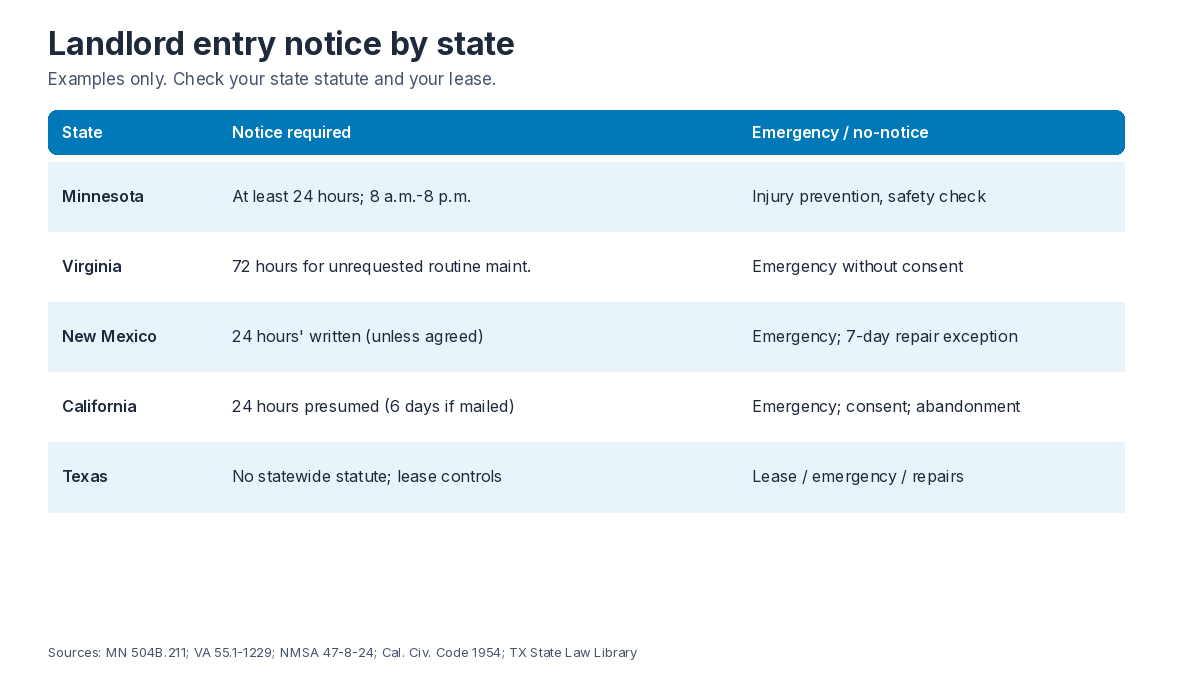
These are examples, not a fifty-state survey. Check your state statute and your lease.
What counts as an emergency?
Statutes usually define emergency as a situation that needs immediate entry to protect people or property, not as a convenient time for a landlord to drop by.
Under Minnesota Statutes section 504B.211, subdivision 4, a landlord may enter without prior notice if immediate entry is needed to prevent injury to persons or property, to check a tenant’s safety, or to comply with local ordinances on unlawful activity in the unit.
Virginia Code section 55.1-1229(A)(4) allows entry without the tenant’s consent “in case of emergency,” and still says the landlord may not abuse the right of access or use it to harass the tenant.
NMSA 47-8-24 allows entry without consent in an emergency and says the owner shall not abuse the right of access.
A scheduled filter change or a showing is not an emergency. Ask for a short written note of what happened and when they entered.
Can my lease change the notice rules?
Sometimes: Minnesota forbids waiving notice as a lease condition, New Mexico applies “unless otherwise agreed,” and Texas leaves entry to the lease.
Under Minnesota Statutes section 504B.211, a tenant may not waive the right to prior notice of entry as a lease condition, and the landlord may not require that waiver.
Under NMSA 47-8-24, the 24-hour written notice rule applies unless otherwise agreed, but the owner still may not abuse the right of access.
The Texas State Law Library FAQ says there is no state statute on entry, so you should check the lease carefully for when the landlord may enter and whether notice is required.
Before you sign, use our lease agreement checklist to find the entry clause. If this is your first rental, see how to rent your first apartment.
What can you do if your landlord keeps entering without notice?
Check your lease, ask for notice in writing, keep a dated log, and contact your state attorney general or a local tenant group.
- Re-read the entry clause and any state rule that applies to your address.
- Send a short written request asking for the notice your lease or state law requires, and keep a copy.
- Log each entry with the date, time, who entered and whether you got notice.
- Contact your state attorney general consumer or housing unit, or a local tenant/legal aid group, for next steps where you live.
In Texas, the State Law Library says courts treat quiet enjoyment as implied in every lease, which a landlord may breach by entering more often than necessary, at unreasonable times, or against the lease.
Under Minnesota Statutes section 504B.211, subdivision 6, a violation can bring remedies that may include a rent reduction up to lease rescission, deposit recovery (less lawful deductions), and up to a $500 civil penalty per violation. Outcomes still depend on the facts.
Under NMSA 47-8-24, a resident may seek injunctive relief or terminate, plus damages, for unlawful or unreasonable entry.
If the dispute escalates toward ending the tenancy, see our guide on how to break a lease. Do not change locks or withhold rent based only on this article.
How does Apartment One fit in?
Apartment One helps you screen once and keep landlord-renter communication in writing through in-app messaging. You still decide where to apply.
Apartment One is an online platform where renters complete a verified background and credit screening once, then get matched to rental properties they qualify for, while landlords list properties for free and receive pre-screened applicants.
Screening covers credit (FICO 9 from Experian), eviction and criminal records. You can share your report with landlords instead of paying for a new check with every application.
The Tenant Fit Index (TFI) is Apartment One’s 0-100 score matching a renter to a property based on credit, income-to-rent ratio, eviction history, criminal history, and lifestyle preferences. The TFI is a tool used alongside written criteria, not a ranking or a decision-maker.
Quick Screen is $35 one-time for a screening report only, and Tenant Plus is $60 one-time for screening plus access to matched property listings. Pricing can vary by state.
Apartment One is FCRA-compliant and follows GLBA and CCPA data handling. Data is encrypted, and payments are processed through Stripe.
Know your rights before you sign, and rent where you qualify. Screen once and see your matches.
Frequently asked questions
Can my landlord enter when I’m not home?
It depends on your state and lease. Under Minnesota Statutes section 504B.211, if the landlord enters when the tenant is not present and prior notice was not given, the landlord must leave a written disclosure of the entry in a conspicuous place.
Can maintenance come in without notice if I asked for a repair?
Often yes for that work. In Virginia, if the tenant requests maintenance, notice is not required for that work. Under NMSA 47-8-24, notice is not required for repairs or services within seven days of a resident’s request. Check your statute and lease.
Is 24 hours’ notice required everywhere?
No. Minnesota and New Mexico commonly use 24-hour rules, California presumes 24 hours’ written notice is reasonable, Virginia uses 72 hours for unrequested routine maintenance, and Texas has no statewide entry statute, so the lease controls.
Can a landlord show my apartment to new renters?
Often yes, with notice. Minnesota Statutes section 504B.211 lists showing the unit to prospective tenants as a reasonable business purpose, and Virginia Code section 55.1-1229 says the tenant may not unreasonably withhold consent for exhibiting the unit to prospective tenants.
Can I refuse entry?
Not always. Virginia Code section 55.1-1229 says the tenant shall not unreasonably withhold consent for inspections, repairs, services or showings. Refusing without a good reason can create its own lease problem.
2 Responses