

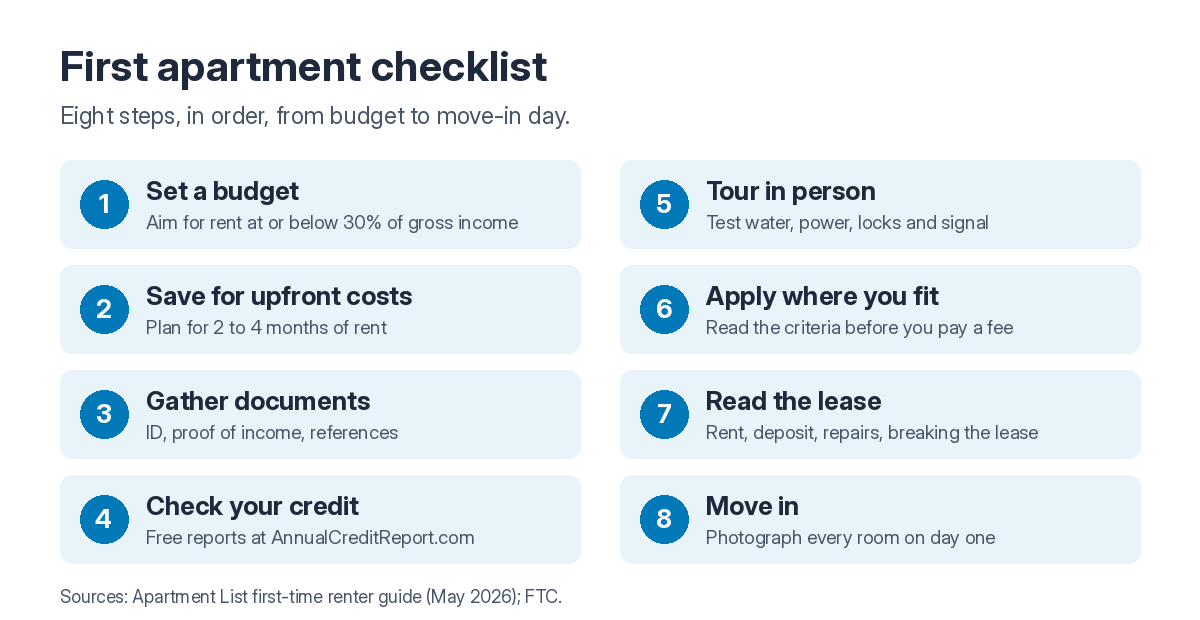
To rent your first apartment, set a budget, save for upfront costs, gather your ID and proof of income, check your credit, and start looking about two months before you move. Then tour in person, apply to places you’re likely to qualify for, and read the lease before you sign. This checklist walks through each step.
Learning how to rent your first apartment is easier when you know the order of the steps. You’re also in good company. Harvard’s Joint Center for Housing Studies reports in America’s Rental Housing 2026 that Gen Z added 6.7 million renter households between 2019 and 2024.
The same report says Gen Z now heads 10.4 million renter households, or 23% of all renters.
This guide is general information, not legal or financial advice. Rules vary by state and city.
How to rent your first apartment: what documents do you need?
Most landlords want a photo ID, proof of income and a credit check. Many also ask for references, rental history or a co-signer if you’re new to renting.
Apartment List’s first-time renter guide (May 29, 2026) lists a credit score, proof of income such as pay stubs or a W-2, and references as common requirements.
Here is a starter folder to build before you apply:
- Photo ID: a driver’s license, state ID or passport.
- Proof of income: recent pay stubs, a W-2, an offer letter or bank statements.
- References: an employer, a professor or a past roommate who can vouch for you.
- Rental history: past addresses and landlord contacts, if you have any.
- Co-signer details: if a parent or guardian will back your lease.
Scan everything into one folder on your phone. When the right place opens up, you can apply the same day.
How much money should you save before renting?
Plan for more than the first month’s rent. A deposit, fees and moving costs can add up fast.
Apartment List’s first-time renter guide suggests budgeting two to four months’ rent for upfront costs.
The same guide recommends keeping rent at or below 30% of your gross income. For example, a $1,200 apartment would mean setting aside roughly $2,400 to $4,800 before you move.
That cushion usually covers some mix of these costs:
- First month’s rent and a security deposit
- Application fees for each place you apply
- Utility setup or deposits
- Movers or a rental truck
- Basics like a bed, cleaning supplies and kitchen items
Need help with the math? Our guide on how much rent you can afford walks through the 30% rule and the 3x income rule.
How old do you have to be to rent an apartment?
In most states, you must be 18 to sign a lease on your own. A few states set the age higher.
Apartment List’s first-time renter guide says the age is 19 in Alabama and Nebraska and 21 in Mississippi.
If you’re younger than that, or you have no credit or income history yet, a co-signer may help. A co-signer agrees to pay if you can’t, so pick someone who understands that risk.
When should you start looking for your first apartment?
Start about 60 to 90 days before your move-in date. That gives you time to save, tour and apply without rushing.
Apartment List’s first-time renter guide recommends starting at least 60 days ahead.
Use the first few weeks to pick neighborhoods and set a firm price limit. Then save searches and check new listings often. Good units in busy markets can go quickly.
Not sure you want a 12-month lease? Read our guide to month-to-month rentals to weigh the trade-offs.
How do you check your credit before applying?
Pull your free credit reports and look for errors before a landlord sees them. It’s free, and it gives you time to fix problems.
The Federal Trade Commission’s free credit reports page says you can get free weekly reports from each of the three bureaus at AnnualCreditReport.com.
The FTC calls AnnualCreditReport.com the only authorized website for these free reports. You can also order by phone at 1-877-322-8228.
Check that every account is yours and every balance is correct. If you find a mistake, dispute it with the bureau that reported it.
Thin or damaged credit isn’t the end of the road. Our guide to getting approved with bad credit covers co-signers, deposits and other options.
What should you check when you tour an apartment?
Look past the paint. Test what you’ll use every day, and ask about costs that aren’t in the rent.
- Water: run the taps and shower, and check the water pressure and how fast it gets hot.
- Power: flip light switches and try a few outlets.
- Climate: ask how the unit is heated and cooled, and test it.
- Doors and windows: make sure they open, close and lock.
- Pests and damp: look under sinks and in closets for droppings, stains or a musty smell.
- Cell signal: check it in each room.
- Noise: listen for traffic, neighbors or nearby businesses.
- Costs: ask which utilities you’ll pay and whether there are parking, pet or amenity fees.
- Photos: take pictures so you can compare places later.
If you can, visit at night too. A quiet street at noon can feel very different at 10 p.m.
How do you apply without paying fee after fee?
Apply only where you meet the listed criteria, and ask what each fee covers before you pay. Fewer, better-targeted applications cost less.
Apartment List’s first-time renter guide puts typical application fees at $25 to $100 per applicant.
Those fees add up if you apply to five or six places. A few habits help:
- Read the income, credit and pet rules before you apply.
- Ask whether the landlord accepts a screening report you already have.
- Have your documents ready so you don’t lose a unit to a slower applicant.
Our guide to rental application fees explains typical costs and the states that cap them.
What should you look for in your first lease?
A lease is a binding contract, so read every page before you sign. Ask questions about anything you don’t understand.
This is general education, not legal advice. Pay close attention to these terms:
- Rent and due date: the amount, the grace period and any late fees.
- Lease length: the start and end dates, plus what happens at renewal.
- Deposit: how much it is and what can be deducted when you leave.
- Repairs: how to request them and who pays for what.
- Breaking the lease: the notice you’d need and any fees.
- Rules: guests, pets, subletting and quiet hours.
Get every promise in writing, such as a new appliance or fresh paint. On move-in day, photograph each room and note any damage. Those photos can help when you ask for your deposit back.
How do you avoid rental scams on your first apartment?
Never pay money or share sensitive details before you’ve seen the unit and agreed to rent it. First-time renters are frequent targets.
The FTC reported on December 22, 2025 that people ages 18 to 29 were three times more likely than older adults to report losing money to a rental scam.
The FTC’s rental listing scams page says a landlord doesn’t need your Social Security number or credit score until you’ve agreed to rent a place.
Watch for rent far below similar units, pressure to pay fast, and requests for wire transfers, gift cards or crypto. Search the address online to see whether the same unit appears with a different price or contact.
How does Apartment One help first-time renters?
Apartment One lets you screen once and share that report, instead of starting over for every unit. You also see how well each property fits your profile.
Apartment One is an online platform where renters complete a verified background and credit screening once, then get matched to rental properties they qualify for, while landlords list properties for free and receive pre-screened applicants.
The Tenant Fit Index (TFI) is Apartment One’s 0-100 score matching a renter to a property based on credit, income-to-rent ratio, eviction history, criminal history, and lifestyle preferences.
Your tenant screening covers FICO 9 credit from Experian, eviction records and criminal records. Tenant Plus costs $60 one time and adds a full profile, matched rentals and in-app messaging. Quick Screen costs $35 one time and gives you a shareable screening report.
No thick credit file yet? Financial Stability Documents let you show bank funds, which may help you qualify. Each landlord still sets its own criteria and makes the final decision. Compare plans on our pricing page.
Renting for the first time? Screen once with Apartment One, see your Tenant Fit Index, and get matched to rentals you’re likely to qualify for.
Frequently asked questions
Can I rent an apartment with no rental history?
Yes, many first-time renters do. Offer other proof that you’ll pay, such as pay stubs, an offer letter, bank statements, references or a co-signer. Each landlord sets its own rules.
Do I need a co-signer for my first apartment?
Not always. A co-signer can help if your income, credit or age falls short of a landlord’s criteria. The co-signer agrees to pay if you don’t, so both of you should read the lease.
Do I need renters insurance?
Some landlords require it, and it’s worth having either way. Apartment List’s first-time renter guide puts renters insurance at about $10 to $20 a month.
How long does it take to get approved for an apartment?
It varies by landlord and by how fast you return documents and references. Having your ID, income proof and references ready helps you avoid delays.
How much does Apartment One cost for renters?
Quick Screen is a $35 one-time screening report. Tenant Plus is $60 one time and adds a full profile, matched rentals and in-app messaging. See the pricing page for current details.
5 Responses