

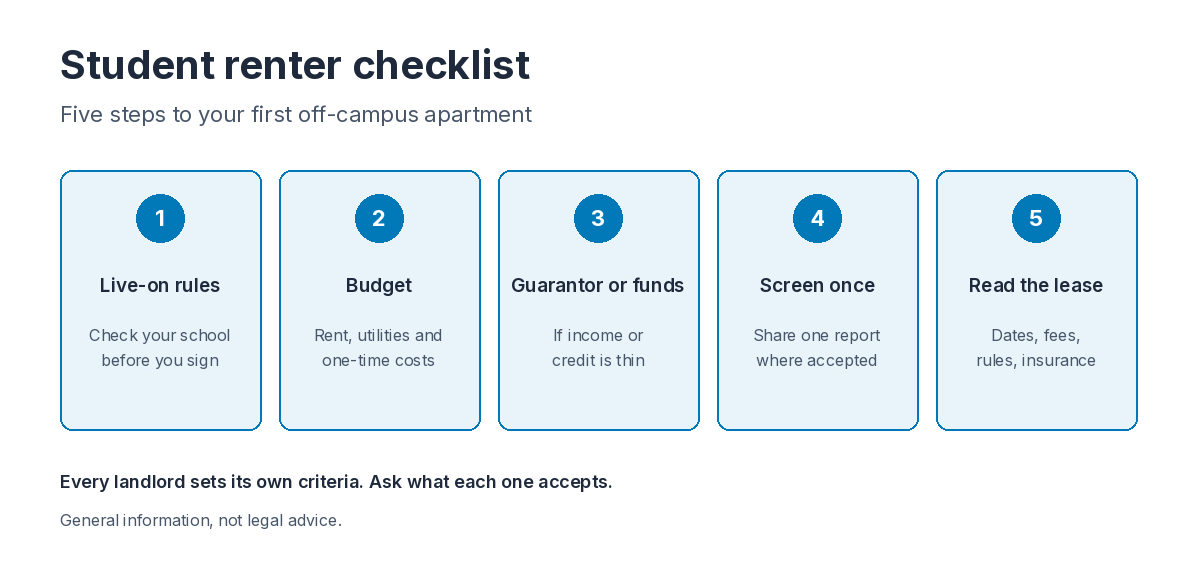
Yes. To rent a college student apartment off campus, you need to meet the landlord’s written criteria. First check whether your school requires you to live on campus. Then budget, line up a guarantor or proof of funds if your income or credit is thin, screen once, and read the lease before you sign.
General information, not legal advice.
Can you rent a college student apartment off campus?
Yes. Landlords look at whether you meet their written rental criteria, and students can qualify in several ways even with little income or credit history.
Most students rent with one or more of these: a part-time job, savings or family support, a guarantor who signs for them, or roommates who share the rent. The sections below cover each one.
If this is your first lease ever, start with our step-by-step guide on how to rent your first apartment. This guide focuses on what is different for students.
Do you have to live on campus first?
It depends on your school, so check your school’s live-on rule before you sign anything off campus. At New Mexico State University, NMSU Housing and Residential Life says first-time, full-time undergraduates admitted to the Las Cruces campus “will be required to live in a university-operated residence hall for the first academic year, or two semesters.”
Once your live-on year is done, you can plan the move. Look at your class schedule, campus parking or transit, and how far you want to commute before you start your search.
Many schools publish exemptions, so read your housing office’s page and ask before you commit. Signing a lease you can’t use could leave you paying for two places.
If you are looking near NMSU, see our page on apartments for rent in Las Cruces, NM.
What do landlords look for in a student applicant?
Landlords usually look at income, credit and rental history, the same as for any applicant. Students often have less of each, which is why a guarantor or proof of funds can help.
- Income: Pay stubs, an offer letter, or other proof you can cover your share of rent
- Credit: Your credit history, which may be short or empty if you are new to credit
- Rental history: Past leases or landlord references, if you have them
- Background: Eviction and criminal records, depending on the landlord’s criteria
A landlord needs a permissible purpose to pull a screening report on you. Under 15 U.S.C. 1681b, one such purpose is a report furnished “in accordance with the written instructions of the consumer to whom it relates,” which means your written authorization.
To see what these reports include, read our guide to what a background check for an apartment shows.
How do you qualify with little income or credit?
You can often qualify with a guarantor, proof of savings or funds, or roommates who share the rent. Ask each landlord which options they accept.
A guarantor is someone, often a parent, who agrees to cover the rent if you can’t. Our guide on how a guarantor for an apartment works explains what landlords ask of guarantors.
If your credit is low, Apartment One’s Financial Stability Documents let you show bank funds so you can qualify on savings instead.
If you don’t have pay stubs, our guide on how to rent an apartment without proof of income covers other ways to show you can pay.
Build a simple budget before you apply. Add up rent, utilities, internet, renters insurance, groceries and transportation. Then compare that total with what you can reliably cover each month.
Plan for one-time costs too. A security deposit, application fees, moving help and basic furniture can add up before your first rent payment is even due.
Gather your documents early so you can apply quickly when you find a place:
- Government-issued photo ID
- Proof of enrollment, if a landlord asks
- Pay stubs, an offer letter or bank statements
- Your guarantor’s contact details, if you have one
- Names and phone numbers of past landlords or references
Should you rent with roommates?
Roommates can make rent more affordable, but choose them carefully and agree on who signs the lease. Ask the landlord whether every roommate must be on the lease and must qualify.
Before you commit, talk through money, schedules and house rules. Our guide on how to screen a roommate lists the questions to ask and what to put in writing.
Think about timing, too. Many student leases run 12 months, while the school year is shorter. Ask whether the landlord allows subletting over the summer or offers a lease that ends closer to the spring semester.
If the landlord requires every roommate to qualify, a roommate with a guarantor or stronger credit may change who signs and how. Settle that before anyone pays a deposit.
How do you avoid paying application fee after application fee?
Screen once and share your report instead of paying for a new report with every application. Ask each landlord whether they accept a shared report before you apply.
Application fees add up fast when you apply to several places. Our guide to rental application fees explains what landlords charge and what to ask.
Apartment One is an online platform where renters complete a verified background and credit screening once, then get matched to rental properties they qualify for, while landlords list properties for free and receive pre-screened applicants.
The Tenant Fit Index (TFI) is Apartment One’s 0-100 score matching a renter to a property based on credit, income-to-rent ratio, eviction history, criminal history, and lifestyle preferences. The TFI is a tool used alongside each landlord’s written criteria, not a ranking or a decision-maker.
Quick Screen is $35 one-time for a screening report only, and Tenant Plus is $60 one-time for screening plus access to matched property listings. Pricing can vary by state.
Apartment One is FCRA-compliant and follows GLBA and CCPA data handling. Data is encrypted, and payments are processed through Stripe.
What should you check before signing a lease?
Read the whole lease and confirm the rent, dates, fees and rules before you sign. Ask about anything you don’t understand, and get the answers in writing.
- Lease start and end dates, and whether they fit your academic calendar
- Rent, due date, late fees and how to pay
- Security deposit amount and move-out conditions
- Who pays which utilities
- Rules on guests, subletting over breaks, pets and parking
- Renters insurance requirements
Before you sign, tour the apartment in person or by live video before you pay anything. Our guide to rental scams explains how to spot fake listings and protect your deposit.
Use our lease agreement checklist as you read. If the lease mentions insurance, our guide on whether a landlord can require renters insurance explains what to expect.
Screen once and see the off-campus rentals you qualify for.
Frequently asked questions
Can I use financial aid to pay rent?
Ask your school’s financial aid office. They can explain how your aid package applies to housing costs and when funds are released.
Do I need a cosigner to rent as a student?
Not always, but many students use one when income or credit is limited. Ask the landlord what they require, and see our guide on guarantors for apartments.
When should I start looking for an off-campus apartment?
Start once you know your school’s live-on rules and your move-in date. Give yourself time to budget, line up a guarantor or proof of funds, and compare listings.
Can international students rent an apartment?
Yes, but requirements vary by landlord. Ask each landlord what documents they accept for identity, income and credit history.
What is Federal Work-Study?
According to Federal Student Aid, Federal Work-Study provides part-time jobs for undergraduate and graduate students with financial need. Ask your financial aid office whether you are eligible.