

A guarantor for an apartment is someone who signs a legal promise to pay your rent and other lease costs if you don’t. Landlords often ask for one when your income, credit or rental history falls short of their written criteria. A guarantor usually needs strong income and credit, and doesn’t live in the unit.
General information, not legal advice.
What does a guarantor for an apartment do?
A guarantor backs your lease financially. If you miss rent or owe for damage, the landlord can turn to the guarantor to pay what the guaranty covers.
The guarantor usually signs a separate document called a guaranty, or a guarantor section inside the lease. That document sets out what they’re responsible for and for how long. A guarantor doesn’t get the right to live in the unit.
For the landlord, a guarantor adds a second person who can pay. For you, it can be the difference between a conditional approval and a denial.
What’s the difference between a guarantor and a cosigner?
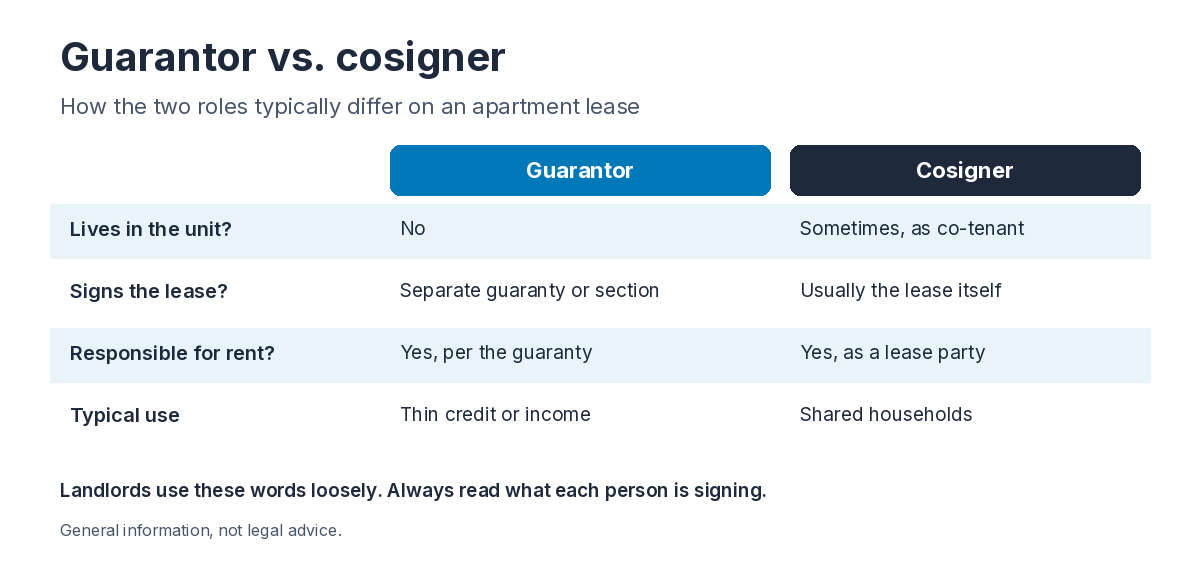
A guarantor usually backs the lease without living there, while a cosigner often signs the lease as a co-tenant. In practice, landlords use the two words loosely, so read the document to see what each person is actually agreeing to.
| Question | Guarantor (typical) | Cosigner (typical) |
|---|---|---|
| Lives in the unit? | No | Sometimes; often signs as a co-tenant |
| Signs the lease? | Usually signs a separate guaranty or guarantor section | Usually signs the lease itself |
| Responsible for rent? | Yes, as set out in the guaranty | Yes, as a party to the lease |
| Typical use | Students, first-time renters, thin credit or income | Shared households or added financial backing |
Who can be a guarantor, and what do they need?
A guarantor is usually a parent, relative or close friend with steady income and good credit. The landlord sets the requirements, and the guarantor typically goes through the same screening you do.
Expect a guarantor to provide:
- Government-issued photo ID
- Proof of income, such as pay stubs, tax returns or an employment letter
- Permission for a credit and background check
- A completed guarantor application and a signed guaranty
Some landlords set income rules for guarantors. For example, a New York City lease application page on the Feil Organization’s website says a guarantor “needs to show an income of 80x the monthly rent,” compared with 40x for applicants. That’s one building’s requirement, not a law or a citywide rule. High income multiples like this are a local market habit, so check each landlord’s written criteria.
Requirements can go beyond income. Kaled Management’s application requires guarantors to have a minimum credit score of 750 and their primary residence in New York.
Fees can apply to guarantors too. The same Kaled Management application charges an additional $20 processing fee when a guarantor is required. New York caps these fees: N.Y. Real Prop. Law 238-a(1)(b) limits background and credit check fees to “the actual cost of the background check and credit check or twenty dollars, whichever is less.”
The same New York law says the landlord “shall waive the fee or fees if the potential tenant provides a copy of a background check or credit check conducted within the past thirty days.”
Why would a landlord ask you for a guarantor?
A landlord usually asks for a guarantor when your application doesn’t fully meet their criteria but is close. It’s often a conditional approval rather than a denial.
Common triggers include income below the landlord’s income-to-rent requirement, limited or low credit, no rental history, or being a student without steady income.
If the request was based on a screening or credit report, you have rights. The FTC says landlords who “require a co-signer” based partly or completely on a consumer report must give the applicant an adverse action notice. Under 15 U.S.C. 1681m(a), that notice must name the reporting company and explain your right to a free copy of the report.
Our adverse action notice guide explains what that notice should contain.
What if you don’t have anyone to be your guarantor?
You still have options. Ask the landlord which alternatives they accept, then offer the one that fits your situation best. If you’ve already been turned down, our guide on what to do when your rental application is denied explains your next steps.
- An institutional guarantor service. These companies act as your guarantor for a fee. Some properties work with them directly; for example, The Verge in Las Cruces lists a “Leap Guarantor Option” among its amenities. Read the service’s terms and fees before you sign up.
- A larger security deposit, where your state’s limits allow it. Our guide to security deposit laws covers state caps.
- Proof of funds. Bank statements showing savings can reassure a landlord when your income or credit is thin.
- A roommate on the lease whose income counts toward the rent.
For more options, see our guides to getting approved for an apartment with bad credit and renting an apartment without proof of income. First-time renters can also start with our guide on how to rent your first apartment.
What should a guarantor know before signing?
A guarantor should know exactly what they’re promising to pay and for how long before they sign. A guaranty is a legal commitment, so it’s worth reading closely and getting advice if anything is unclear.
- What it covers. Rent only, or also damage, fees and legal costs?
- How long it lasts. Does it end with the current lease, or carry into renewals?
- Any cap. Is there a maximum amount, or is it unlimited?
- Notice. Will the landlord tell the guarantor if rent is late?
- Copies. Ask for signed copies of both the guaranty and the lease.
When you ask someone, come prepared. Share the lease terms, the monthly rent, your income and your budget. Explain how you plan to pay rent on time and what you’d do if your income changed. Give them time to read the guaranty before they commit.
Talk openly with the person you ask. They’re trusting you with their finances, and a clear plan for paying rent protects both of you.
How can you show you qualify without a guarantor?
Know your screening results before you apply, and apply where you already meet the landlord’s criteria. That way, you’re less likely to be asked for a guarantor in the first place.
Apartment One is an online platform where renters complete a verified background and credit screening once, then get matched to rental properties they qualify for, while landlords list properties for free and receive pre-screened applicants. The Tenant Fit Index (TFI) is Apartment One’s 0-100 score matching a renter to a property based on credit, income-to-rent ratio, eviction history, criminal history, and lifestyle preferences. The TFI is a tool used alongside each landlord’s written criteria, not a ranking or a decision-maker.
If your credit is low, Apartment One’s Financial Stability Documents let you qualify on bank funds. You can share one report with landlords instead of starting over. Quick Screen is $35 one-time for a screening report only, and Tenant Plus is $60 one-time for screening plus access to matched property listings. Pricing can vary by state, so check Apartment One’s pricing page. Each landlord still makes its own decision, and some may still ask for a guarantor.
Apartment One is FCRA-compliant and follows GLBA and CCPA data handling. Data is encrypted, and payments are processed through Stripe.
Show landlords where you stand before they ask for a guarantor. Screen once with Apartment One, add Financial Stability Documents if your credit is thin, and share one report.
Frequently asked questions
Can a parent be a guarantor from another state?
Often yes, but it depends on the landlord. Some require local guarantors; for example, Kaled Management’s application requires a guarantor’s primary residence to be in New York. Ask before your parent applies.
Does being a guarantor affect your credit?
A guarantor agrees to pay if the tenant doesn’t, so the landlord can pursue the guarantor for amounts the guaranty covers. The guarantor should read the guaranty and ask the landlord how unpaid amounts are handled.
Can a landlord require a guarantor from everyone?
Landlord policies vary, so check your state and local rules. Whatever the policy, the Fair Housing Act at 42 U.S.C. 3604(b) bars different terms because of race, color, religion, sex, familial status or national origin. It also bars discrimination because of disability under 42 U.S.C. 3604(f).
Can I remove a guarantor later?
It depends on the guaranty and the landlord. If your income or credit improves, ask the landlord in writing whether they’ll release the guarantor at renewal, and get any release in writing.
Do students need a guarantor?
Many students are asked for one because they have little income or rental history. Some student housing offers alternatives; The Verge in Las Cruces lists a guarantor service option among its amenities.
2 Responses