

Many landlords accept a guarantor as an alternative path when an applicant misses one written criterion, such as income. A good cosigner policy for landlords is written down, applied the same way to every applicant, and checked against local rules, because some places limit guarantor requirements for voucher holders.
General information, not legal advice.
Should landlords accept a cosigner or guarantor?
Often, yes, as long as you offer it under a written policy and apply it consistently. A guarantor gives you a second person who agrees to cover the rent if the tenant doesn’t, which can let you say yes to an applicant who is otherwise a good fit.
Students, first-time renters, people new to the area and people with a short credit history often have limited income or credit history on paper. A guarantor option keeps those applicants in your pool without lowering your standards for everyone.
The risk is inconsistency. If you offer a guarantor to one applicant and not to another in the same situation, you invite questions about fairness. The fix is a short written policy that says exactly when a guarantor is accepted and what the guarantor must show.
If you’re a renter, see our guide to getting a guarantor for an apartment.
What’s the difference between a cosigner and a guarantor?
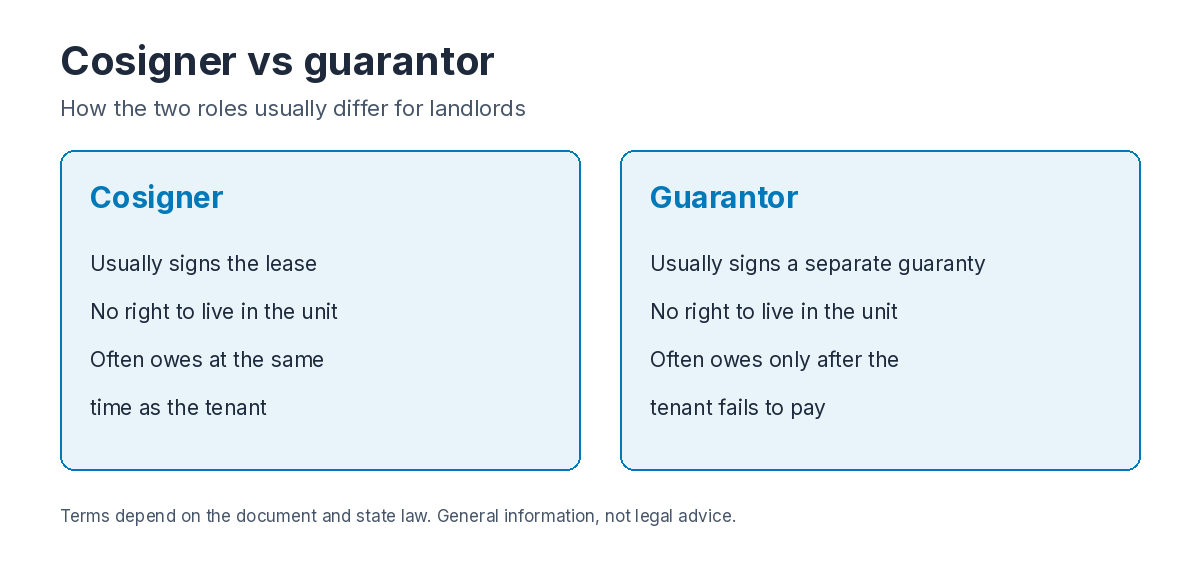
A cosigner usually signs the lease itself, while a guarantor usually signs a separate guaranty that backs up the tenant’s obligations. In everyday use people mix the two terms, so your documents matter more than the label.
| Cosigner | Guarantor | |
|---|---|---|
| What they sign | Usually the lease itself | Usually a separate guaranty agreement |
| Right to live in the unit | Usually none, even though they signed | None |
| When they owe money | Often at the same time as the tenant | Often only after the tenant fails to pay |
| What to define in writing | Their share of obligations and how long it lasts | What the guaranty covers, its limit and how long it lasts |
Terms depend on the document and on state law, so have your lease and guaranty reviewed for your state. Whatever you call the role, define it in writing.
When should you offer a guarantor option?
Offer a guarantor when an applicant meets your other written criteria but falls short on one financial standard, such as income or credit history. Tie the option to your written screening criteria so the trigger is the same for every applicant.
For example, your policy might say: “If an applicant meets all criteria except the income standard, the applicant may add a qualified guarantor.” That one sentence tells everyone, including your leasing staff, when the option applies.
Decide in advance whether a guarantor can cover other gaps, such as a thin credit file. Also decide whether you accept other paths, such as a larger amount of savings shown in bank statements. Write each path down.
Apply the same guarantor policy to every applicant. The Fair Housing Act, 42 U.S.C. 3604(b), makes it unlawful to discriminate in the terms, conditions or privileges of rental because of race, color, religion, sex, familial status or national origin. Section 3604(f) separately prohibits discrimination in rental because of a handicap.
Our guide to tenant screening criteria explains how to write the standards your guarantor policy builds on.
How do you screen a guarantor?
Get the guarantor’s own written authorization, then check their income, credit and identity against the guarantor standards in your policy. Treat the guarantor as a separate applicant for screening purposes.
Under the Fair Credit Reporting Act, 15 U.S.C. 1681b(a)(2), a consumer report may be furnished “in accordance with the written instructions of the consumer to whom it relates.” Get a signed authorization from the guarantor too, not just the tenant.
Set your own guarantor standards and write them down. You might set a higher income standard for guarantors than for tenants, because the guarantor is paying their own housing costs as well. Whatever you choose, use the same standard for every guarantor.
- Identity: Confirm the guarantor is who they say they are.
- Income: Verify it the same way you verify a tenant’s income.
- Credit: Review it against your written guarantor standard.
- Location: Decide whether you accept guarantors who live in other states.
For income checks, see our guide on how to verify tenant income. For the full screening process, see our guide to tenant background checks for landlords.
Where are guarantor requirements limited?
Some cities and states limit what you can require of renters who use housing vouchers or subsidies, and those limits can rule out a guarantor requirement. Check your state and local law before applying a guarantor rule to a voucher holder.
In New York City, the NYC Commission on Human Rights landlord FAQ says that when a voucher program calculates a tenant’s rent portion based on income, imposing additional income requirements violates the NYC Human Rights Law, and “You may not require guarantors or co-signers.”
The same NYC Commission on Human Rights FAQ says that requiring a specific credit score from a voucher holder “is evidence of discrimination.”
In Maryland, the Maryland Department of Housing and Community Development says that since October 1, 2026, when an applicant will pay rent with help from an income-based housing subsidy, a provider generally may not refuse to rent based on the applicant’s income, credit score or lack of one, or adverse credit history from when they didn’t have the subsidy. The DHCD notice adds that providers may verify income for the portion of rent the subsidy doesn’t cover.
The Maryland notice does not mention guarantors. Our reading, not the notice’s: if you can’t turn down a subsidy renter over income or credit, a guarantor requirement triggered by income or credit shouldn’t be used as a workaround.
In California, SB 267 (Chapter 776, Statutes of 2023), which amended Government Code section 12955(o), makes it unlawful, where there is a government rent subsidy, to use an applicant’s credit history without offering the option to provide lawful, verifiable alternative evidence of reasonable ability to pay their portion of the rent, such as government benefit payments, pay records or bank statements.
Under SB 267, if the applicant elects that option, the housing provider must give reasonable time to provide the evidence and reasonably consider it in lieu of credit history. The bill also makes it unlawful to use income standards not based on the tenant’s portion of the rent, while owners may still verify employment, request landlord references and verify identity.
If you rent to voucher holders, our guides to becoming a Section 8 landlord and renting to HUD-VASH tenants cover the program side.
What should a cosigner policy for landlords say?
A guarantor policy should say when a guarantor is accepted, what the guarantor must qualify on, what they sign, how long the guaranty lasts and what happens at renewal. Keep it short enough to hand to every applicant.
- When it applies: The specific criteria a guarantor can make up for, such as income.
- Who qualifies: Your guarantor standards for income, credit and identity, set by you and applied to everyone.
- Consent: The guarantor signs a written authorization before you screen them.
- What they sign: The lease as a cosigner, or a separate guaranty, and what it covers.
- How long it lasts: The original lease term only, or renewals too.
- Renewal: Whether you re-check the guarantor or release them if the tenant now qualifies alone.
- Voucher and subsidy renters: A note that local law may limit guarantor requirements for these applicants.
Make sure the lease matches the policy. Our lease agreement checklist covers the terms to confirm before anyone signs.
How does Apartment One help?
Apartment One gives you pre-screened applicants and another way for renters to show they can pay, while you keep your own written criteria and guarantor policy. You make every decision.
Apartment One is an online platform where renters complete a verified background and credit screening once, then get matched to rental properties they qualify for, while landlords list properties for free and receive pre-screened applicants.
Screening covers credit (FICO 9 from Experian), eviction and criminal records. Renters with low credit can add Financial Stability Documents to qualify on bank funds, which may mean fewer applicants need a guarantor at all.
The Tenant Fit Index (TFI) is Apartment One’s 0-100 score matching a renter to a property based on credit, income-to-rent ratio, eviction history, criminal history, and lifestyle preferences. The TFI is a tool used alongside each landlord’s written criteria, not a ranking or a decision-maker.
Apartment One supports Section 8 rentals and VASH rentals too.
Apartment One is FCRA-compliant and follows GLBA and CCPA data handling. Data is encrypted, and payments are processed through Stripe.
List free on Apartment One and receive pre-screened applicants; renters can also qualify with Financial Stability Documents.
Frequently asked questions
Can a landlord require a cosigner?
In many places, a landlord can ask for a cosigner or guarantor under a written policy applied to everyone. Some cities and states limit this for voucher holders, so check your local law.
Can I require a guarantor from a Section 8 tenant?
Not in New York City, where the NYC Commission on Human Rights says you may not require guarantors or co-signers when a voucher program sets the tenant’s rent portion by income. Elsewhere, check your state and local law.
Do I need the guarantor’s permission to run a credit check?
Get it in writing. A landlord needs a permissible purpose under 15 U.S.C. 1681b, and the guarantor’s own written authorization under 1681b(a)(2) is the clearest one, so have every guarantor sign before you screen them.
Can a guarantor live out of state?
That is up to your policy. Decide whether you accept out-of-state guarantors, write it down and apply it the same way to everyone.
Does a guarantor have to sign the lease?
It depends on your documents. A cosigner usually signs the lease, while a guarantor usually signs a separate guaranty. Have your documents reviewed for your state.