

Landlords owe an applicant an adverse action notice whenever a tenant screening or credit report contributes, even slightly, to a denial or to an approval with tougher conditions, like a co-signer, a bigger deposit or higher rent. Under federal law, the notice names the screening company and explains the applicant’s rights.
This is general information, not legal advice; have an attorney review your notice template.
What is an adverse action notice for landlords?
An adverse action notice is the disclosure the Fair Credit Reporting Act (FCRA) requires when a consumer report contributes to a decision that goes against a rental applicant.
The FTC’s guide for landlords defines the term broadly: “An adverse action is any action by a landlord that is unfavorable to the interests of a rental applicant or tenant.” The duty itself comes from 15 U.S.C. 1681m(a), which applies to anyone who takes adverse action based in whole or in part on a consumer report.
For permissible purpose and what a screening report contains, see our guide to tenant background checks for landlords.
When do landlords have to send an adverse action notice?
You have to send one whenever a consumer report influences a denial or a conditional approval on worse terms.
According to the FTC, the notice is due if you reject an applicant, raise the rent or deposit, require a co-signer, or take any other adverse action based partly or completely on a consumer report. The CFPB’s list of consumer reporting companies says the same applies when an applicant is “conditionally accepted” with a co-signer, a larger deposit or higher rent than other applicants.
The report doesn’t have to be the main reason. The FTC says the notice is still required when the report was a minor factor and not the primary reason for your decision.
| Decision | Notice needed? | Why |
|---|---|---|
| You deny the application based in whole or in part on a screening or credit report | Yes | A denial is an adverse action under 15 U.S.C. 1681m(a) |
| You approve only if the applicant adds a co-signer or guarantor because of the report | Yes | Approval on worse terms counts (FTC, CFPB) |
| You ask for a higher deposit than other applicants pay because of the report | Yes | Approval on worse terms counts (FTC, CFPB) |
| You charge higher rent than other applicants pay because of the report | Yes | Approval on worse terms counts (FTC, CFPB) |
| You approve on your standard terms | No | Nothing unfavorable happened to the applicant |
| You deny for a reason that has nothing to do with a consumer report | Not under 1681m(a) | Your state or city may still require a written reason |
As a best practice, treat borderline cases as needing a notice. For when a higher deposit is allowed at all, see our guide to security deposit laws. For setting conditional-approval rules in advance, see tenant screening criteria.
What must an adverse action notice include?
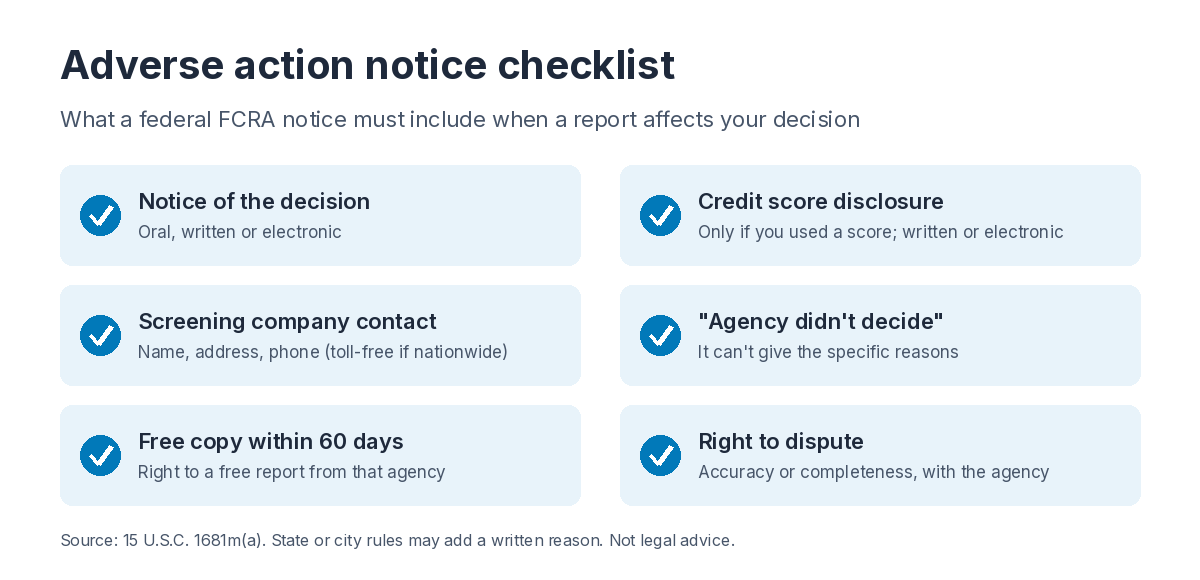
The notice must include four elements, and the second one applies only if you used a credit score. All four come from 15 U.S.C. 1681m(a).
- Notice of the decision. Tell the applicant that you took the adverse action. The statute allows this orally, in writing or electronically.
- Credit score disclosure, if you used a score. Give the numerical score in writing or electronically, along with the related score details.
- The reporting company’s contact details and a disclaimer. Give the name, address and phone number of the consumer reporting agency that furnished the report. Include a statement that the agency didn’t make the decision and can’t explain the specific reasons for it.
- The applicant’s rights. Explain the right to a free copy of the report from that agency, including the 60-day window, and the right to dispute its accuracy or completeness with the agency.
For nationwide agencies, the phone number must be toll-free under 15 U.S.C. 1681m(a)(3).
The score details are set out in 15 U.S.C. 1681g(f)(1): the range of possible scores, up to four key factors that hurt the score, the date the score was created, and who provided the score or the file it was based on. The FTC says the key factors must be listed in order of their importance based on their effect on the score.
What does a sample adverse action notice look like?
A sample notice is a one-page letter covering the decision, the reporting company, an agency statement, the applicant’s rights and an optional score block. The structure below follows the elements in 15 U.S.C. 1681m(a); it is a starting point, not a finished legal form.
Sample adverse action notice structure (fill in the brackets)
[Your name or company] | [Mailing address] | [Phone or email]
[Date]
To: [Applicant name], re: application for [property address, unit]
1. Decision. We have [declined your application] / [approved your application on these conditions: co-signer required / deposit of $[amount] / monthly rent of $[amount]]. This decision was based in whole or in part on information in a consumer report.
2. Reporting company. The report was furnished by [agency name], [street address], [phone number; toll-free number if it is a nationwide agency].
3. Agency statement. [Agency name] did not make this decision and cannot tell you the specific reasons for it.
4. Your rights. You have the right to a free copy of your report from [agency name] if you ask within 60 days of receiving this notice. You also have the right to dispute the accuracy or completeness of any information in the report directly with [agency name].
5. Credit score (include only if you used one). Score: [number]. Range of possible scores: [low] to [high]. Key factors that hurt the score: [factor 1], [factor 2], [factor 3], [factor 4]. Date created: [date]. Provided by: [source].
6. Reason or criteria not met (only if your state or city requires it). [Criterion from your written policy].
Have your attorney review your template before you use it.
Do states add extra requirements?
Yes, some states and cities add requirements on top of the FCRA, most often a written reason for the denial.
Minnesota adds a deadline when you charge a screening fee. Under Minn. Stat. 504B.173, a landlord who accepts an applicant screening fee must notify a rejected applicant within 14 days and identify the criteria the applicant failed to meet.
Seattle requires reasons. The City of Seattle’s screening guidance says landlords must give a written statement explaining why they are denying a rental application.
Maryland added a criminal-history process on October 1, 2026. Maryland’s Department of Housing and Community Development says that under the Fair Chance Housing Act, a provider that withdraws a conditional offer because of criminal history must give the reason and let the applicant request a reassessment. The same DHCD notice says the law covers providers with five or more units and authorizes penalties of up to $500 per violation.
Renters can read the other side of this process in our guide to renting an apartment with a criminal record.
How should you deliver the notice and keep records?
Deliver the notice in writing or electronically, even though federal law allows parts of it to be oral.
The FTC says that while oral adverse action notices are allowed under the FCRA, written notices are the best practice. Under 15 U.S.C. 1681m(a)(2), any credit score disclosure has to be in writing or electronic.
The text of 15 U.S.C. 1681m(a) doesn’t set a deadline, so a sensible habit is to send the notice at the same time you communicate the decision. State rules such as Minnesota’s 14-day limit can set a firm date.
A written procedure also protects you. Under 15 U.S.C. 1681m(c), a person isn’t liable for a violation of that section if they show they maintained reasonable procedures to assure compliance at the time.
These best practices help you show that kind of procedure:
- Use one template for every applicant.
- Send by email or a tenant portal that timestamps delivery, or by mail with a dated copy.
- Save a copy of each notice with the application file, the criteria you applied and the report you relied on.
- Keep records for as long as your attorney advises and any state rule requires.
What happens after the applicant gets the notice?
The applicant can request a free copy of the report and dispute errors with the reporting company. Our renter guide to what shows up on an apartment background check explains that side of the process.
Under 15 U.S.C. 1681j(b), the agency must provide a free copy if the applicant asks within 60 days after receiving the notice. Under 15 U.S.C. 1681i, the agency generally has 30 days to reinvestigate a dispute, extendable by up to 15 days if the applicant sends more information during that period.
Regulators are watching tenant screening. The Justice Department announced on Aug. 12, 2026 that screening company RentGrow will pay $2.25 million and accept an injunction to settle alleged FCRA violations.
How does Apartment One fit into your screening process?
Apartment One is an online platform where renters complete a verified background and credit screening once, then get matched to rental properties they qualify for, while landlords list properties for free and receive pre-screened applicants.
The Tenant Fit Index (TFI) is Apartment One’s 0-100 score matching a renter to a property based on credit, income-to-rent ratio, eviction history, criminal history, and lifestyle preferences.
You list free with Property Partner and receive pre-screened applicants, each with a TFI for your property. Screening covers FICO 9 credit from Experian, eviction records and criminal records. The TFI is a tool to use alongside your own written criteria, not a decision-maker.
Apartment One includes shareable reports and in-app messaging. Apartment One is FCRA-compliant and follows GLBA and CCPA data handling. Data is encrypted, and payments are processed through Stripe.
The notice duty stays with you. Under 15 U.S.C. 1681m(a), it falls on whoever takes the adverse action, so name the consumer reporting agency that furnished the report you relied on.
Make every screening decision consistent and documented. List your rental free on Apartment One and review pre-screened applicants against your own criteria.
Frequently asked questions
Do I need to send an adverse action notice if I require a co-signer?
Yes, if a consumer report contributed to that condition. The FTC lists requiring a co-signer as an adverse action, and the CFPB says the same about conditional acceptance with a co-signer.
Can an adverse action notice be given verbally?
Partly. Under 15 U.S.C. 1681m(a), the notice can be oral, written or electronic, but a credit score disclosure must be written or electronic. The FTC calls written notices the best practice.
Do I have to tell the applicant their credit score?
Yes, if you used a numerical credit score in the decision. Under 15 U.S.C. 1681m(a)(2), you must disclose the score with its range, key factors, date and source.
Do I have to explain why I denied the application?
Not under the FCRA, which requires the agency details and the applicant’s rights. Some places do require reasons, including Minnesota when you charge a screening fee and Seattle, so check your state and city rules.
Does it cost anything to list on Apartment One?
No. Property Partner listing is free for landlords.
3 Responses