

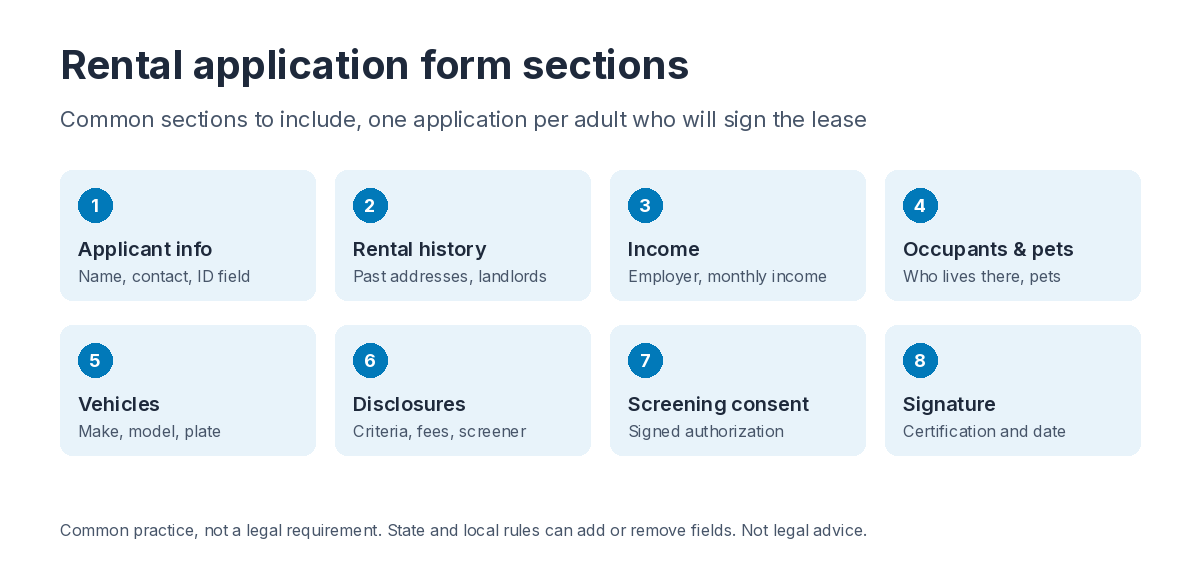
A rental application form should collect each adult applicant’s identity and contact details, rental history, employment and income, occupants, pets and vehicles, plus a signed screening authorization and your fee and criteria disclosures. Leave off questions tied to protected classes, and check state rules on ID numbers, fees and criminal-history questions.
This is general information, not legal advice; check your state and local law and have an attorney review your form.
What should a rental application form include?
A rental application form should include nine common sections, from applicant details to a signed certification. No single federal law lists required fields, so the checklist below reflects common practice, not legal requirements.
| Section | Fields | Why it matters |
|---|---|---|
| Applicant and co-applicant info | Full legal name, date of birth, phone, email, current address, ID number field (see state rules below) | Identifies each adult and lets you run screening on the right person |
| Rental history | Current and past addresses for a set period, landlord names and contact details, rent amounts, move-out reasons | Lets you check payment and lease history against your criteria |
| Employment and income | Employer, position, start date, monthly income, other income sources | Supports your income-to-rent standard |
| Occupants and pets | Names of everyone who will live in the unit; pet type, size and number | Confirms occupancy and pet policy fit |
| Vehicles | Make, model, plate number | Needed if you assign parking |
| Emergency contact | Name, relationship, phone | Gives you someone to reach in an emergency |
| Screening authorization and fee disclosure | Signed consent to screening, fee amount and what it covers, screening company name and address | Documents consent and gives fee transparency |
| Criteria acknowledgment | Link to or copy of your written criteria, with an initial box | Shows the applicant saw your standards first |
| Certification and signature | Statement that the information is true, signature, date | Confirms accuracy and records when the applicant applied |
Common practice; state and local rules can add or remove fields.
Ask only for what your written criteria use. If your policy doesn’t weigh a field, it’s extra personal data to protect. Your form should point to your standards rather than restate them; our guide to tenant screening criteria covers how to write them.
As common practice, give every adult who will sign the lease a separate application. That keeps each person’s consent, income and history clearly tied to their own signature.
What should you leave off a rental application?
Leave off any question tied to a protected class, such as familial status, disability, religion or national origin. In some places, also leave off criminal-history questions until later in the process.
Federal fair housing rules reach the form itself. Under 24 CFR 100.75, the ban on discriminatory notices and statements covers written documents used in renting. The regulation names applications specifically. For the full list of off-limits topics, see our guide to questions landlords can’t ask.
Maryland changes the timing for criminal history. Maryland’s Department of Housing and Community Development says that under the Fair Chance Housing Act, effective Oct. 1, 2026, providers with five or more units generally must make a conditional offer before checking an applicant’s criminal history. For how criminal history fits into a fair policy, see our guide to renting with a criminal record.
Court-record questions carry risk too. In September 2026, the New York Attorney General announced a $352,250 settlement with a Brooklyn firm that denied 203 applicants based on housing court records. The same settlement announcement says the firm charged applicants $500 to $750 “good faith deposits.”
Do you have to accept an ITIN instead of a Social Security number?
In some states, yes. Minnesota and Vermont both require landlords to accept an Individual Taxpayer Identification Number (ITIN). Other states may have their own rules.
In Minnesota, Minn. Stat. 504B.117 requires a landlord to give applicants the option on the rental application to submit an ITIN or a Social Security number, labeled as “SSN or ITIN” on the form. The same Minnesota statute bars denying an application solely because the applicant provided an ITIN. Under the same statute, a landlord may still deny if the credit report attached to the ITIN is insufficient.
In Vermont, 9 V.S.A. 4456a requires a landlord to accept any unexpired government-issued ID, an ITIN or a Social Security number to run a background or credit check. The same Vermont law, as amended effective July 1, 2025, bars requiring a Social Security number to complete a residential rental application.
Minnesota also confirms some basic identity fields. Under Minn. Stat. 504B.111, a landlord may ask for the tenant’s full name and date of birth on the lease and application.
A flexible ID field, such as “SSN, ITIN or other ID,” works in more locations. Collect the number only when you’re ready to screen.
What disclosures belong on or with the application?
Your screening criteria, the screening company’s name and contact details, applicants’ rights and your fee terms belong on or with the application. Some states and cities require these in writing before you charge a fee.
| Place | Rule that changes your form | Source |
|---|---|---|
| Minnesota | Offer an “SSN or ITIN” option; you may ask for full name and date of birth; disclose screening company and criteria in writing before taking a screening fee | Minn. Stat. 504B.117, 504B.111, 504B.173 |
| Vermont | No application fee; accept government ID, an ITIN or an SSN for screening; no SSN requirement | 9 V.S.A. 4456a |
| Seattle | Criteria, disqualifiers and the screening agency’s name and address should be in writing and easily accessible; charge only the actual cost of screening | City of Seattle |
| Maryland (5+ units) | Generally no criminal-history check before a conditional offer, effective Oct. 1, 2026 | Maryland DHCD |
In Minnesota, Minn. Stat. 504B.173 requires a landlord who accepts a screening fee to first disclose the screening service’s name, address and phone number in writing. The statute also requires a written disclosure of your rental criteria before you take the fee. The same Minnesota statute makes an applicant who gives materially false information liable for damages plus a civil penalty of up to $500.
Seattle sets expectations for written disclosure. The City of Seattle’s screening guidance says your criteria and the screening agency’s name and address should be in writing and easily accessible. The Seattle guidance says the same about what could disqualify an applicant. The same Seattle page says landlords can charge only the actual cost of screening.
Vermont goes further on fees. Under 9 V.S.A. 4456a, a landlord can’t charge an application fee to apply for a residential rental at all. For fee caps elsewhere, see our guide to rental application fees.
Should the application include a screening authorization?
Yes, as a best practice. A signed authorization shows the applicant knows about your background and credit check and agrees to it.
The legal basis for screening is permissible purpose. Under 15 U.S.C. 1681b(a)(3)(F)(i), a consumer report may go to someone with a legitimate business need tied to a transaction the consumer starts.
Make the authorization a short block with its own signature line. Name the type of reports you’ll request and the screening company you use. For what a tenant screening report covers, see our guide to tenant background checks for landlords.
Should you use an online or paper rental application?
Use an online application if you can, because that is how more renters now apply. Keep a paper option for applicants who need it, and handle paper copies securely.
Zillow’s 2025 renter report says that since at least 2018, the share of renters who applied in person or on paper has fallen, and online applications became more common. Our guide on how to find good tenants shows where an online application fits in your screening process.
Paper and digital files both need safe disposal. Under the FTC’s Disposal Rule, 16 CFR 682.3(a), anyone who keeps consumer report information for a business purpose must dispose of it properly. The Disposal Rule calls for reasonable measures against unauthorized access or use.
What happens after you review the application?
Compare each complete application against the same written criteria, in the same order, for every applicant. Then verify the details that matter most, such as income.
Our guide on how to verify tenant income explains how to check the documents applicants submit. If a screening report leads you to deny an applicant or approve them on worse terms, 15 U.S.C. 1681m(a) requires an adverse action notice that names the screening company.
How does Apartment One simplify applications?
Apartment One is an online platform where renters complete a verified background and credit screening once, then get matched to rental properties they qualify for, while landlords list properties for free and receive pre-screened applicants.
The Tenant Fit Index (TFI) is Apartment One’s 0-100 score matching a renter to a property based on credit, income-to-rent ratio, eviction history, criminal history, and lifestyle preferences.
Renters screen once (FICO 9 credit from Experian, eviction records and criminal records) and share one report. You list free with Property Partner and receive pre-screened applicants, each with a TFI for your property. The TFI is a tool to use alongside your own written criteria, not a decision-maker. In-app messaging lets you ask applicants follow-up questions.
Apartment One is FCRA-compliant and follows GLBA and CCPA data handling. Data is encrypted, and payments are processed through Stripe.
Build one clear application, pair it with written criteria, and apply it to everyone. List your rental free on Apartment One and review pre-screened applicants against your own criteria.
Frequently asked questions
What information is required on a rental application?
No single federal law lists required fields. Common sections are applicant details, rental history, employment and income, occupants, pets, vehicles, a screening authorization and a signature. Some states add rules, such as Minnesota’s required “SSN or ITIN” option under Minn. Stat. 504B.117.
Can a landlord require a Social Security number on a rental application?
Not in Vermont, where 9 V.S.A. 4456a bars requiring one to complete the application. In Minnesota, Minn. Stat. 504B.117 requires an ITIN option. Elsewhere, check your state law.
Can I ask about criminal history on a rental application?
It depends on where your rental is. In Maryland, the state housing department says providers with five or more units generally must make a conditional offer before checking criminal history. Check your state and city rules.
Should each adult fill out a separate rental application?
Common practice is yes, for every adult who will sign the lease. It ties each person’s consent, income and history to their own signature. This is common practice, not a legal requirement.
Does it cost anything to list on Apartment One?
No. Property Partner listing is free for landlords.