

The questions landlords can’t ask are the ones that reveal or target a protected class, such as race, religion, national origin, sex, disability or whether you have children. Landlords can ask about rent, income, references and rules, as long as they ask every applicant the same way. State and local laws often add more protected groups.
Fair housing complaints are common, and most involve rentals. The National Fair Housing Alliance’s 2025 Fair Housing Trends Report counted 32,321 housing discrimination complaints in 2024.
That report found 27,007 of those complaints, or 83.56%, arose in the rental market. Disability complaints made up the largest share, at 54.59%.
This guide covers the questions landlords can’t ask on applications, in interviews and in rental ads, plus what you can ask instead.
This article is general information, not legal advice. Fair housing rules vary by state and city, so check with a local attorney or fair housing agency before you change your process.
Who is protected under the Fair Housing Act?
The federal Fair Housing Act protects seven classes: race, color, national origin, religion, sex, familial status and disability. Many states and cities protect more.
HUD’s fair housing booklet, “Fair Housing: Equal Opportunity for All,” lists all seven classes.
HUD’s booklet explains that familial status covers children under 18 living with a parent or legal custodian. It also covers pregnant women and people securing custody of a child.
Local laws can go further. New York City, for example, publishes its own tenant-selection guidance. That’s why some items below are labeled NYC-specific.
What questions can landlords ask rental applicants?
You can ask questions tied to whether someone can pay rent and follow the lease. The key is to ask every applicant the same questions.
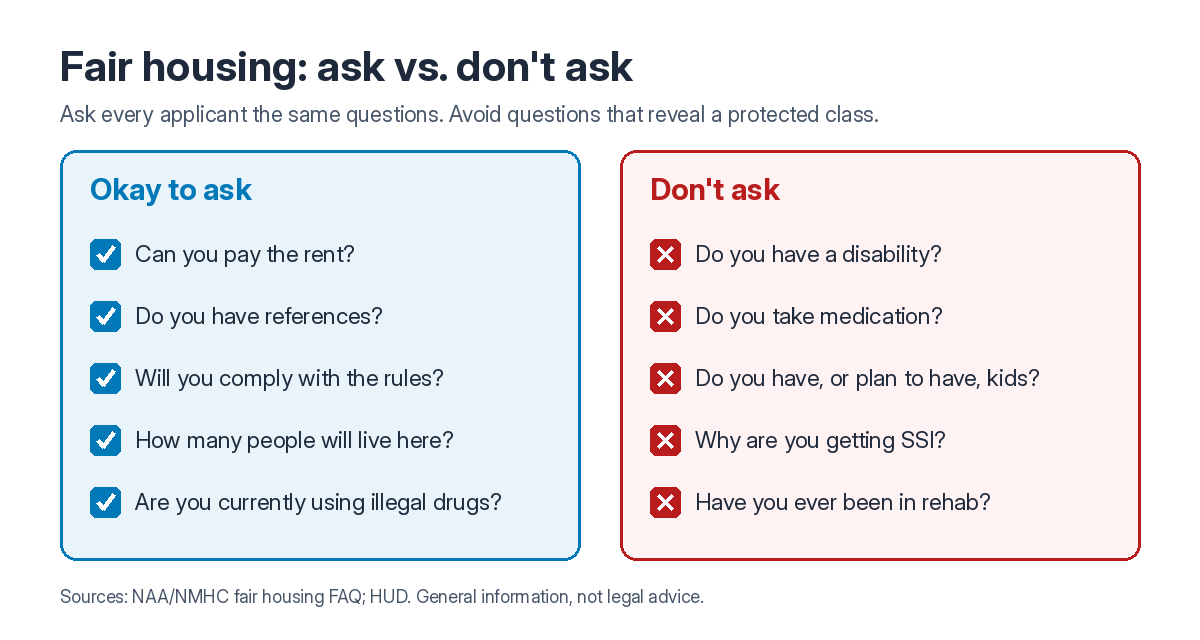
The National Apartment Association and National Multifamily Housing Council fair housing FAQ lists questions that are okay to ask all applicants:
- Can you pay the rent?
- Do you have references regarding your resident history?
- Will you comply with the rules?
- Do you have a criminal history?
- Are you currently using illegal drugs?
- Have you been convicted of the illegal manufacture or distribution of a controlled substance?
Some state and local laws limit the criminal history question, so check the rules where your property sits. More on that below.
New York City’s fair housing tenant selection page adds that landlords may set financial and credit qualifications. Whatever criteria you use must apply equally to all applicants.
What are the questions landlords can’t ask?
Landlords can’t ask questions, directly or indirectly, that reveal a protected class. That holds even if you ask everyone.
The table below pairs common “don’t ask” questions with a safer alternative. Items marked NYC-specific come from New York City’s guidance and may not apply in your area.
| Don’t ask | Ask instead |
|---|---|
| Do you have a disability? | Can you meet the lease terms and pay the rent? |
| Do you take medication? | Are you currently using illegal drugs? |
| Are you capable of living independently? | Will you comply with the rules? |
| Do you have kids, or are you planning to? | How many people will live in the unit? |
| What is your religion? Where were you born? (NYC-specific examples) | Do you have references regarding your resident history? |
| Are you married? How old are you? (NYC-specific examples) | Does your income meet our written criteria? |
| A photo, birth certificate or marriage certificate (NYC-specific) | Government-issued ID, required of every applicant |
The NAA/NMHC fair housing FAQ also says not to ask how severe a disability is, why someone gets SSI, or whether they’ve been in drug or alcohol rehab.
New York City’s fair housing tenant selection page says requiring a picture with the application may be evidence of discrimination in NYC.
That NYC page also says you can require government-issued ID. You must ask for it from every applicant and shouldn’t insist on one form, such as a driver’s license.
What can’t you say in a rental ad?
A rental ad can’t signal a preference for or against a protected class. That rule covers listings, flyers, signs and even what you say on the phone.
Federal regulation 24 CFR 100.75 (eCFR, current as of Oct 22, 2026) makes it unlawful to publish a rental notice or ad that shows a preference, limitation or discrimination based on a protected class.
The same section applies to written and oral statements. It names applications, flyers, brochures, signs, banners and posters as written notices.
The phrases below are our own illustrations, not quotes from the regulation. Describe the property, not the person you picture living there.
- Risky: “adults only,” “perfect for a single professional,” “no wheelchairs,” “Christian household.”
- Better: “two-bedroom near transit,” “quiet building,” “no smoking,” “ground-floor unit.”
Listing in several places? Our roundup of free rental listing sites for landlords can help you post one consistent ad everywhere.
Can you say “clean criminal background” in a listing?
It’s risky, and some states now restrict it. Blanket criminal history bans can have a discriminatory effect.
The Maryland Attorney General announced on August 31, 2026 a settlement with Bay Management Group over “clean criminal background check” ad language.
The Attorney General’s office found reasonable cause that the language had a discriminatory effect. Bay agreed to remove it, use individualized assessments, train staff and pay $30,000 in civil penalties.
Maryland’s Fair Chance Housing Act took effect October 1, 2026, according to the Maryland Department of Housing and Community Development (Sept 22, 2026).
DHCD says the law applies to providers who own or manage five or more units in Maryland. It generally requires a conditional offer before a criminal history check and bars ads saying you won’t consider applicants with records.
DHCD also says the law authorizes penalties of up to $500 per violation.
Other cities are moving the same way. WILX reported on October 21, 2026 that Lansing, Michigan, is weighing an ordinance requiring written denials for larger properties.
Under that proposal, applicants would get 14 days to respond with proof of rehabilitation. For more on screening, read our tenant background check guide for landlords.
What is a reasonable accommodation, and can you ask for proof?
A reasonable accommodation is a change to a rule or policy that a person with a disability needs. You can ask for verification of the need when the need isn’t obvious.
HUD’s fair housing booklet gives an example: a building with a “no pets” policy must make an exception for a guide dog.
HUD’s booklet also covers reasonable modifications. A tenant with a disability may make physical changes to a unit at their own expense, and may need to restore it when they leave in some cases.
The NAA/NMHC fair housing FAQ says a property owner can request verification of the person’s need for the requested accommodation.
Verification is about the need, not the diagnosis. Asking for medical records or a disability’s severity crosses the line.
Are any landlords exempt from fair housing rules?
Some small landlords are exempt from parts of the federal law in limited cases. The ban on discriminatory ads and statements still applies to them.
HUD’s fair housing booklet says the Act exempts, in some circumstances, owner-occupied buildings with no more than four units and single-family housing rented without a broker.
The booklet adds that the ban on discriminatory statements still covers those owners. State and local laws may also remove the exemption, so don’t assume it applies to you.
Can landlords refuse Section 8 vouchers?
Federal law doesn’t list source of income as a protected class, but some states and cities protect it. Check local rules before you write “no vouchers.”
Maryland is one example. DHCD says landlords there generally can’t refuse a subsidy holder based on income, credit score or past credit history from before the subsidy.
Thinking about accepting vouchers? Read our guide on how to become a Section 8 landlord.
What happens if a renter files a fair housing complaint?
A renter can file with HUD or sue in court, and settlements can be costly. Clear, consistent screening is your best protection.
HUD’s fair housing booklet says a person can file a HUD complaint within one year of the alleged violation. They can also file a private lawsuit within two years.
State laws bring their own penalties. The New York Attorney General announced on September 18, 2026 a settlement with Brooklyn High Rise LLC over “tenant blacklisting.”
The office found that 203 applicants were illegally denied housing based on their housing court history. Brooklyn High Rise agreed to pay $352,250 in penalties and restitution.
That case turned on a New York-specific law. According to the Attorney General’s office, tenant blacklisting “was made illegal in 2019 following changes to the Real Property Law.”
How does Apartment One help landlords screen consistently?
Apartment One gives you the same screening package for every applicant. That makes it easier to apply your written criteria the same way each time.
Apartment One is an online platform where renters complete a verified background and credit screening once, then get matched to rental properties they qualify for, while landlords list properties for free and receive pre-screened applicants.
The Tenant Fit Index (TFI) is Apartment One’s 0-100 score matching a renter to a property based on credit, income-to-rent ratio, eviction history, criminal history, and lifestyle preferences.
Screening covers FICO 9 credit from Experian, eviction records and criminal records. Listing as a Property Partner is free, and in-app messaging keeps renter conversations in one place.
Apartment One doesn’t replace your own fair housing review or legal advice. You still set your criteria, follow your state and local rules on criminal history, and make the final decision. See plan details on our pricing page.
Screen every applicant the same way. List free on Apartment One and receive pre-screened applicants, each with a Tenant Fit Index score.
Frequently asked questions
Can a landlord ask if I have kids?
Federal law protects familial status, so landlords shouldn’t ask questions meant to find out whether you have or plan to have children. They can ask every applicant how many people will live in the unit.
Can a landlord ask about my disability or medication?
No. The NAA/NMHC fair housing FAQ says not to ask whether someone has a disability or takes medication. If you request an accommodation, a landlord can ask to verify the need for it.
Can a landlord ask for a photo or birth certificate?
In New York City, the city’s fair housing guidance says requiring a photo or birth certificate may be evidence of discrimination. Landlords there can require government-issued ID from every applicant. Rules elsewhere vary.
Are small landlords exempt from the Fair Housing Act?
HUD says some owner-occupied buildings with four or fewer units and some single-family rentals without a broker are exempt in certain cases. The ban on discriminatory ads still applies, and state laws may be stricter.
Is listing on Apartment One free?
Yes. Landlords list properties for free as Property Partners and receive pre-screened applicants, each with a Tenant Fit Index score.
One Response