

A rental application fee usually covers the landlord’s credit and background check plus the cost of processing your application. Fees vary, and many states and cities cap or limit them. To avoid paying again and again, screen once and ask whether landlords accept a reusable report. Then apply only where you meet the criteria.
One rental application fee rarely feels like much. The trouble starts when you apply to three, four or five places in the same month. This guide explains what the fee pays for, what is typical, when you might get it back and which places limit it. It also covers how to stop paying for a new screening at every property.
This is general information, not legal advice. Fee laws vary by state and city.
What is a rental application fee, and what does it pay for?
A rental application fee is a charge a landlord collects when you apply for a unit. It typically pays for screening and processing, not for the apartment itself.
Harvard’s Joint Center for Housing Studies (JCHS) notes in “From Deposits to Fees, Renters Struggle with Up-Front Costs” (March 16, 2026) that application fees often cover background and credit checks, processing and administering applications.
The fee is separate from a security deposit. JCHS describes a deposit as money held to cover damage beyond normal wear and tear, typically returned to the tenant.
How much is a typical apartment application fee?
The median is around $75 among renters who paid one. Many renters also apply more than once, so the total can climb fast.
According to a Zillow survey of recent renters cited by Harvard JCHS (March 16, 2026), 73% paid an application fee, and those who paid gave a median of $75.
The same JCHS post reports that renters who paid a security deposit paid a median of $795.
JCHS also found that renter households had median cash savings of just $1,810 in 2022, per the Survey of Consumer Finances.
In a follow-up post, “Curbing Fees: How States and Cities are Addressing Up-Front Rental Costs” (March 19, 2026), JCHS reports that 57% of recent renters submitted two or more applications.
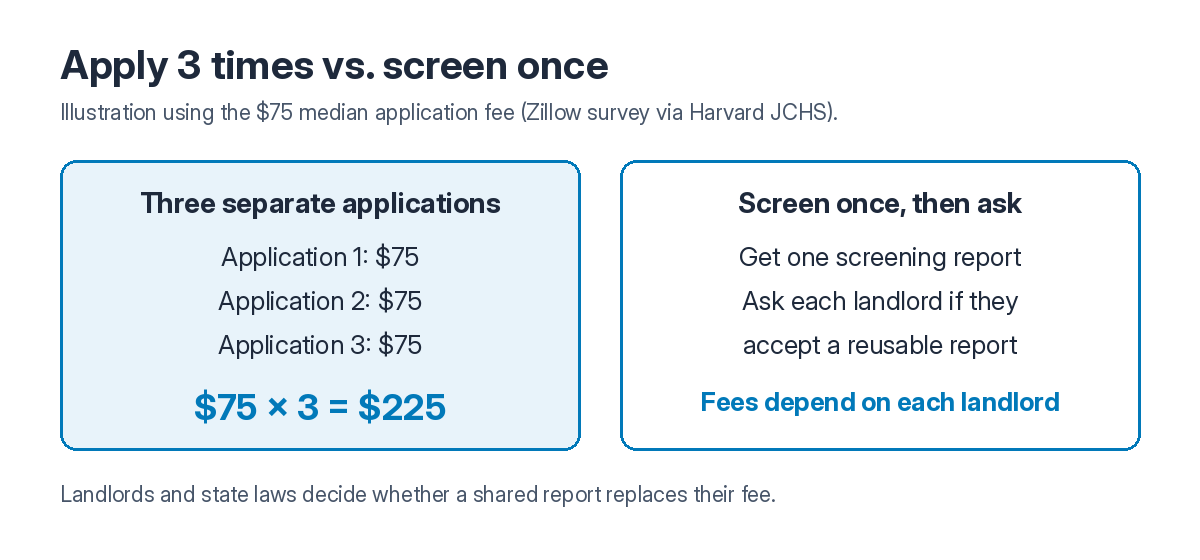
Here is a simple illustration. At the $75 median, three applications would cost $225. Five would cost $375. Those are examples, not quotes, because each landlord sets its own fee within local law.
Are rental application fees refundable?
Usually not by default, but some states require refunds in certain cases. Ask about the refund policy before you pay.
JCHS’s fee-law review gives two examples. In California, landlords must process applications in the order received, accept the first qualified applicant and refund any payment to applicants who are not selected. In Montana, property managers of four or more units must refund the fee, less any costs incurred, to an applicant who did not sign the lease.
If your state has no rule like this, the landlord’s own policy applies. Get it in writing.
Which states cap or limit application fees?
A growing number of states and cities cap application fees or tie them to the real cost of screening. Most laws JCHS reviewed cap the fee at $50.
Here are examples from the JCHS review of more than 30 laws:
| Place | What JCHS reports |
|---|---|
| Connecticut | $50 cap (2023 law) |
| Vermont | Application fees banned |
| Eugene, OR | $10 cap |
| Illinois and Colorado | Limited to actual screening cost; payments portable across properties for 30 days |
| Virginia | $50 cap ($32 for public and subsidized housing), plus out-of-pocket screening costs |
| California | Process in order received; refund applicants not selected |
Laws change, and cities can add their own rules. Check your state’s and city’s current rules before you apply.
What is a reusable (portable) tenant screening report?
A reusable or portable report is a recent screening report you pay for once and share with landlords. In states with these laws, a landlord that accepts one generally can’t also charge you an application fee.
Colorado’s HB23-1099, the Rental Application Fairness Act (effective August 7, 2023), requires landlords, with limited exceptions, to accept a portable tenant screening report. Apartment One hasn’t confirmed its report qualifies under any state’s portable-report law.
Under that law, a landlord may require the report to have been prepared by a consumer reporting agency within the previous 30 days. If you provide one, the landlord can’t charge an application fee or a fee to access the report.
Maryland’s Real Property §8-218 defines a reusable tenant screening report as one prepared within the previous 30 days by a consumer reporting agency at the tenant’s request and expense.
Maryland landlords must say whether they accept these reports. A landlord that accepts one may not charge an application fee or an access fee.
Each law spells out what the report must contain and who must prepare it. Where your state allows reusable reports, ask the landlord whether they will accept yours.
How can I avoid paying multiple application fees?
Apply less often and more precisely. Know the landlord’s criteria before you pay, and ask about reusable reports.
- Ask for the screening criteria first. Income, credit and rental history requirements tell you whether applying is worth the fee.
- Ask whether they accept a reusable report. In some states the answer affects whether they can charge you.
- Apply only where you match. A targeted application is cheaper than a long shot.
- Keep your documents ready. Pay stubs, ID and references help you move fast once you find the right place.
- Check your report for errors. Fixing a mistake once is easier than explaining it at every property.
The CFPB’s guide, “Review your rental background check”, says that if a landlord denies you or charges more because of a report, the landlord must tell you and give you the screening company’s contact details.
According to the CFPB, you are entitled to a free copy of that report from the screening company if you ask within 60 days.
Moving often? Month-to-month rentals can be another option. Credit worries? See how to get approved with bad credit.
How does Apartment One help you screen once?
As an Apartment One renter, you complete one screening and can download and share the report with landlords. With Tenant Plus, you also get matched to rentals where you meet the landlord’s criteria.
Apartment One is an online platform where renters complete a verified background and credit screening once, then get matched to rental properties they qualify for, while landlords list properties for free and receive pre-screened applicants.
The Tenant Fit Index (TFI) is Apartment One’s 0-100 score matching a renter to a property based on credit, income-to-rent ratio, eviction history, criminal history, and lifestyle preferences.
Your screening covers FICO 9 credit from Experian, eviction records and criminal records. Quick Screen ($35, one-time) gives you a screening report you can download and share. Tenant Plus ($60, one-time) adds matched listings.
The Apartment One site FAQ confirms that Quick Screen and Tenant Plus reports can be downloaded and shared with landlords outside Apartment One. Whether a landlord accepts it, or waives its own fee, is up to that landlord and your local law.
Payments run through Stripe, data is encrypted and the service follows FCRA, GLBA and CCPA requirements. Learn more about our online tenant screening service.
Stop paying for a new screening at every property. Screen once and share your report.
Get your Quick Screen →Want matched listings too? See Tenant Plus
Frequently asked questions
Is an application fee the same as a holding deposit?
No. An application fee generally pays for screening and processing your application. A holding deposit is money some landlords take to reserve a unit while you finish the process, and rules on it vary by state.
Can a landlord charge an application fee and not run a check?
The answer depends on your state and city. Some places limit fees to the actual cost of screening. Check your state’s current rules and ask the landlord what the fee covers before you pay.
Does Apartment One replace the landlord’s application?
No. Landlords may still require their own application. In states with portable-report laws such as Colorado, the fee may be waived when a landlord accepts a qualifying report. The application itself still applies.
How long is a screening report valid?
Colorado and Maryland’s reusable-report laws use reports prepared within the previous 30 days. Outside those rules, landlords set their own standards and may ask for a recent report.
Can I get a free copy of the report a landlord used?
Yes, in many cases. According to the CFPB, if a landlord denies you or charges more because of a report, you are entitled to a free copy from the screening company if you request it within 60 days.
2 Responses