

To screen a roommate, talk through money, schedules and house rules first. Then verify their ID, income and past rental references, and get a screening report only with their written permission, as 15 U.S.C. 1681b allows. Ask your landlord whether they must be on the lease, and put your shared rules in writing.
General information, not legal advice.
Why should you screen a roommate?
You should screen a roommate because you’ll share a home, bills and often a lease with them. A little vetting up front can prevent missed rent, conflict and safety problems later.
Screening isn’t only about credit. It’s about whether your habits, budgets and expectations fit. A great person can still be a poor roommate match if one of you works nights and the other hosts dinners every weekend.
The goal is a fair, consistent process. Ask every candidate the same questions, check the same things, and decide based on how well you’d live together.
What questions should you ask a potential roommate?
Ask about money, daily routines and house rules before anything else. These topics cause most roommate friction.
- Budget: Can you comfortably pay your share of rent and utilities each month?
- Rent timing: How would you handle it if you were going to be late with your share?
- Schedule: What are your work or class hours? Are you home during the day?
- Guests: How often do you have people over? What about overnight guests or partners?
- Cleaning: How do you like to split chores? What does “clean” mean to you?
- Pets: Do you have pets or plan to get one? Does the lease allow them?
- Smoking and vaping: Do you smoke or vape, and where?
- Noise: Do you play music, game late or work from home on calls?
- Move-out: How long do you plan to stay, and how much notice would you give?
For the budget question, our guide to how much rent you can afford can help you both check the numbers.
Can you run a background check on a roommate?
Only with their permission. Under 15 U.S.C. 1681b(a)(2), a consumer reporting agency may furnish a report “in accordance with the written instructions of the consumer to whom it relates.”
In practice, that means two good options:
- Get written consent. If you order a report, the candidate should authorize it in writing through the screening company.
- Ask them to share their own report. The candidate screens themselves and shows you the results. It keeps them in control of their data.
Beyond a report, you can also:
- Check a government-issued photo ID in person or on video
- Ask for proof they can pay their share, such as a pay stub or offer letter
- Call a past landlord or former roommate as a reference
Our guide to what a background check for an apartment shows explains what these reports can include.
With Apartment One, each of you can screen yourself and choose who sees your report. Quick Screen is $35 one-time for a screening report only, covering credit, eviction and criminal history, and you can share your report with others. Pricing can vary by state, so check Apartment One’s pricing page.
What red flags should you watch for?
Watch for pressure to pay before you meet, refusal to meet or video chat, and details that don’t add up. Any of these is a reason to slow down.
- Asking for a deposit or rent before you’ve met or seen the home
- Refusing a video call, tour or meeting in person
- A story, name or job that changes between conversations
- Pushing you to pay by wire transfer, gift card or cryptocurrency
- Unwillingness to let you verify ID or references
- Rushing you to decide today
If you’re the one moving into someone else’s place, the same rules apply to the listing. Our guide to rental scams explains how to spot fake listings and protect your money.
Do fair housing rules apply when choosing a roommate?
It depends on where you live, so check your state and city rules before you advertise. Federal law has been read narrowly for shared living units, but that isn’t the whole picture.
In Fair Housing Council v. Roommate.com, the Ninth Circuit held in 2012 that the federal Fair Housing Act doesn’t apply to the sharing of living units. That’s one federal appeals court’s ruling, and state or local laws can be broader.
Advertising rules can still matter. The federal exemption for small owner-occupied buildings in 42 U.S.C. 3603(b) doesn’t extend to section 3604(c), which covers discriminatory notices, statements and advertisements.
The safest approach is to focus your ad and your questions on the home, the rent and the house rules. Choose based on habits, budget and fit, and apply the same process to every candidate.
Does your new roommate need to be on the lease?
Your lease and your landlord decide that, so ask the landlord before anyone moves in. Many leases limit who can live in the unit or how long guests can stay.
If your landlord wants the roommate on the lease, they may screen the roommate too. Read the lease together so you both know what you’re signing.
If the landlord says no or the roommate can’t qualify alone, don’t move them in anyway. That can put your own tenancy at risk. A roommate who can’t qualify alone may be able to add a guarantor; see our guide on what a guarantor for an apartment is. First-time renters can find more in our guide on how to rent your first apartment.
What should a roommate agreement include?
A roommate agreement should spell out money, chores, guests and how someone moves out. It’s a written record of what you agreed to, separate from your lease with the landlord.
- Rent split: Who pays what, when and how
- Utilities and internet: Whose name each account is in and how bills are split
- Security deposit share: How much each person paid and how it’s divided at move-out
- Chores and shared supplies: A schedule and who buys what
- Guests: Limits on overnight guests and how much notice to give
- Quiet hours and shared spaces
- Pets, smoking and parking, consistent with the lease
- Move-out notice: How much notice someone gives and what happens to their share of rent
- Disputes: How you’ll raise problems before they grow
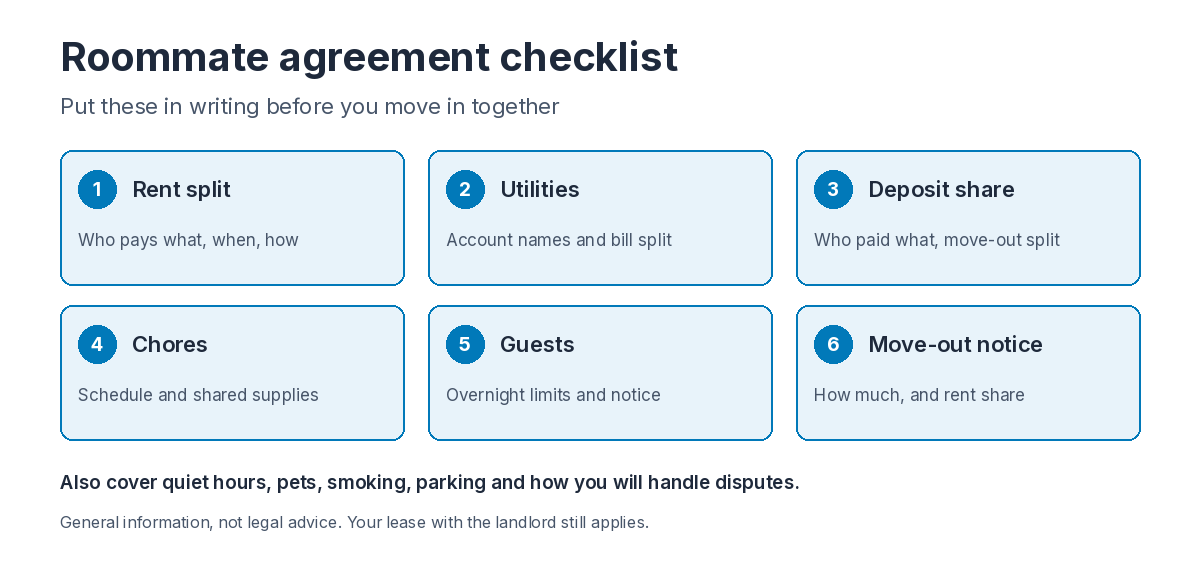
Write it yourselves in plain language, and both sign and keep a copy. Students in Las Cruces can also check the ASNMSU Renter’s Handbook, which covers lease agreements, security deposits and maintenance disputes.
How can Apartment One help you and a roommate?
Each of you can screen once, share your own report, and look for rentals that fit. Apartment One doesn’t choose roommates for you; you decide together.
Apartment One is an online platform where renters complete a verified background and credit screening once, then get matched to rental properties they qualify for, while landlords list properties for free and receive pre-screened applicants. The Tenant Fit Index (TFI) is Apartment One’s 0-100 score matching a renter to a property based on credit, income-to-rent ratio, eviction history, criminal history, and lifestyle preferences. The TFI is a tool used alongside each landlord’s written criteria, not a ranking or a decision-maker.
Tenant Plus is $60 one-time for screening plus access to matched property listings. Each landlord still makes its own decision.
Apartment One is FCRA-compliant and follows GLBA and CCPA data handling. Data is encrypted, and payments are processed through Stripe.
Make roommate vetting easier on both sides. Each of you can screen once with Apartment One, share your own report, and look for rentals that fit.
Frequently asked questions
How do you split rent fairly?
Many roommates split rent evenly, while others adjust for bedroom size, a private bathroom or parking. Agree on a method before you sign, and write it into your roommate agreement.
What if a roommate stops paying?
It depends on your lease. If you’re both on it, check what it says about responsibility for rent, and talk to your roommate and your landlord early. Keep records of what each person has paid.
Is it safe to find roommates online?
It can be, if you verify before you pay. Meet on video or in person, check ID and references, and never send money before you’ve seen the home. Our guide to rental scams covers common warning signs.
Can my roommate see my screening report?
Only if you share it. Under 15 U.S.C. 1681b(a)(2), a consumer reporting agency can furnish a report based on your written instructions, so you decide who sees yours.
Should we both screen with the same service?
It isn’t required. Using the same service can make reports easier to compare, but what matters most is that each person screens with consent and shares results honestly.