

Under the SCRA, covered servicemembers can terminate certain residential leases after entry into military service, PCS or deployment orders of at least 90 days, or qualifying stop-movement orders. Deliver written notice plus a copy of orders. Effective dates follow 50 U.S.C. section 3955, and the landlord may not impose an early termination charge.
General information, not legal advice. Confirm the statute text and talk to military legal assistance for your orders.
What is the SCRA military clause for breaking a lease?
It is a federal right under 50 U.S.C. section 3955 that lets a covered lessee terminate certain residential leases after entry into service, qualifying PCS or deployment orders, or qualifying stop-movement orders.
Under 50 U.S.C. section 3955 via Cornell LII, a lessee on a covered residential lease may terminate the lease at any time after (A) entry into military service; (B) the date of military orders for a permanent change of station or to deploy with a military unit (or as an individual in support of a military operation) for not less than 90 days; or (C) certain stop-movement orders described in the statute.
The same section 3955 states that termination of the lease also terminates any obligation a dependent of the lessee may have under the lease.
According to the HUD Exchange Housing Protections for Servicemembers Check-Sheet, a servicemember can terminate a residential lease without penalty following entry into military service, including after receiving a PCS or deployment order.
Who does the SCRA protect?
The Department of Justice describes coverage for full-time active duty members of the Army, Navy, Air Force, Marine Corps, Coast Guard and Space Force; reservists on federal active duty; National Guard members on federal orders for more than 30 days; and certain PHS and NOAA commissioned officers, with dependents receiving certain protections.
According to the U.S. Department of Justice Financial and Housing Rights page, military service under the SCRA includes those groups, and dependents include a spouse, children and any other person for whom the servicemember has provided more than half of their financial support for the past 180 days.
Under 50 U.S.C. section 3955(a)(2), when the servicemember terminates the lease, dependents’ obligations under that lease end with it.
When can you terminate a residential lease under section 3955?
You can terminate after entry into military service, after PCS or deployment orders of not less than 90 days, or after qualifying stop-movement orders described in the statute for covered residential leases.
Section 3955(b)(1) covers residential leases occupied or intended to be occupied by a servicemember or dependents when the lease is executed by someone who later enters military service; when a servicemember in service later receives PCS or deployment orders of not less than 90 days; or in the stop-movement scenarios set out in subsection (b)(1)(C).
The DOJ page likewise states that the lease must be executed by a person who later enters military service, or by someone already in service who later receives PCS or deployment orders for at least 90 days, and notes that SCRA also allows termination upon receipt of retirement or separation orders as described there.
How do you give notice the right way?
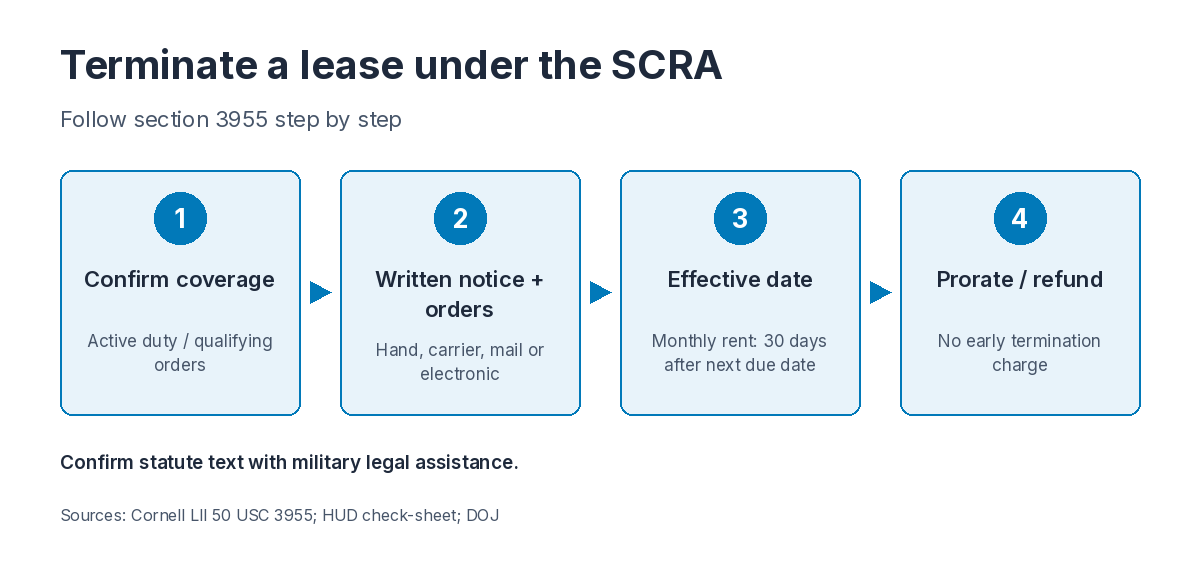
Deliver written notice of termination and a copy of the servicemember’s military orders to the lessor or the lessor’s agent by an allowed method in section 3955(c).
Under 50 U.S.C. section 3955(c), termination is made by delivery of written notice of termination and a copy of the servicemember’s military orders to the lessor (or grantee) or the lessor’s agent. Delivery may be by hand delivery, private business carrier, U.S. mail with return receipt requested, or specified electronic means.
The DOJ Financial and Housing Rights page likewise says the servicemember must submit written notice and a copy of military orders – or a letter from a commanding officer – and that notice may be sent electronically in addition to mail or hand delivery.
Keep proof of what you sent and when it was delivered.
When does the lease actually end, and what do you still owe?
For monthly-rent residential leases covered by section 3955(b)(1)(A) or (B), termination is effective 30 days after the next rent due date that follows delivery of notice. Other rent schedules and stop-movement leases use different effective-date rules in section 3955(d). Rent before the effective date is prorated, advance rent after that date must be refunded within 30 days, and the lessor may not impose an early termination charge.
Read carefully from 50 U.S.C. section 3955(d)(1): for a lease described in subparagraph (A) or (B) of subsection (b)(1) that provides for monthly payment of rent, termination is effective 30 days after the first date on which the next rental payment is due and payable after the date on which the notice under subsection (c) is delivered. For any other lease described in subparagraphs (A) and (B) of subsection (b)(1), termination is effective on the last day of the month following the month in which the notice is delivered.
For stop-movement leases under subsection (b)(1)(C), section 3955(d)(1)(B) says termination is effective on the date on which the requirements of subsection (c) are met.
Under section 3955(e)(1), unpaid rent for the period preceding the effective termination date shall be paid on a prorated basis, and the lessor may not impose an early termination charge. Under section 3955(f), rents paid in advance for a period after the effective date shall be refunded within 30 days of the effective date.
What other housing protections should military renters know?
SCRA also limits eviction without a court order in covered cases, and non-military early-termination options still matter if you are not SCRA-eligible.
The HUD Exchange check-sheet states that a servicemember and/or dependents cannot be evicted without a court order during active duty if the premises are occupied as a residence or for which rent does not exceed $4,089.62. That rent-cap figure comes from the check-sheet and can be inflation-adjusted over time.
If you are not covered by SCRA, or you are leaving for a non-military reason, see how to break a lease for negotiation and other options. For lease language before you sign the next place, use the lease agreement checklist.
How does Apartment One fit in?
When orders send you to a new duty station, Apartment One helps you screen once and share a report for the next place you qualify for. You still decide where to apply, and screening never promises approval.
Apartment One is an online platform where renters complete a verified background and credit screening once, then get matched to rental properties they qualify for, while landlords list properties for free and receive pre-screened applicants.
Screening covers credit (FICO 9 from Experian), eviction and criminal records. You can share your report with landlords instead of starting over after each PCS.
The Tenant Fit Index (TFI) is Apartment One’s 0-100 score matching a renter to a property based on credit, income-to-rent ratio, eviction history, criminal history, and lifestyle preferences. The TFI is a tool used alongside written criteria, not a ranking or a decision-maker.
Quick Screen is $35 one-time for a screening report only, and Tenant Plus is $60 one-time for screening plus access to matched property listings. Pricing can vary by state.
Apartment One is FCRA-compliant and follows GLBA and CCPA data handling. Data is encrypted, and payments are processed through Stripe.
Moving on orders? Know your SCRA rights, then screen once for the next place you qualify for.
Frequently asked questions
Does SCRA waive all rent the day I get orders?
No. Section 3955 sets an effective termination date and requires prorated rent for the period before that date.
Do dependents stay on the lease?
No. Under section 3955(a)(2), the servicemember’s termination ends any obligation a dependent may have under the lease.
Can my landlord charge an early termination fee?
The statute says the lessor may not impose an early termination charge for covered residential lease terminations under section 3955.
What if my lease has its own military clause?
SCRA sets a federal floor of protections. Which clause controls depends on your lease and the facts, so get legal advice if they conflict.
Where can I get help?
Start with military legal assistance on your installation and the Department of Justice servicemembers resources linked in this article.