

To request a reasonable accommodation, ask your housing provider for a change to a rule, policy, practice or service that you need because of a disability. You can ask orally or in writing, and you do not have to use special words, but a dated written request is usually helpful and creates a record.
General information, not legal advice. Fair housing rights and complaint deadlines depend on your facts and location. Talk to a fair-housing attorney or agency before you act.
What is a reasonable accommodation in housing?
A reasonable accommodation is a change, exception or adjustment to a rule, policy, practice or service that a person with a disability may need to have an equal opportunity to use and enjoy a dwelling.
That definition comes from the 2004 HUD/DOJ Joint Statement on reasonable accommodations (May 14, 2004), long-standing federal guidance from HUD and the Department of Justice under the Fair Housing Act. The statement says there must be an identifiable relationship, or nexus, between the requested accommodation and the person’s disability.
Common examples include an exception to a no-pets rule for an assistance animal, a reserved parking space near the unit, a change in the rent due date tied to when disability benefits arrive, or help with communication during the application process. Whether a specific request is reasonable depends on the facts.
Some housing is outside these rules. The joint statement notes that the Fair Housing Act’s reasonable accommodation requirements do not apply to owner-occupied buildings with four or fewer units, though state or local laws may still cover them.
How is a reasonable modification different from an accommodation?
An accommodation changes a rule or policy, while a modification is a physical change to the unit or common areas, such as installing a grab bar or a ramp.
California’s Civil Rights Department (CRD) puts it this way in its November 4, 2026 announcement: reasonable accommodations are changes to rental policies or rules, and reasonable modifications are physical changes to the property. CRD gives the examples of a no-pets exception for an emotional support animal and a grab bar.
The 2004 HUD/DOJ Joint Statement on reasonable accommodations itself does not address modifications; its footnote points to the separate federal regulation at 24 C.F.R. 100.203. If your request involves construction, review that rule and talk to a fair-housing agency about who pays and what approval is required.
| Reasonable accommodation | Reasonable modification | |
|---|---|---|
| What changes | A rule, policy, practice or service | The physical space |
| Examples | Pet-rule exception, parking space, rent date change | Grab bar, ramp, lever handles |
| Key federal source | 2004 HUD/DOJ Joint Statement | 24 C.F.R. 100.203 |
How do you request a reasonable accommodation from a landlord?
Tell the landlord or manager that you have a disability-related need and what change you are asking for. You can do this by phone, in person or in writing, and a family member or someone acting for you can make the request.
The 2004 HUD/DOJ Joint Statement on reasonable accommodations says a request can be made orally or in writing, that the person does not need to mention the Fair Housing Act or use the words “reasonable accommodation,” and that a family member or other person acting on the applicant’s or resident’s behalf may make the request. It also notes that putting the request in writing is usually helpful to prevent misunderstandings.
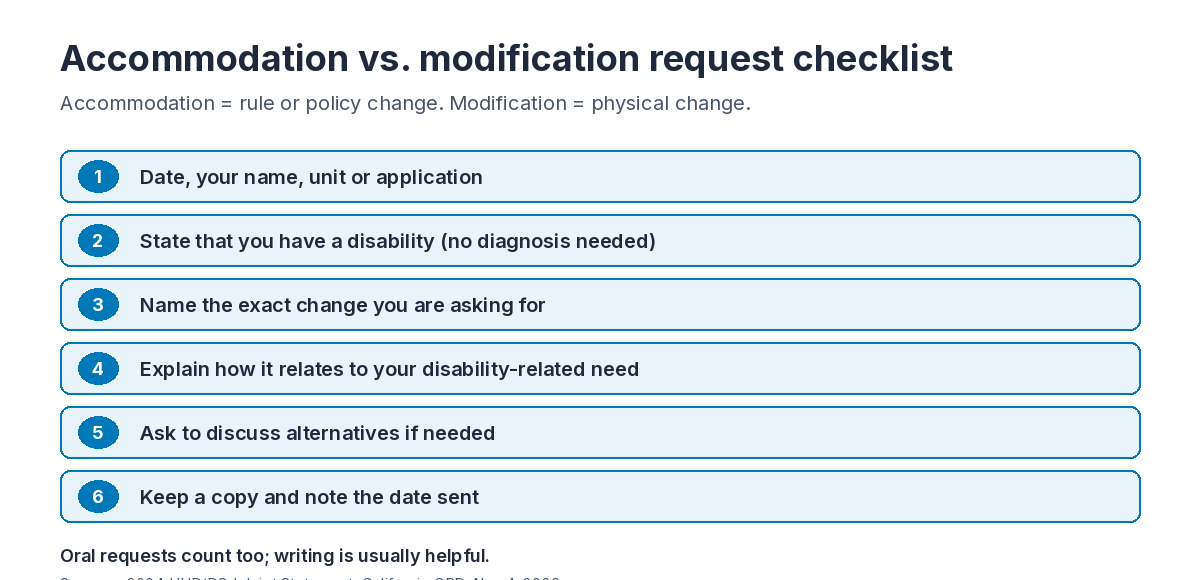
A clear written request usually covers:
- Your name, unit or application, and the date.
- A statement that you have a disability (you do not need to name a diagnosis).
- The specific change you are asking for.
- How the change relates to your disability-related need.
- How and when the provider can reach you to discuss it.
Keep a copy, note the date you sent it, and save any replies. If you ask in person, follow up with a short email summarizing what you asked.
What can a landlord ask for when you request an accommodation?
If your disability and your need are obvious or already known, the landlord generally may not ask for more information. If they are not obvious, the landlord may ask for limited, reliable information needed to evaluate the request.
Under the 2004 HUD/DOJ Joint Statement on reasonable accommodations, when the disability is not obvious, a provider may request reliable disability-related information that is necessary to verify that the person meets the Act’s definition of disability, describes the needed accommodation, and shows the relationship between the disability and the need. If both the disability and the need are obvious or known, the provider may not request additional information.
The statement says providers generally should not ask about the nature or severity of a disability beyond what is needed. Reliable information can come from the person, a doctor or other medical professional, a peer support group, a non-medical service agency, or a reliable third party in a position to know.
Questions about disability during screening are a sensitive area in general. For context, see questions landlords can’t ask.
Can a landlord deny or charge for a reasonable accommodation?
A landlord can deny a request in limited situations, but generally may not charge an extra fee or deposit as a condition of granting one.
The 2004 HUD/DOJ Joint Statement on reasonable accommodations says a provider can deny a request if there is no disability-related need for it, or if granting it would impose an undue financial and administrative burden or fundamentally alter the provider’s operations. Even then, the statement says the provider should discuss alternatives in an interactive process that could meet the need.
The same statement says providers may not require people with disabilities to pay extra fees or deposits as a condition of receiving an accommodation. For how pet rules and assistance animal requests can interact, see pet policy for rental property.
How fast must a landlord respond to an accommodation request?
Federal guidance says providers must respond promptly, and an undue delay can itself be treated as a failure to provide a reasonable accommodation.
The 2004 HUD/DOJ Joint Statement on reasonable accommodations says a housing provider has an obligation to provide prompt responses to reasonable accommodation requests and that an undue delay may be deemed a failure to provide a reasonable accommodation. It does not set a fixed number of days.
In California, the CRD announcement says housing providers must quickly consider and respond, must actively engage if they cannot grant a request immediately, and that failing to engage in a timely manner is illegal housing discrimination under state law.
What is California’s new CRD accommodation letter tool?
It is a free online letter generator from California’s Civil Rights Department that helps California renters with disabilities write accommodation or modification requests. It is a California resource, not a federal one.
CRD announced the tool on November 4, 2026. According to CRD, it includes a checklist, definitions, examples, sample rationales and legal information, and it lets renters write in the language of their choice. CRD also said that each year it investigates hundreds of disability discrimination cases in housing, by far the most common type of civil rights complaint in housing made to the state.
Outside California, you can still use the same structure: a dated letter naming the change you need and how it relates to your disability.
What if your request is denied or ignored?
Ask for the reason in writing, offer alternatives, and if you believe the denial is unlawful, contact HUD, your state fair housing agency, or a fair-housing attorney. Federal deadlines apply.
The 2004 HUD/DOJ Joint Statement on reasonable accommodations says a person may file a complaint with HUD within one year of the alleged discrimination, or file a lawsuit in federal district court within two years. State deadlines and procedures can differ, so confirm the timeline that applies to you.
If an application was turned down for other reasons, see what to do if your rental application is denied.
How does Apartment One work for renters?
Apartment One lets you screen once and share one report with landlords you apply to.
Apartment One is an online platform where renters complete a verified background and credit screening once, then get matched to rental properties they qualify for, while landlords list properties for free and receive pre-screened applicants.
Screening covers credit (FICO 9 from Experian), eviction and criminal records. Quick Screen is $35 one-time for a screening report only, and Tenant Plus is $60 one-time for screening plus access to matched property listings. Pricing can vary by state.
For more on how landlords use reports, see rental tenant screening.
The Tenant Fit Index (TFI) is Apartment One’s 0-100 score matching a renter to a property based on credit, income-to-rent ratio, eviction history, criminal history, and lifestyle preferences. The TFI is a tool used alongside written criteria, not a ranking or a decision-maker.
Apartment One is FCRA-compliant and follows GLBA and CCPA data handling. Data is encrypted, and payments are processed through Stripe.
Screen once, then apply with a shareable report.
Frequently asked questions
Do I have to put a reasonable accommodation request in writing?
No. Federal guidance says requests can be oral or written, but a dated written request is usually helpful because it creates a record.
Do I need to use the words reasonable accommodation?
No. The 2004 HUD/DOJ Joint Statement says you do not need to mention the Fair Housing Act or use those words.
Can my landlord charge a fee for an accommodation?
Generally no. The joint statement says providers may not require extra fees or deposits as a condition of granting a reasonable accommodation.
Is California’s CRD letter tool available in other states?
It is a California Civil Rights Department resource for California renters. Renters elsewhere can follow a similar letter structure and check their own state agency.
How long do I have to file a fair housing complaint?
Under federal law, generally one year to file with HUD or two years to sue in federal court. State deadlines can differ.