

Landlords report all rental income and their ordinary rental expenses on Form 1040 Schedule E, Part I. Most individuals use the cash method, so you count rent in the year you receive it and deduct expenses in the year you pay them. Improvements are not deducted all at once; you recover them through depreciation on Form 4562.
General information based on IRS publications, not tax or legal advice. Rules depend on your facts; talk to a qualified tax professional and review Publication 527 before you file.
What rental income must landlords report on Schedule E?
You must report all rental income, including normal rent, advance rent, lease-cancellation payments, expenses a tenant pays for you, and the fair market value of property or services you accept instead of rent.
The IRS page Tips on rental real estate income, deductions and recordkeeping says all rental income must be reported on your tax return, and that a cash basis taxpayer reports rental income in the year it is received, regardless of when it was earned. The same IRS page notes that most individuals use the cash method of accounting.
Advance rent counts when you receive it. The IRS rental tips page says to include advance rent in income in the year you receive it regardless of the period covered or your accounting method. Its example: on a 10-year lease, if you receive the first year’s rent and the last year’s rent in year one, both amounts are income in year one.
A payment to cancel a lease is rent. According to the IRS rental tips page, if a tenant pays you to cancel a lease, include the payment in income in the year you receive it regardless of your accounting method.
Tenant-paid expenses count too. The IRS rental tips page says that if your tenant pays any of your expenses, you include them in rental income, and you can deduct them if they are deductible rental expenses.
Property or services in place of rent are income at fair market value. The IRS rental tips page uses the example of a tenant who paints the property instead of paying two months of rent: you include the rent the tenant would have paid.
Are security deposits taxable rental income?
Not if you plan to return the deposit to the tenant at the end of the lease. If you keep part or all of it because the tenant did not meet the lease terms, the amount you keep is income in that year.
The IRS rental tips page says do not include a security deposit in income when you receive it if you plan to return it, but include any amount you keep in the year you keep it. It also says a security deposit used as a final payment of rent is advance rent, which you include when you receive it.
State law controls how and when deposits must be returned, which is a separate question from tax treatment. For state return rules, see our guide to security deposit laws.
Which rental property tax deductions can landlords take currently?
You can generally deduct the ordinary and necessary expenses of managing, conserving and maintaining the rental. The IRS names interest, taxes, advertising, maintenance, utilities and insurance as examples, and cash-basis landlords deduct them in the year paid.
According to the IRS rental tips page, ordinary expenses are those that are common and generally accepted in the business, and necessary expenses are those deemed appropriate, such as interest, taxes, advertising, maintenance, utilities and insurance. The same page says you can deduct certain materials, supplies, repairs and maintenance that keep the property in good operating condition.
For the full list of common rental expenses and the exceptions to each, read IRS Publication 527, Residential Rental Property.
This post does not say whether any particular tenant-screening product or fee is deductible for you. Ask your tax professional how to treat the specific costs you pay. For business context on marketing a vacancy, see how to reduce rental vacancy and free rental listing sites for landlords.
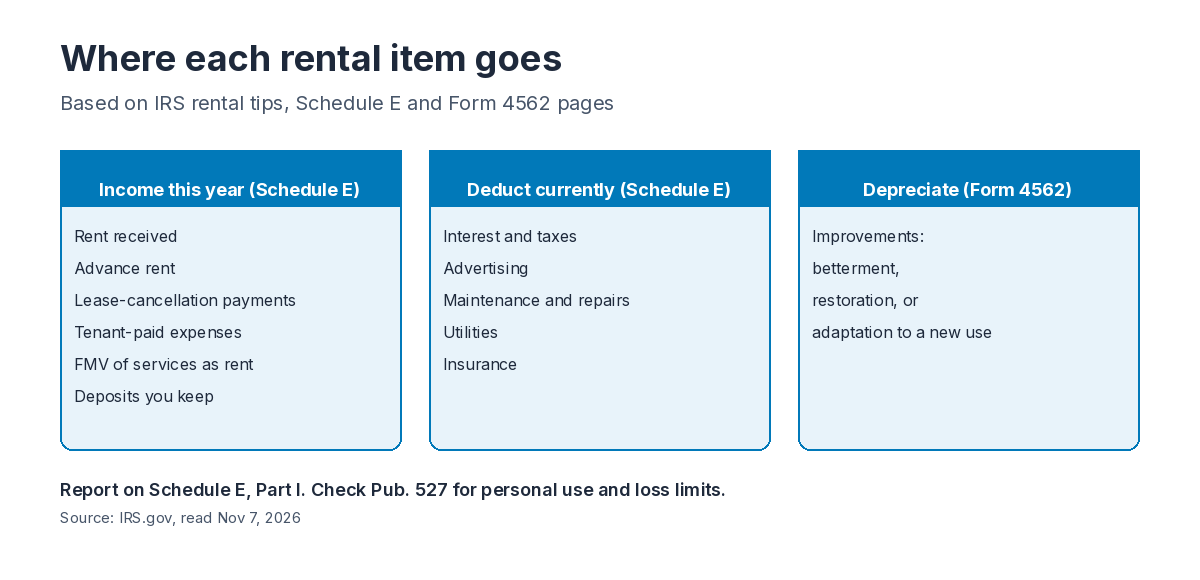
| Bucket | What goes here (IRS-listed examples) | Where it shows up |
|---|---|---|
| Income this year | Rent received, advance rent, lease-cancellation payments, tenant-paid expenses, FMV of property or services, kept deposits | Schedule E, Part I |
| Currently deductible expense | Ordinary and necessary costs such as interest, taxes, advertising, maintenance, utilities, insurance, repairs | Schedule E, Part I |
| Capitalize and depreciate | Improvements (betterment, restoration, adaptation to a new use) | Form 4562, then Schedule E |
What counts as an improvement vs. a repair for depreciation?
An improvement is a betterment, a restoration, or an adaptation to a new or different use. You cannot deduct improvements in the year you pay for them; you recover their cost through depreciation, reported using Form 4562.
The IRS rental tips page says you may not deduct the cost of improvements, that a rental property is improved only if the amounts paid are for a betterment, restoration or adaptation to a new or different use, and that the cost of improvements is recovered through depreciation.
The same IRS page says you can recover some or all of your improvements by using Form 4562 to report depreciation beginning in the year the rental is first placed in service, and in any year you make an improvement or add furnishings.
According to the IRS About Form 4562 page, Form 4562 is used to claim depreciation and amortization, to make the section 179 election to expense certain property, and to provide information on listed property.
If you are unsure whether a cost is a repair or an improvement, check Publication 527 or ask a tax professional rather than guessing.
How do you report rental activity on Form 1040 Schedule E Part I?
List each rental property’s income, expenses and depreciation on Schedule E, Part I, attach more Schedules E if you have more than three properties, and check the loss limits and personal-use rules before you finish.
According to the IRS About Schedule E (Form 1040) page, Schedule E is used to report income or loss from rental real estate, royalties, partnerships, S corporations, estates, trusts and residual interests in REMICs.
The IRS rental tips page says that if you rent buildings, rooms or apartments, you normally report rental income and expenses on Form 1040 or 1040-SR, Schedule E, Part I, listing total income, expenses and depreciation for each property. With more than three rental properties, you attach as many Schedules E as needed and fill in the totals column on only one.
The same IRS page warns that if rental expenses exceed rental income, your loss may be limited by the passive activity loss rules and the at-risk rules (Forms 8582 and 6198). It also says personal use of a unit you rent, including a vacation home or a rented room in your residence, can limit expenses and losses, and points to Publication 527 for those rules.
For personal-use day tests and dollar limits, read the current Pub. 527 for the year you’re filing.
What records should landlords keep for rental deductions?
Keep documentary evidence for every expense, such as receipts, canceled checks and bills, plus records that support all the rental income you report.
The IRS rental tips page says you must be able to document rental income and expenses if your return is selected for audit, and that without evidence you may be subject to additional taxes and penalties. It says you generally must have documentary evidence, such as receipts, canceled checks or bills, to support expenses.
A practical setup (a suggestion, not an IRS requirement):
- One folder or digital label per property, per year.
- A simple ledger of rent received, with dates.
- Separate lists for repairs and for improvements, with dates placed in service.
- Copies of leases, deposit receipts and any deposit deductions you kept.
Clear leases make records easier too. Our lease agreement checklist covers the rent, deposit and payment terms worth putting in writing.
How does Apartment One fit in for landlords?
Apartment One helps you fill vacancies by listing free and receiving pre-screened applicants. It does not prepare taxes, and you still make every leasing decision.
Apartment One is an online platform where renters complete a verified background and credit screening once, then get matched to rental properties they qualify for, while landlords list properties for free and receive pre-screened applicants.
Screening covers credit (FICO 9 from Experian), eviction and criminal records, and landlords can message applicants in-app.
The Tenant Fit Index (TFI) is Apartment One’s 0-100 score matching a renter to a property based on credit, income-to-rent ratio, eviction history, criminal history, and lifestyle preferences. The TFI is a tool used alongside written criteria, not a ranking or a decision-maker.
Apartment One is FCRA-compliant and follows GLBA and CCPA data handling. Data is encrypted, and payments are processed through Stripe.
List your rental for free and get pre-screened applicants.
Frequently asked questions
Do I report advance rent when received or when earned?
When received. The IRS says to include advance rent in rental income in the year you receive it, regardless of the period covered or your accounting method.
Is a security deposit income?
Not if you plan to return it to the tenant. If you keep part or all of it because the tenant did not meet the lease terms, the IRS says to include the amount you keep in income that year.
Can I deduct improvements in the year I pay for them?
No. The IRS says the cost of improvements is not currently deductible and is recovered through depreciation, which you report using Form 4562.
Where do I report residential rental income?
Usually on Form 1040 or 1040-SR, Schedule E, Part I, where you list income, expenses and depreciation for each rental property.
Is this tax advice?
No. This is general information drawn from IRS pages. Talk to a qualified tax professional and review Publication 527 for your situation.
One Response