

If you rent out most housing built before 1978, federal law requires you to give tenants specific lead disclosures before they sign the lease: the EPA pamphlet, any known lead information and records, and a Lead Warning Statement in the lease. Keep the signed forms for three years. Landlords are not required to test for lead under this rule.
General information, not legal advice. Federal lead disclosure rules apply to most pre-1978 housing; state and local lead laws can add requirements. Check EPA guidance and your state or city rules, or talk to an attorney.
Do landlords have to disclose lead-based paint?
Yes, for most pre-1978 “target housing,” before a renter signs a lease.
According to the EPA page on real estate disclosures about potential lead hazards (updated May 27, 2026), lead-based paint for use in homes was banned in the U.S. in 1978 but is still present in millions of homes, and deteriorating lead-based paint is a hazard. The Lead-based Paint Disclosure Rule requires sellers, landlords, real estate agents and property managers to provide specific information about known lead-based paint and lead-based paint hazards before prospective renters and homebuyers sign a lease or contract.
The EPA says the rule applies to most pre-1978 private housing, public housing, federally owned housing and housing receiving federal assistance. It was directed by Section 1018 of the Residential Lead-Based Paint Hazard Reduction Act of 1992 (Title X), as the EPA frequent questions page explains.
Which rentals are exempt from the lead disclosure rule?
The EPA lists several exemptions, including housing built after 1977, short leases of 100 days or less with no renewal, and certain zero-bedroom or elderly or disability housing when no child under six lives or is expected to live there.
According to the EPA disclosure page, the rule does not apply to:
- Zero-bedroom units such as efficiencies, lofts and dormitories (unless a child under six lives or is expected to live there).
- Leases for 100 days or less where no lease renewal or extension can occur.
- Housing specifically for the elderly or persons with disabilities (unless a child under six resides or is expected to reside there).
- Housing tested by a certified lead-based paint inspector or risk assessor and found lead-based paint free.
- Foreclosure sales.
- Housing built after 1977.
What must a landlord give a tenant before signing?
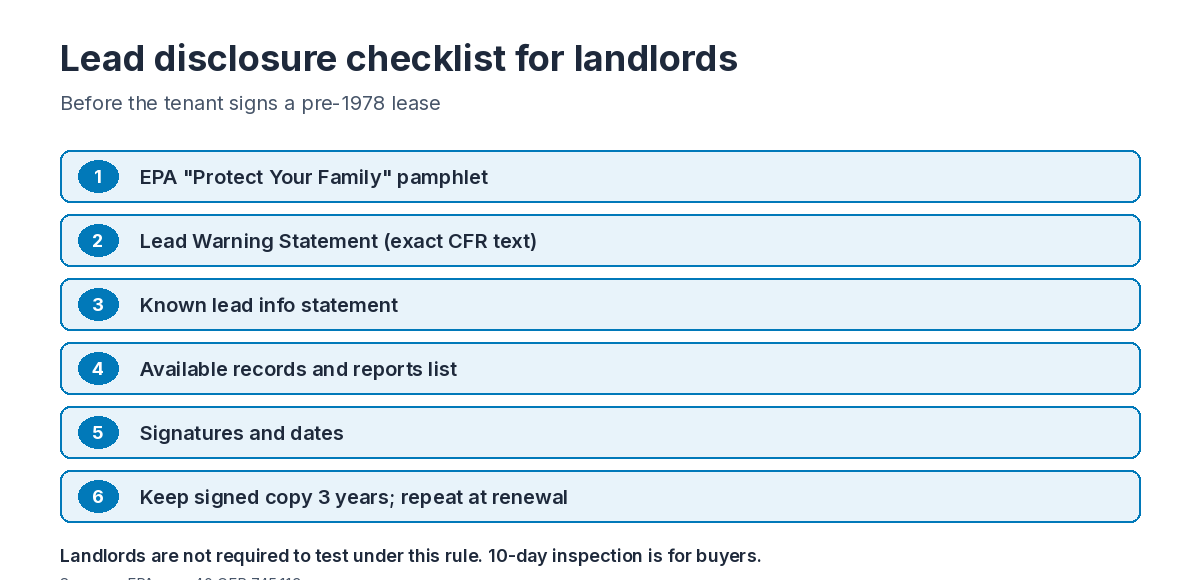
Before a renter signs, you must give the EPA pamphlet, disclose any known lead information, provide available records and reports, and include a Lead Warning Statement in or with the lease.
The EPA says landlords must:
- Give a copy of the “Protect Your Family From Lead In Your Home” pamphlet.
- Disclose any known information about lead-based paint and hazards.
- Provide all available records and reports (for multi-unit buildings, including common areas and other units from building-wide evaluations).
- Provide a Lead Warning Statement as an attachment to or language inserted into the lease, in the same language as the rest of the contract.
The EPA offers a sample Lessor’s Disclosure form in English and Spanish. Renters can ask for a paint inspection before signing, but the same EPA page says landlords are not required to do one by this rule. The 10-day inspection period described on that page is for homebuyers, not renters.
What does the lead warning statement in a lease have to say?
It must use the exact federal language in 40 CFR 745.113(b)(1), plus the other disclosure and signature elements in that section.
Under 40 CFR 745.113(b), each contract to lease target housing must include, as an attachment or within the contract, in the language of the contract:
Housing built before 1978 may contain lead-based paint. Lead from paint, paint chips, and dust can pose health hazards if not managed properly. Lead exposure is especially harmful to young children and pregnant women. Before renting pre-1978 housing, lessors must disclose the presence of known lead-based paint and/or lead-based paint hazards in the dwelling. Lessees must also receive a federally approved pamphlet on lead poisoning prevention.
That is the exact Lead Warning Statement required by 40 CFR 745.113(b)(1). The same section also requires:
- A lessor statement disclosing known lead-based paint or hazards, or indicating no knowledge.
- A list of available records or reports provided, or a statement that none are available.
- A lessee statement affirming receipt of that information and the pamphlet.
- When agents are involved, a statement that the agent informed the lessor of the lessor’s obligations under 42 U.S.C. 4852d and is aware of the duty to ensure compliance.
- Signatures of lessors, agents and lessees, with dates.
Add this packet to your lease paperwork; see our lease agreement checklist.
Do you have to disclose again at lease renewal, and how long do you keep the forms?
Yes at renewal for new information and the pamphlet, and you must keep the signed disclosure for at least three years from the start of the lease.
The EPA FAQ says existing tenants do not have to be given the pamphlet, but when tenants renew their leases, landlords must give them the pamphlet and any available reports, the same information required for new tenants.
Under 40 CFR 745.113(c), the lessor and any agent shall retain a copy of the completed attachment or lease for no less than 3 years from the commencement of the leasing period.
If you give disclosures electronically, the EPA says you must get consent and explain the right to paper copies, how to withdraw consent, and how to access and retain records. Store the signed forms with the lease and move-in inspection so they are easy to produce later.
What happens if a landlord skips the disclosure?
You can face EPA penalties, and a renter who did not get the disclosure can sue for triple damages and report the violation to EPA.
The EPA disclosure page says landlords and agents who do not give the proper information may be subject to penalties, and renters who did not receive the disclosure can report it at epa.gov/lead/violation. The EPA FAQ adds that a seller, lessor or agent who fails to give the proper information can be sued for triple the amount of damages under 42 U.S.C. 4852d(b)(3) and may face civil and criminal penalties.
As one example, EPA announced on August 10, 2026 that Konover Residential Corporation agreed to pay a $359,069 penalty to settle alleged disclosure violations for leases on 11 apartment units at Cargill Falls Mill in Putnam, Connecticut. EPA said the alleged gaps included no pamphlet, no lead warning statement in the lease, no known-information disclosure and no records disclosure.
State and city lead laws can add duties beyond the federal rule. Check your local requirements separately. Renovation work that disturbs paint falls under a separate EPA rule, the Renovation, Repair and Painting Rule.
How does Apartment One fit in for landlords?
Once your disclosure packet is ready, you can list your rental for free and receive pre-screened applicants. For listing tips, see how to write a rental listing and tenant screening criteria.
Apartment One is an online platform where renters complete a verified background and credit screening once, then get matched to rental properties they qualify for, while landlords list properties for free and receive pre-screened applicants.
Screening covers credit (FICO 9 from Experian), eviction and criminal records, and landlords can message applicants in-app.
The Tenant Fit Index (TFI) is Apartment One’s 0-100 score matching a renter to a property based on credit, income-to-rent ratio, eviction history, criminal history, and lifestyle preferences. The TFI is a tool used alongside written criteria, not a ranking or a decision-maker.
Apartment One is FCRA-compliant and follows GLBA and CCPA data handling. Data is encrypted, and payments are processed through Stripe.
List your rental for free and get pre-screened applicants.
Frequently asked questions
Does the rule apply to a house built in 1980?
No. The EPA says housing built after 1977 is excluded from the Disclosure Rule.
Do I have to test for lead before renting?
No. The EPA says the Disclosure Rule does not require landlords to inspect; renters can ask for an inspection.
Does a 3-month rental need the disclosure?
Only leases of 100 days or less with no renewal or extension are excluded. A three-month lease that can renew is not excluded under that exemption.
Can I send the disclosure electronically?
Yes, if you get the renter’s consent and explain the right to paper copies, how to withdraw consent, and how to access and retain records, as the EPA describes.
Is this legal advice?
No. Check EPA guidance and your state or city rules, or talk to an attorney.