

55+ apartments are age-restricted rentals where at least 80% of occupied units have at least one resident age 55 or older. They’re exempt from federal familial-status rules, so they can limit children, but they must publish age policies and verify ages. They’re usually independent living, so care isn’t typically included.
More older adults are renting. Harvard’s Joint Center for Housing Studies reports in America’s Rental Housing 2026 that renter households age 60 and over grew by 2.3 million, or 26%, between 2014 and 2024.
The same report notes that renting can offer older households more accessibility features and fewer maintenance responsibilities. This guide explains how 55+ apartments work, who qualifies and how to find one.
This article is general information, not legal or financial advice.
What are 55+ apartments?
55+ apartments are rental communities designed and operated for people 55 and older. Federal law lets them follow age rules that other housing can’t.
HUD’s fair housing booklet, “Fair Housing: Equal Opportunity for All,” says housing for older persons is exempt from the familial status protections if it meets certain rules.
HUD’s booklet adds that the exemption doesn’t cover the other protected classes. A 55+ community still can’t discriminate based on race, religion, disability or any other protected class.
The detailed rules are in federal regulation 24 CFR part 100, subpart E (eCFR, current as of Oct 22, 2026).
Under §100.305, at least 80 percent of occupied units must have at least one person age 55 or older. Under §100.306, the community must publish and follow policies that show it operates as 55+ housing.
Wording matters here. Section 100.306(b) says phrases like “adult living” or “adult community” in written ads don’t show an intent to operate as 55+ housing. When you search, look for communities that clearly describe themselves as 55+ housing.
How do 55+ apartments compare with other senior housing?
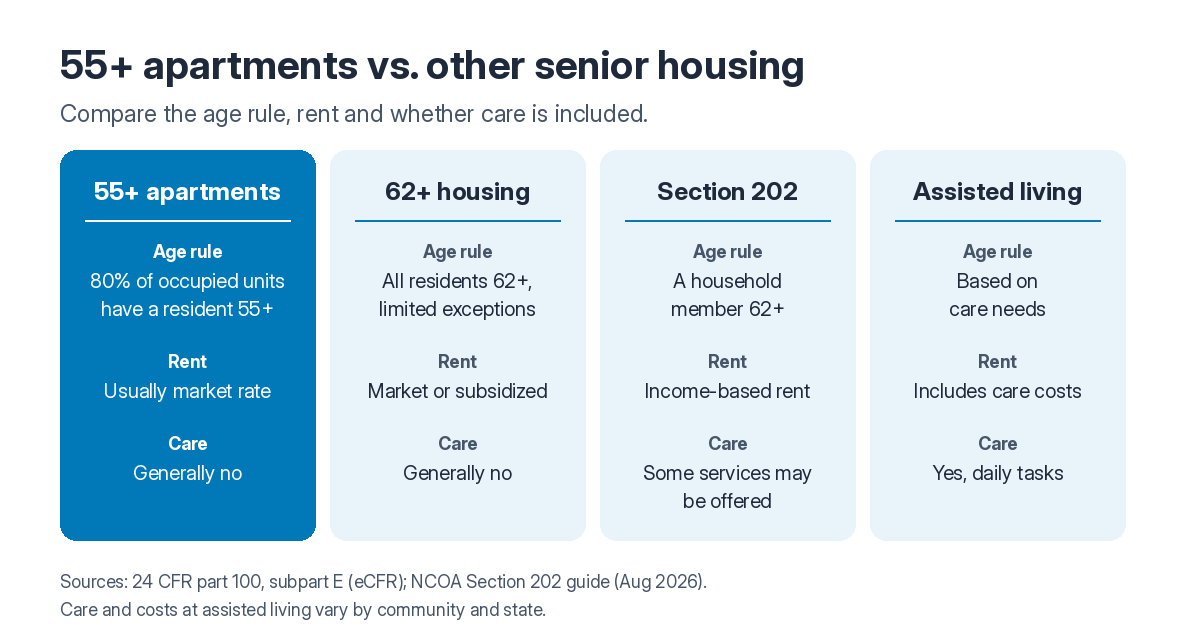
55+ apartments are one of several types of senior housing. The main differences are the age rule, who pays and whether care is included.
| Type | Age rule | Rent | Care included? |
|---|---|---|---|
| 55+ apartments | 80% of occupied units have a resident 55+ | Usually market rate | Generally no |
| 62+ housing | Intended for and occupied solely by people 62+, with limited exceptions | Market rate or subsidized | Generally no |
| Section 202 housing | At least one household member 62+ | Income-based | Some supportive services may be offered |
| Independent living | Set by the community | Often includes amenities | Generally no medical care |
| Assisted living | Based on care needs | Includes care costs | Yes, help with daily tasks |
The 55+ and 62+ rules come from 24 CFR §§100.303 and 100.305. Section 202 details come from the National Council on Aging’s Section 202 guide (Aug 3, 2026).
Independent and assisted living vary widely by community and state, so ask each one what’s included. You can also browse senior living rentals on Apartment One.
Can people under 55 live in 55+ apartments?
Often, yes. Up to 20% of occupied units can be without a resident 55 or older, and each community sets its own rules for those units.
Federal regulation 24 CFR §100.305(h) says each community may decide the age restriction, if any, for units without a resident 55 or older. It must follow its published policies when it does.
That means one community may allow a younger spouse, while another may not. Ask for the written age policy before you apply.
The same section also allows some under-55 residents without counting against the community. These include on-site employees and people needed to provide a reasonable accommodation to a resident with a disability, such as a live-in caregiver.
How do 55+ communities verify age?
Communities must have a system to confirm ages, usually with a standard ID. Expect to show proof of age when you apply.
Under 24 CFR §100.307, a 55+ community must be able to verify its 80% occupancy through reliable surveys and affidavits.
The regulation lists a driver’s license, birth certificate and passport among the documents that count as reliable proof of age.
It also requires the community to update its occupancy information at least once every two years. So you may be asked to confirm your household again later.
Are there affordable 55+ apartments?
Yes, but demand is high. Subsidized senior housing, vouchers and income-based programs can help, though waiting lists are common.
Affordability is a real problem for older renters.
Help doesn’t reach everyone who qualifies. A Harvard JCHS blog post (Aug 11, 2025) found that only 36.5% of eligible older adults received federal rental assistance in 2021.
Section 202 is one option. The National Council on Aging’s Section 202 guide says at least one household member must be 62 or older, and household income must be below 50% of the area median.
NCOA adds that residents typically pay an income-based rent, and HUD helps cover the rest.
Vouchers can help too. See our guide to apartments that accept Section 8 and our Section 8 housing page. Veterans can learn about VASH rentals.
How do you find 55+ apartments near you?
Start with your local public housing agency and HUD’s search map, then contact properties directly. Private 55+ communities also list on rental sites.
USA.gov’s subsidized rental housing page (updated April 27, 2026) suggests contacting your nearest public housing agency to check eligibility.
You can also call the Public and Indian Housing Information Resource Center at 1-800-955-2232, the page says.
USA.gov also points to the HUD map, where you can select “Find Affordable Housing Opportunities Near Me.” Each property has its own application process, and some have waiting lists.
For Section 202 housing, NCOA says you must apply with the property owner or manager directly. Apply early, since waiting lists are common.
What should you bring when you apply for a 55+ apartment?
Bring proof of age, proof of income and anything that shows you can pay the rent. Having it ready can speed up your application.
- Photo ID with your birth date: a driver’s license, state ID or passport.
- Income proof: Social Security or pension statements, or pay stubs if you still work.
- Bank or retirement statements: useful if you rely on savings.
- References: a past landlord or someone who knows you well.
- Household details: the names and ages of everyone who will live with you.
Living on a fixed income? Our guide on how much rent you can afford can help you set a realistic budget.
What should you check when you tour a 55+ apartment?
Look for features that will work for you now and later. Step-free entries, elevators and grab bars can matter as much as the view.
- Step-free entry and an elevator, or a ground-floor unit
- Wide doorways and halls
- A walk-in shower or space for grab bars
- Good lighting in halls, stairs and parking areas
- Easy-to-reach outlets, switches and cabinets
- Nearby transit, shopping and medical offices
If a unit needs changes, ask about them. HUD’s fair housing booklet says tenants with disabilities may make reasonable modifications at their own expense.
HUD’s booklet notes that in some cases you may need to restore the unit when you move out. Ask for written approval before any work begins.
How does Apartment One help you find a 55+ apartment?
Apartment One supports senior living rentals, and you only need to screen once. You can also qualify using bank funds if you live on savings.
Apartment One is an online platform where renters complete a verified background and credit screening once, then get matched to rental properties they qualify for, while landlords list properties for free and receive pre-screened applicants.
The Tenant Fit Index (TFI) is Apartment One’s 0-100 score matching a renter to a property based on credit, income-to-rent ratio, eviction history, criminal history, and lifestyle preferences.
Your screening covers FICO 9 credit from Experian, eviction records and criminal records. Financial Stability Documents let you show bank funds, which may help if your income is mostly savings.
Apartment One is a rental platform, not a care provider. Each property sets its own age policy and criteria and makes the final decision. Learn more on our renters page.
Looking for a 55+ or senior apartment? Screen once with Apartment One, add Financial Stability Documents if you rely on savings, and get matched to senior rentals that fit.
Browse senior living rentals →Get started with Apartment One
Frequently asked questions
What age do you have to be for a 55+ apartment?
Federal rules require at least one resident age 55 or older in at least 80% of occupied units. Each community sets its own rules for the rest, so ask for the written age policy.
Can my adult child or caregiver live with me?
It depends on the community’s policy. Federal rules let a community allow under-55 residents in some units, and a live-in caregiver needed as a reasonable accommodation doesn’t count against it.
Do 55+ apartments include meals or care?
Generally no. Most 55+ apartments are independent living. Some offer amenities or activities, but medical or personal care is usually found in assisted living instead.
Is there a waiting list for senior apartments?
Often, especially for subsidized housing. NCOA says many Section 202 properties have waiting lists, so contact properties and apply as early as you can.
Can I qualify for a 55+ apartment with retirement savings instead of income?
Some landlords accept savings or bank funds, but each one decides. On Apartment One, Financial Stability Documents let you show bank funds, which may help you qualify.