

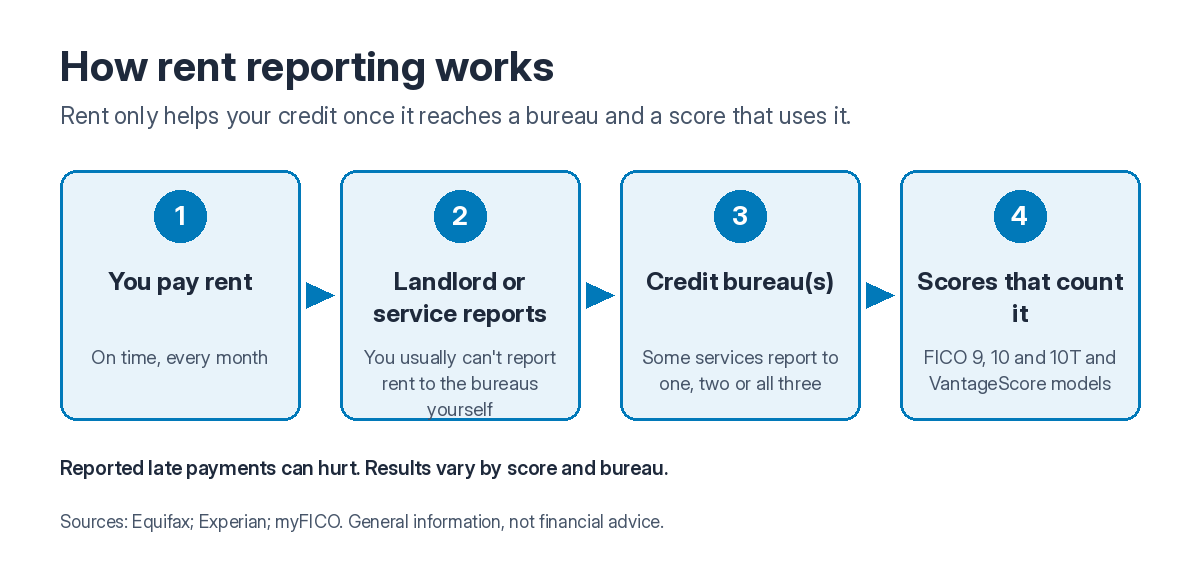
Paying rent builds credit only if your payments are reported to a credit bureau. Most landlords don’t report them on their own, according to Equifax. When on-time rent is reported, newer FICO Scores and all VantageScore versions can count it. Results vary, and reported late payments can hurt.
Does paying rent build credit? For most renters, rent is the biggest bill they pay every month, yet it usually never reaches a credit report. This guide explains how rent reporting works and which scores count it. It also covers what the research says and how to get your rent reported.
If you’re renting for the first time, our guide on how to rent your first apartment covers the full process.
This article is general information, not financial or legal advice.
Does paying rent build credit on its own?
Usually not, because rent rarely shows up on a credit report. “Rent payments seldom appear on credit reports, as few landlords report them,” Experian explains, adding that landlords aren’t legally required to report.
Equifax says rent payments may help you build credit only if they’re reported to the nationwide credit bureaus. In many cases, Equifax adds, landlords don’t report rent on their own.
The one way rent often does show up is the bad way. Experian notes that the only way most landlords influence credit reports is by turning a tenant’s unpaid debt over to a collection agency.
How does rent reporting work?
Rent reporting means a landlord, property manager or third-party service sends your payment history to one or more credit bureaus. HUD’s January 2025 rent reporting guidance describes two main types.
| Positive-only reporting | Full-file reporting | |
|---|---|---|
| What gets reported | On-time payments only | All payment history, including missed payments |
| Risk to your score | Low risk of negative impact, per HUD | Late or missed payments can hurt |
| HUD’s view | Recommended | Not recommended by HUD |
Source: HUD PD&R, Rent Reporting FAQ (January 2025).
Which bureaus get the data matters too. Experian says positive rent history reported through Experian RentBureau goes only to the Experian credit bureau, not TransUnion or Equifax. So, per Experian, only scores based on your Experian report reflect it.
Which credit scores count rent payments?
Newer scoring models do. myFICO says that since 2014, FICO has included reported rental data in all new versions, naming FICO Score 9, FICO Score 10 and FICO Score 10T.
Experian adds that the newest versions of the FICO Score and all versions of the VantageScore can recognize rent once it’s on your report. Older scores that many lenders still use may ignore it, so a reported payment doesn’t change every score you have.
How much can rent reporting raise your credit score?
It depends on where you start, and results vary. HUD’s guidance says 70 to 80% of participants experienced score increases. According to HUD, renters starting in the subprime range (300 to 600) gained the most, and those starting in the prime range (661 to 780) gained the least.
HUD also cautions that those increases may not have a practical effect for most renters. In HUD’s words, they often won’t be large enough to move renters into a better tier. Renters with no score see the clearest benefit: HUD says rent reporting can produce scoreable credit files for renters who were unscoreable.
The Urban Institute (June 2025) ran a randomized study of 269 renters in an opt-in, positive-only program. In the Urban Institute’s results, the share without a credit score was cut in half, from 16% to 8%. Urban also found about a 12 percentage point rise in the likelihood of a near-prime VantageScore (601 or higher). The Urban Institute found no statistically significant effect on average scores or on reaching prime.
The takeaway: rent reporting is most useful if you have thin or no credit. It won’t fix a low score on its own, and nobody can promise a specific point gain.
How do you get your rent reported to the credit bureaus?
Equifax says you usually can’t report rent payments to the bureaus yourself. Instead, you’ll need a program from your landlord or a rent-reporting service. Equifax suggests these steps before you sign up:
- Ask your landlord first. Some landlords or property managers already offer reporting.
- Compare services. Equifax says to check which bureaus receive the reports, since some report to one, two or all three.
- Review the fees. Equifax lists monthly fees, setup fees and extra costs for reporting past payments as things to check.
- Ask what happens if you pay late. Find out whether late payments get reported.
- Check your reports. Equifax recommends reviewing your credit reports often to confirm payments appear correctly.
You can check your reports for free; our guide on whether a rental credit check hurts your credit explains how.
Do landlords have to offer rent reporting?
Not in most places, but a few states now require landlords to offer it. Here are two confirmed against official state sources:
| State | What landlords must do | Fee limit | Source |
|---|---|---|---|
| California | Offer positive rent reporting to at least one nationwide bureau, at signing and at least once a year; buildings with 15 or fewer units are exempt unless the owner is a REIT, corporation or certain LLC that owns more than one building | Lesser of actual cost or $10 a month | AB 2747 (2024) |
| Maryland | Offer to report complete, timely payments, at least once a year; new leases from Oct. 1, 2026, existing leases by Jan. 1, 2027 | Lesser of actual cost or $10 a month | Maryland DHCD (Sept. 2026) |
Under California’s AB 2747, a tenant who opts out can’t opt back in for six months. Laws change, so check your state’s current rules or ask your landlord what’s offered.
Can rent reporting hurt your credit?
Yes, if late payments get reported. Equifax says late or missed rent payments that are reported may hurt your score. Unpaid rent may also affect your credit if a collection agency takes over the debt, according to Equifax.
That’s why Equifax advises being honest about your habits. If you often pay rent late, Equifax says it may be better not to have it reported and to focus on reminders and budgeting first. myFICO also notes that your landlord might report past payments, so think about any late ones before you enroll. Choosing a positive-only program, as HUD recommends, lowers this risk.
Does rent payment history help you get a mortgage?
It can. Fannie Mae says its Desktop Underwriter can consider positive rent payment history in some cases. At least one borrower must have rented for 12 or more months at $300 or more a month. Per Fannie Mae, they must also have no mortgage on their credit report, limited credit history or no credit score. Fannie Mae calls this a positive-only change, meaning missing rent payments won’t be counted against a borrower.
HUD’s guidance adds that the FHA TOTAL Scorecard has used positive rental history since Oct. 30, 2022, for renters paying $300 or more a month for 12 months.
How does Apartment One help renters?
Apartment One is an online platform where renters complete a verified background and credit screening once, then get matched to rental properties they qualify for, while landlords list properties for free and receive pre-screened applicants.
The Tenant Fit Index (TFI) is Apartment One’s 0-100 score matching a renter to a property based on credit, income-to-rent ratio, eviction history, criminal history, and lifestyle preferences.
Apartment One doesn’t report rent to the credit bureaus. Instead, it lets you screen once and share one report with landlords. That way you don’t pay for a new screening every time you apply. Your screening covers FICO 9 credit from Experian, eviction records and criminal records. Financial Stability Documents let you show bank funds, which may help if your credit history is still thin.
Quick Screen costs $35, one-time, and Tenant Plus costs $60, one-time, according to our pricing page. If past credit problems or an eviction hold you back, see our guides on getting approved with bad credit and renting with an eviction.
Building your rental history? Screen once with Apartment One and get one report you can share with landlords.
Frequently asked questions
Do I need my landlord’s permission to report rent?
Not always. Experian says either you or your landlord can sign up for a rent-reporting service. Equifax recommends asking your landlord first, since they may already offer a program.
Can I report past rent payments?
Some services can. Equifax lists extra costs for reporting past payments as a fee to check. myFICO notes that a landlord might report past payments too, so consider any late payments in your history before you enroll.
Does Experian Boost count rent?
Yes. Experian says Experian Boost is free and can add eligible rent payments to your Experian credit report. It only affects your Experian report, and Experian notes that not all lenders use scores impacted by Experian Boost.
Will rent reporting help me get an apartment?
It may help your credit file, but nothing guarantees approval. Experian says landlords can use RentBureau data when screening applicants, and each landlord sets its own criteria. Our guide on getting approved with bad credit covers other ways to strengthen an application.
How much does Apartment One cost for renters?
Quick Screen costs $35, one-time, and Tenant Plus costs $60, one-time, according to our pricing page.
One Response