

HUD-VASH pairs a HUD housing voucher that helps a veteran pay rent with VA case management, according to the VA. As a HUD-VASH landlord, you list the unit, screen the applicant under your written criteria, pass the housing agency’s inspection, and sign a lease with the HUD tenancy addendum before assistance starts.
General information, not legal advice.
What is HUD-VASH?
HUD-VASH is a joint HUD and VA program that combines rental help with support services for veterans. The VA’s HUD-VASH page says the program combines “a Housing Choice Voucher (HCV) from HUD that helps pay rent for qualifying housing” with “VA case management and supportive services that help Veterans remain successfully housed.”
The program is large and national. According to the VA, “Since 2008, HUD has awarded more than 116,000 HUD-VASH vouchers, including Tribal HUD-VASH rental subsidies,” and the program “operates in all 50 states, Puerto Rico, Guam, and the U.S. Virgin Islands.”
For landlords, the key line is about where the voucher can be used. The VA says veterans receive a voucher “that can be used to rent an eligible privately owned apartment or home from a landlord who accepts vouchers.”
How is HUD-VASH different from a regular Section 8 voucher?
The main difference is the VA case manager who stays involved after move-in. The rental assistance itself is a Housing Choice Voucher, the same type the VA describes as coming from HUD.
The VA says that after a veteran is housed, “Every participant is paired with a trained VA case manager.” With a standard voucher, there is usually no assigned support worker tied to the tenancy.
The referral path is also different. VASH applicants typically come to the housing agency through the VA, so you may hear from a case manager before you hear from the agency. Ask your local housing agency how referrals work in your area.
Because the voucher works much like other Housing Choice Vouchers, much of the paperwork will feel familiar. Our guide on how to become a Section 8 landlord covers the HAP contract, inspections and payment basics in more detail.
How does a lease-up work for a HUD-VASH landlord?
A VASH lease-up follows the voucher process: referral, screening, inspection, lease with addendum, then the housing assistance payments contract. Under 24 CFR 982.305(a), the housing agency may not approve the tenancy or sign a HAP contract until the unit is eligible, “has been inspected by the PHA and passes HQS,” the lease includes the tenancy addendum, and the rent is reasonable.
- List the unit. Say clearly that you accept vouchers, including VASH.
- Get a referral. A veteran, their VA case manager or the housing agency reaches out.
- Screen under your written criteria. Apply the same criteria you use for every applicant.
- Request the tenancy approval. The veteran submits the agency’s request paperwork for your unit.
- Pass the inspection. The housing agency inspects the unit against its housing quality standards.
- Sign the lease and addendum. Your lease must include the HUD tenancy addendum.
- Sign the HAP contract. The agency signs with you, and assistance can begin.
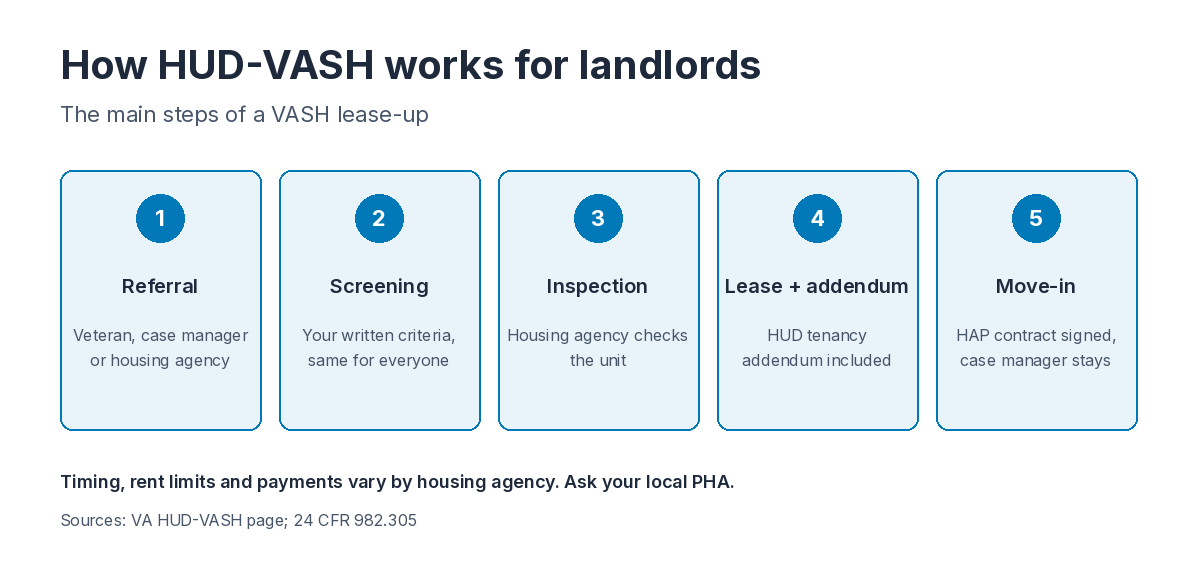
Under 24 CFR 982.305(b), the inspection and the signed lease “including the HUD-prescribed tenancy addendum” are among the steps that must be completed before the beginning of the initial lease term.
Before the inspection, walk the unit yourself. Check that smoke alarms work, outlets and fixtures are safe, windows and doors lock, and there is hot water and working heat. Fix small issues early so the agency’s inspection goes smoothly.
Payment timing, rent limits and inspection schedules vary by housing agency. Call your local public housing agency and the VA medical center’s HUD-VASH team before you list, so you know their process.
What does the VA case manager do, and what don’t they do?
The VA case manager supports the veteran; you remain the landlord. The VA says case managers give “practical help with budgeting for rent, understanding a lease, and maintaining a positive relationship with their landlord.”
The VA also lists clinical support, such as connections to primary care. It describes ongoing case management that “continues for as long as needed.”
What the case manager doesn’t do is take over your role. You still:
- Set and apply your written screening criteria
- Collect the tenant’s share of rent
- Handle repairs and maintenance
- Enforce the lease the same way you would for any tenant
If a problem comes up during the tenancy, such as late rent or a noise complaint, talk to the tenant first, the same as you would with anyone. With the tenant’s okay, you can also loop in the case manager to help find a fix. Document what happened and follow your lease.
A good working practice is to ask the veteran, with their permission, who their case manager is and how to reach them. Keep that contact for questions about the tenancy, and keep the veteran’s health information out of it.
Can you screen a HUD-VASH applicant?
Yes. Screen a VASH applicant with the same written criteria you use for every applicant, and apply them the same way.
Write your standards down before you list. Our guide to tenant screening criteria walks through how to build a fair, consistent policy.
Keep questions focused on the tenancy. Rental history and ability to pay the tenant’s share are fair topics. Don’t ask about a veteran’s disability, health or treatment. Fair housing rules apply to every applicant, and state and local rules may add more.
The Tenant Fit Index (TFI) is Apartment One’s 0-100 score matching a renter to a property based on credit, income-to-rent ratio, eviction history, criminal history, and lifestyle preferences. The TFI is a tool used alongside each landlord’s written criteria, not a ranking or a decision-maker.
How do you list a VASH-friendly rental?
List the unit where voucher holders search, say you accept vouchers, and connect with your local housing agency and VA HUD-VASH team. Apartment One supports VASH rentals and Section 8 rentals.
Apartment One is an online platform where renters complete a verified background and credit screening once, then get matched to rental properties they qualify for, while landlords list properties for free and receive pre-screened applicants.
As a Property Partner, you list for free and receive pre-screened applicants, with in-app messaging to talk with them. For other options, see our roundup of free rental listing sites for landlords.
In your listing, keep the details clear: rent, deposit, move-in date, pet policy and a line that you accept vouchers. Renters looking for voucher-friendly homes can use our guide to apartments that accept Section 8.
Apartment One is FCRA-compliant and follows GLBA and CCPA data handling. Data is encrypted, and payments are processed through Stripe.
List your rental free and receive pre-screened applicants, including VASH renters.
Frequently asked questions
Do I have to accept VASH vouchers?
It depends on where your rental is. Some states and cities have source-of-income laws that cover vouchers, so check your state and local rules or ask your local housing agency.
Who pays the rent with a HUD-VASH voucher?
The voucher pays part of the rent and the veteran pays a share. The VA says the Housing Choice Voucher “helps pay rent for qualifying housing,” and your local housing agency sets how payments work.
Does the unit need an inspection?
Yes. Under 24 CFR 982.305(a), the housing agency can’t approve the tenancy or sign a HAP contract until the unit “has been inspected by the PHA and passes HQS.”
How many HUD-VASH vouchers are there?
According to the VA, HUD has awarded more than 116,000 HUD-VASH vouchers since 2008, including Tribal HUD-VASH rental subsidies.
Where do I start as a HUD-VASH landlord?
Call your local public housing agency and the HUD-VASH team at your nearest VA medical center. Ask how referrals, inspections and payments work locally, then list your unit as voucher-friendly.