

HUD’s May 22, 2026 FHEO memo is enforcement guidance, not a nationwide ban on emotional support animals. FHEO says it will find reasonable cause and recommend charges only for animals trained to provide disability-related assistance. State and local fair housing rules, and private lawsuits, can still apply. Get counsel before you change a pet or accommodation policy.
General information, not legal advice. Check your state and local fair housing law and talk to counsel before you change a policy.
What changed in HUD’s May 2026 ESA guidance?
On May 22, 2026, FHEO permanently rescinded its January 28, 2020 assistance-animal notice and limited its animal-related enforcement focus to trained disability-assistance animals. The change is enforcement guidance, not a final rewrite of the Fair Housing Act statute.
According to the HUD FHEO Enforcement Guidance memorandum from Assistant Secretary Craig W. Trainor dated May 22, 2026, for animal-related reasonable accommodation complaints FHEO “will find reasonable cause and recommend charges only for those cases involving animals trained to provide disability-related assistance.”
The same May 22, 2026 FHEO memorandum permanently rescinds FHEO’s January 28, 2020 notice on assistance animals and states that the guidance does not address how HUD will process complaints under Section 504 of the Rehabilitation Act or the ADA.
The same memorandum notes that over 20% of FHEO’s fair housing complaints had revolved around untrained ESAs under the prior approach, and that HUD intends future notice-and-comment rulemaking on animal-related reasonable accommodations.
As Holland & Knight summarized in June 2026, this is a change in federal FHEO enforcement posture; state and local laws are not rewritten by the memo.
What is the difference between a service animal, an assistance animal, and an emotional support animal in housing?
Under the May 2026 FHEO posture, the key line is training: animals individually trained to perform disability-related work or tasks are the focus of FHEO enforcement, while untrained emotional support animals are not treated the same way for FHEO charging decisions.
The May 22, 2026 FHEO memorandum says FHEO will use the training component of the ADA service-animal definition to assess Fair Housing Act animal-related reasonable accommodation complaints, and that FHEO will find reasonable cause for failure to waive a pet policy “only where the animal has been individually trained to perform work or perform tasks directly related to the complainant’s disability.”
A footnote in the same FHEO memorandum notes that, unlike Titles II and III of the ADA, an animal-related reasonable accommodation under the Fair Housing Act could involve a species other than a dog, provided the animal is trained to perform a disability-related service.
For broader pet rent, pet deposits and everyday pet-policy basics that this post does not repeat, see our pet policy for rental property guide.
What can landlords ask after the May 2026 FHEO guidance?
Focus questions on whether the animal is individually trained to perform disability-related work or tasks, document consistently, and check state or local rules before you rely only on the federal memo. There’s no official federal form for ESA documentation.
Under the May 22, 2026 FHEO memorandum, requests to waive pet policies for trained assistance animals are “presumptively reasonable,” while requests for untrained ESAs are not, and FHEO “no longer expects housing providers to categorically extend accommodations for trained assistance animals to untrained ESAs.”
Practical documentation steps that stay aligned with that training focus (suggestions, not a promise every question is lawful in every state):
- Ask whether the animal has been individually trained to do work or perform tasks directly related to the resident’s disability.
- Ask what work or tasks the animal is trained to perform (not a demand for a medical diagnosis in every case – follow counsel for disability inquiry limits).
- Keep the same written process for every request and save the dates, answers and your decision.
- Confirm whether your state or city fair housing agency still treats untrained ESAs differently from FHEO.
For disability-related questioning limits and other interview risks, see questions landlords can’t ask. For how to write criteria once and reuse them, see tenant screening criteria.
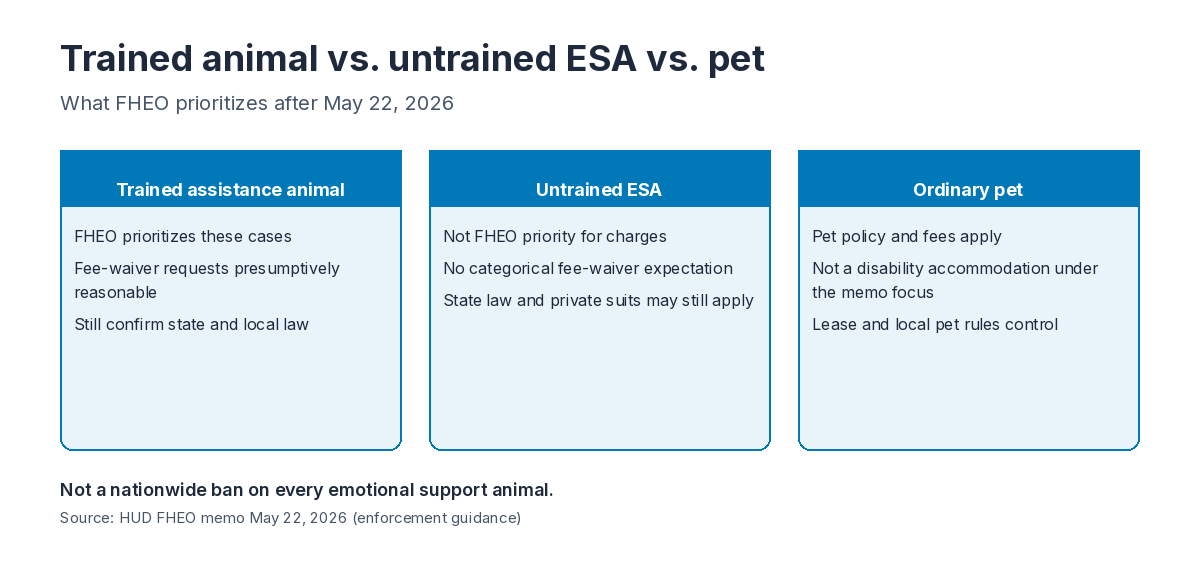
| Animal type | FHEO enforcement posture after May 22, 2026 | Still check state/local? |
|---|---|---|
| Trained assistance / service animal | FHEO will find reasonable cause and recommend charges only for trained disability-assistance animals; fee-waiver requests for trained animals are presumptively reasonable | Yes |
| Untrained emotional support animal (ESA) | FHEO no longer expects categorical accommodations (including fee waivers) for untrained ESAs; those requests are not presumptively reasonable | Yes – state agencies and private lawsuits may still apply |
| Ordinary pet | Pet policy and pet fees apply under the lease; not framed as a disability accommodation under the memo’s trained-animal focus | Yes – lease and local pet rules still control |
Do landlords still have to waive pet deposits or pet rent for untrained ESAs?
Under the May 2026 FHEO guidance, FHEO no longer expects housing providers to categorically waive pet policies or fees for untrained ESAs, but state or local law and private lawsuits can still create separate risk.
The May 22, 2026 FHEO memorandum states that FHEO will find reasonable cause for failure to waive a pet policy only where the animal has been individually trained to perform disability-related work or tasks, and that FHEO no longer expects categorical extension of trained-animal accommodations to untrained ESAs.
Holland & Knight’s June 2026 summary likewise states that housing providers are no longer expected by FHEO to categorically grant accommodation requests (including fee waivers) for untrained ESAs, and that state and local laws are not impacted by this change in federal FHEO policy.
The Housing Equality Center of Pennsylvania warns that until a final HUD rule is issued and takes effect, courts may still rely on prior case law, and individuals who allege denial of an ESA accommodation can still sue in federal court.
Do state fair housing laws and private lawsuits still apply?
Yes. The FHEO memo preserves private civil actions, and state or local agencies may still accept ESA-related complaints even when FHEO will not charge those cases.
The May 22, 2026 FHEO memorandum states that nothing in the enforcement guidance affects a complainant’s right to file a private civil action in federal or state court within two years after the alleged discriminatory housing practice.
According to the Housing Equality Center of Pennsylvania, state agencies such as the Pennsylvania Human Relations Commission may still accept ESA complaints, and consumers who are denied an untrained ESA accommodation may need to use court or state processes rather than expecting an FHEO probable-cause finding.
Holland & Knight similarly notes that private litigants retain the ability to bring Fair Housing Act claims and that state and local laws are not rewritten by the federal enforcement change.
Do not treat the memo as a nationwide ban on emotional support animals.
How should landlords update pet and accommodation policies?
Review written pet and accommodation criteria, distinguish trained assistance animals from pets and untrained ESAs, document every request the same way, and get fair-housing counsel for your portfolio and state before you publish a new policy.
- Separate lease language for ordinary pets from the process used for disability-related animal requests.
- Write when you will ask about training and what you will record.
- Apply the same steps to every applicant and resident.
- Flag state or city rules that still go beyond FHEO’s enforcement focus.
- Train leasing staff so answers match the written policy.
For another example of written screening criteria used alongside a changing legal backdrop, see fair chance housing laws. When you refresh lease packets, use the lease agreement checklist.
How does Apartment One fit in for landlords?
Apartment One helps you list free and receive pre-screened applicants while you keep written animal and screening criteria that match your counsel’s advice. You still make every accommodation and leasing decision.
Apartment One is an online platform where renters complete a verified background and credit screening once, then get matched to rental properties they qualify for, while landlords list properties for free and receive pre-screened applicants.
Screening covers credit (FICO 9 from Experian), eviction and criminal records. Landlords receive pre-screened applicants and can message in-app.
The Tenant Fit Index (TFI) is Apartment One’s 0-100 score matching a renter to a property based on credit, income-to-rent ratio, eviction history, criminal history, and lifestyle preferences. The TFI is a tool used alongside written criteria, not a ranking or a decision-maker.
Apartment One is FCRA-compliant and follows GLBA and CCPA data handling. Data is encrypted, and payments are processed through Stripe.
Screen applicants with clear written criteria, then list your rental for free.
Frequently asked questions
Did HUD ban emotional support animals nationwide?
No. The May 22, 2026 FHEO memorandum changes FHEO enforcement priorities for animal-related complaints. It does not rewrite the Fair Housing Act statute, and state law, future HUD rulemaking and private lawsuits still matter.
Do I still have to allow a trained service animal?
Under the memo’s trained-assistance focus, FHEO will prioritize cases involving animals trained to provide disability-related assistance, and fee-waiver requests for those animals are presumptively reasonable. Confirm ADA and state rules that apply to your property.
Can I charge a pet deposit for an untrained ESA now?
FHEO no longer expects categorical fee waivers for untrained ESAs, according to the May 22, 2026 memorandum and Holland & Knight’s summary. Check state and local fair housing law and talk to counsel before you charge or refuse.
Can a tenant still sue me over an ESA denial?
Yes. The FHEO memorandum states that nothing in the guidance affects the right to file a private civil action in federal or state court within two years.
Does this change Section 504 or ADA processing?
The May 22, 2026 FHEO memorandum says the guidance does not address how HUD will process complaints under Section 504 of the Rehabilitation Act or the ADA.