

Fair chance housing laws limit when and how landlords can use an applicant’s criminal history. Some, like Maryland’s new law, require a conditional offer before a criminal check and a written reason if you withdraw it. Rules differ by state and city, so check where your rental is before you screen.
General information, not legal advice. Check your state and local law.
What are fair chance housing laws?
Fair chance housing laws are state or local rules on when and how a landlord can use criminal history to screen applicants. They often control the timing of the criminal check, what records can be considered, and what you must do if you deny someone.
There is no single national fair chance housing law. Coverage depends on your state, county and city. Some places have none. Start by checking the rules where your rental is located.
This guide covers the landlord side. Renters can read our guide on renting an apartment with a criminal record.
What does Maryland’s new Fair Chance Housing Act require?
Maryland’s Fair Chance Housing Act generally requires covered landlords to make a conditional offer before checking criminal history. According to the Maryland Department of Housing and Community Development, the law (SB 937, Chapter 752) took effect October 1, 2026.
The Maryland DHCD notice says the law applies to “housing providers who own or manage five or more residential units in Maryland.” It does not apply to owner-occupied rental units or to providers who don’t run criminal background checks.
Here is what the Maryland DHCD notice says the law does:
- Conditional offer first: A housing provider “generally must make a conditional offer of housing before checking an applicant’s criminal history.”
- Reason and reassessment: If the provider withdraws a conditional offer based on criminal history, it must give the reason, and the applicant may request a reassessment.
- No exclusion ads: Providers may not advertise that they will not consider applicants with criminal histories.
- No drug or alcohol testing: Providers may not require prospective tenants to take drug or alcohol tests.
- Penalties: Up to $500 per violation.
The DHCD notice also says the department is developing voluntary model forms, and providers are not required to use them.
New Jersey has a similar timing rule: under N.J.S.A. 46:8-55(a)(2), “A housing provider shall not make any oral or written inquiry regarding an applicant’s criminal record prior to making a conditional offer.”
The table below compares the two places covered in detail in this guide. It isn’t a full list.
| Maryland Fair Chance Housing Act | Seattle Fair Chance Housing Ordinance | |
|---|---|---|
| Where it applies | Providers with five or more units in Maryland; not owner-occupied units | Rentals in the City of Seattle |
| When you can check | Generally after a conditional offer | Asking is allowed after the 2023 ruling; check city rules on timing |
| If you deny | Give the reason; applicant can request reassessment | Adverse action based on criminal history remains barred |
Can landlords still ask about criminal history in Seattle?
Asking is no longer barred, but acting on the answer still is. In Yim v. City of Seattle (2023), the Ninth Circuit held that the ordinance’s inquiry provision violated the First Amendment, but rejected the challenge to its adverse action provision.
The Ninth Circuit’s 2023 opinion describes Seattle’s ordinance as one that “prohibits landlords from inquiring about the criminal history of current or potential tenants and from taking adverse action, such as denying tenancy, against them based on that information.”
In a 2025 Ninth Circuit memorandum, the court affirmed that “the Inquiry Provision is severable from the rest of the FCHO,” so the rest of the ordinance remains in place. That memorandum is unpublished and not precedent under Ninth Circuit rules.
In practice, a Seattle landlord should not deny an applicant based on criminal history. Keep records of how you made each decision. Check the city’s current rules before you build a screening process there.
Did HUD’s criminal records guidance change?
Yes. A HUD notice in the Federal Register (published July 17, 2026) says HUD’s Office of General Counsel withdrew its April 4, 2016 guidance, “Application of Fair Housing Act Standards to Use of Criminal Records,” effective September 25, 2025.
The same Federal Register notice says the withdrawn documents “should not be relied upon as authoritative.”
The Fair Housing Act itself has not changed. Under 42 U.S.C. 3604(b), it is unlawful to discriminate in the terms, conditions or privileges of rental because of race, color, religion, sex, familial status or national origin. Section 3604(f) separately prohibits discrimination in rental because of a handicap.
State and local fair chance laws also still apply where they exist. The withdrawal changed federal guidance, not those laws.
How do you screen criminal history the fair chance way?
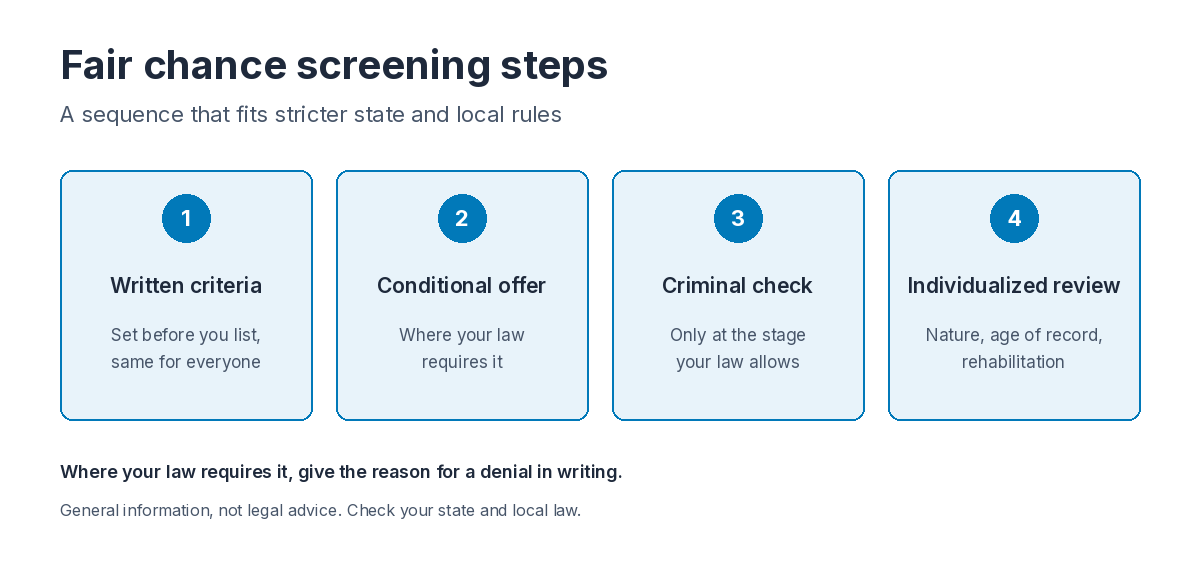
Write your criteria first, make a conditional offer where required, run the criminal check, review each case individually, and give a written reason if you deny. This order fits the stricter local rules. It’s a good habit everywhere.
- Written criteria: Decide what you check and why before you list, and apply it to everyone.
- Conditional offer: Where the law requires it, review income, rental history and credit first, then make a conditional offer.
- Criminal check: Run the check only at the stage your law allows.
- Individualized review: Look at the nature of any record and how long ago it happened. Consider any evidence of rehabilitation the applicant provides.
- Written reason: If you deny or withdraw an offer, explain why in writing and follow any reassessment process.
Our guide to tenant screening criteria explains how to write your standards. For the full check itself, see our tenant background check guide for landlords.
If a screening report plays a part in a denial, federal notice rules may also apply; our guide to the adverse action notice for landlords covers those steps.
Keep your questions consistent, too. Ask every applicant the same things at the same stage. Our guide to questions landlords can’t ask covers what to avoid in calls, showings and applications.
How does Apartment One fit in?
Apartment One helps you collect pre-screened applicants. You keep control of your written criteria and the timing your local law requires. You make every decision.
Apartment One is an online platform where renters complete a verified background and credit screening once, then get matched to rental properties they qualify for, while landlords list properties for free and receive pre-screened applicants.
Screening covers credit (FICO 9 from Experian), eviction and criminal records. See how Apartment One tenant screening works, and check that the stage at which you review criminal records matches your local law.
The Tenant Fit Index (TFI) is Apartment One’s 0-100 score matching a renter to a property based on credit, income-to-rent ratio, eviction history, criminal history, and lifestyle preferences. The TFI is a tool used alongside each landlord’s written criteria, not a ranking or a decision-maker.
Apartment One is FCRA-compliant and follows GLBA and CCPA data handling. Data is encrypted, and payments are processed through Stripe.
List your rental free and get pre-screened applicants, then apply your written criteria the same way to everyone.
Frequently asked questions
Do fair chance housing laws apply to small landlords?
It depends on the law. The Maryland DHCD notice says Maryland’s act covers providers with five or more units in the state and not owner-occupied units. Check your own city and state rules.
Can I put “no felonies” in my rental ad?
Not in Maryland: the Maryland DHCD notice says providers may not advertise that they will not consider applicants with criminal histories. Elsewhere, check local law, and see our guide to questions landlords can’t ask.
Do I have to run a criminal check at all?
Fair chance laws limit how you use a criminal check rather than requiring one. The Maryland DHCD notice says a provider’s decision not to check criminal history may not be the basis for a civil claim against the provider.
What is a conditional offer?
A conditional offer is an offer to rent that depends on the remaining screening, such as a criminal check. Under the Maryland DHCD notice, covered providers generally must make one before checking criminal history.
Is HUD’s 2016 criminal records guidance still in effect?
No. A HUD Federal Register notice says it was withdrawn effective September 25, 2025. The Fair Housing Act and state and local laws still apply.