

Do not throw a former tenant’s belongings away the day they leave. First confirm the tenancy has ended and the unit is vacant, then follow your state’s leftover-property law. California requires written notice and a claim period before sale or disposal; Texas has no general rule for voluntary move-outs, so check the lease and get advice.
General information, not legal advice. Abandoned-property notice periods, storage rules, sale procedures, and value thresholds vary by state and by whether the tenant moved out or was evicted. Talk to a local attorney before you store, sell, or dispose of belongings.
When is leftover tenant property legally abandoned?
It depends on state law. California’s process applies when property remains after the tenancy has ended and the tenant has vacated, while Texas has no general statute for property left after a voluntary move-out.
California (state-specific): California Civil Code section 1983 applies where personal property remains on the premises after a tenancy has terminated and the tenant has vacated the premises. Both conditions matter: a unit that still has a tenant is not covered by this process.
Texas (state-specific): The Texas State Law Library’s guide to a tenant’s abandoned property says the law does not say how a landlord should handle a tenant’s abandoned property if the tenant moves out voluntarily, and that this might be outlined in the lease agreement.
Rules for other states differ. Do not borrow California’s or Texas’s steps if you rent elsewhere; check your own state’s statute and local rules.
What notice do landlords have to give before storing or disposing of belongings?
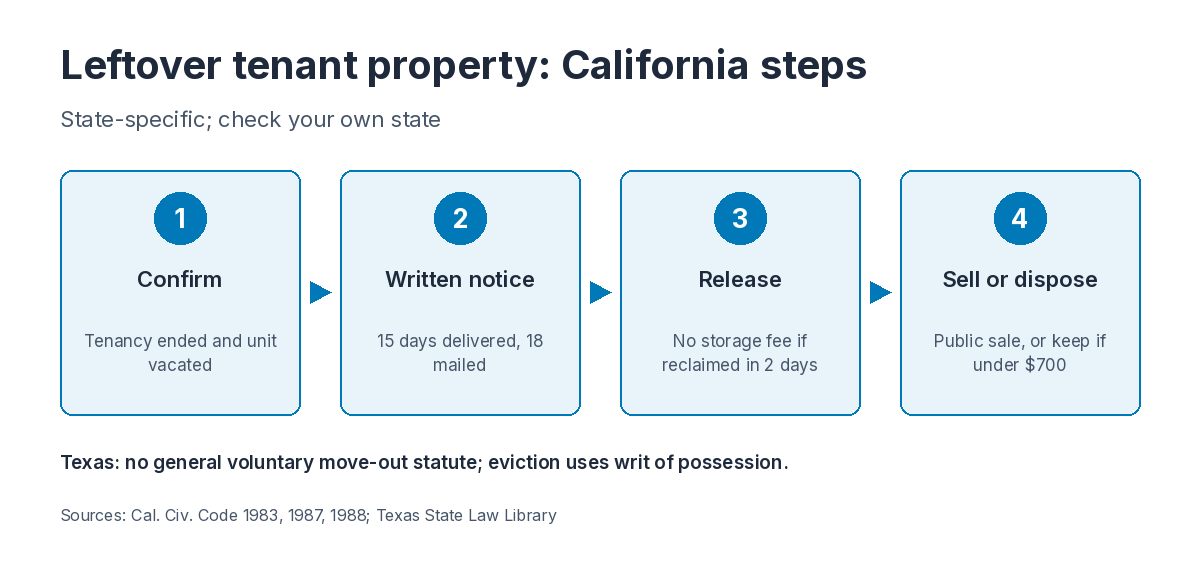
In California, the landlord must give written notice that describes where the property can be claimed, that reasonable storage costs may be charged, and the deadline to claim it, which must be at least 15 days after personal delivery or 18 days after mailing.
Civil Code section 1983, subdivision (b), says: “The date specified in the notice shall be a date not less than 15 days after the notice is personally delivered or, if mailed, not less than 18 days after the notice is deposited in the mail.”
Under section 1983, the notice must be personally delivered or sent by first-class mail, postage prepaid, to the person’s last known address. If mailed to the former tenant, a copy also goes to the vacated premises, and if the former tenant provided an email address, the landlord may also send the notice by email.
In Texas, the Texas State Law Library’s guide to a tenant’s abandoned property does not describe a general notice for property left after a voluntary move-out. Check the lease and ask a local attorney before acting.
Can a landlord charge storage costs or require the tenant to pick items up?
In California, a landlord can generally charge reasonable storage costs before releasing property, but not if the items stayed in the unit and the former tenant reclaims them within two days of vacating.
California Civil Code section 1987, subdivision (c), says: “Notwithstanding subdivision (a), the landlord shall release the personal property described in the notice to the former tenant and shall not require the former tenant to pay the cost of storage if the property remained in the dwelling and the former tenant or other person reasonably believed by the landlord to be its owner reclaims the property within two days of vacating the dwelling.”
The other subdivisions of section 1987 cover different release situations, including release when storage costs apply. Read the full section, and do not apply the two-day, no-storage-fee rule to items you have already moved out of the unit.
When can leftover property be sold or thrown away?
In California, unreleased property must be sold at a public sale by competitive bidding, unless the landlord reasonably believes its total resale value is less than $700, in which case the landlord may keep or dispose of it.
California Civil Code section 1988, subdivision (a), says: “If the personal property described in the notice is not released pursuant to Section 1987, it shall be sold at public sale by competitive bidding. However, if the landlord reasonably believes that the total resale value of the property not released is less than seven hundred dollars ($700), the landlord may retain the property for his or her own use or dispose of it in any manner. Nothing in this section shall be construed to preclude the landlord or tenant from bidding on the property at the public sale.”
Two points to note. The threshold is strictly less than $700, not $700 or less. And this step comes only after the notice and claim process; it is not a shortcut that lets you skip notice.
Texas after an eviction: The Texas State Law Library’s guide to a tenant’s abandoned property says the landlord must follow writ of possession procedures under Property Code sections 24.0061 and 24.0062, in which a law enforcement officer removes the tenant and their property. The property can be placed outside or in a nearby public location, but not while it is raining, sleeting or snowing, and it cannot block a public sidewalk or street.
The library says the landlord does not have to store the property, but the officer can hire a warehouseman to remove and store it. The warehouseman then has a lien, the tenant has 30 days to pay it to recover the property, and if it is not paid by the end of that period, the warehouseman can sell it. These steps apply after an eviction, not to a voluntary move-out.
| California (Civil Code 1983-1988) | Texas (State Law Library) | |
|---|---|---|
| Applies when | Tenancy terminated and tenant vacated | Voluntary move-out: no general statute; after eviction: writ of possession |
| Notice | Written; claim date at least 15 days (personal delivery) or 18 days (mail) | None described for voluntary move-out |
| Storage | Reasonable costs; none if items stayed in unit and reclaimed within 2 days | Landlord need not store after eviction; officer may hire a warehouseman |
| Sale or disposal | Public sale, or keep/dispose if value reasonably believed under $700 | Warehouseman may sell if 30-day lien unpaid |
Is leftover property the same as a notice that the tenant abandoned the unit?
No. Leftover-property rules deal with belongings after the tenancy has ended. Deciding whether a tenant has abandoned the unit itself is a separate question with its own procedure, so do not combine the two.
If you are unsure whether the tenancy has actually ended, resolve that first with counsel before treating any belongings as abandoned.
What practical steps reduce risk with leftover belongings?
Photograph and list the items, keep them secure, and keep copies of every notice you send. These are suggestions, not statutes.
- Take dated photos of each item where it was left.
- Write an inventory, and note anything locked or sealed without opening it.
- Keep copies of notices, mailing receipts and any emails.
- Track the claim deadline on a calendar.
- Add a leftover-property clause to future leases where your state allows; see our lease agreement checklist.
Leftover belongings are separate from the deposit. For deposit rules, see security deposit laws, and for the move-out walk-through, see our move-in inspection checklist.
How does Apartment One fit in for landlords?
Once the unit is clear, you can list it for free and receive pre-screened applicants. For more on turnover, see how to reduce rental vacancy.
Apartment One is an online platform where renters complete a verified background and credit screening once, then get matched to rental properties they qualify for, while landlords list properties for free and receive pre-screened applicants.
Screening covers credit (FICO 9 from Experian), eviction and criminal records, and landlords can message applicants in-app.
The Tenant Fit Index (TFI) is Apartment One’s 0-100 score matching a renter to a property based on credit, income-to-rent ratio, eviction history, criminal history, and lifestyle preferences. The TFI is a tool used alongside written criteria, not a ranking or a decision-maker.
Apartment One is FCRA-compliant and follows GLBA and CCPA data handling. Data is encrypted, and payments are processed through Stripe.
List your rental for free and get pre-screened applicants.
Frequently asked questions
Can I throw away items the day the tenant moves out?
Not under California’s notice-and-claim process, which requires written notice and a claim date first. Texas has no general voluntary-move-out statute, so check the lease and get advice.
What if the property looks like it is worth very little in California?
California Civil Code 1988 lets the landlord keep or dispose of unreleased property if the landlord reasonably believes its total resale value is less than $700, after the notice process.
Does Texas require me to store evicted tenants’ property?
The Texas State Law Library says the landlord does not have to store it. An officer may hire a warehouseman, who then has a lien the tenant has 30 days to pay.
Should this go in the lease?
In Texas, the library notes voluntary move-out handling might be outlined in the lease. A lease clause does not replace following a statute where one exists.
Is this legal advice?
No. Talk to a local attorney before you store, sell, or dispose of a former tenant’s belongings.