

A notice to pay or quit is the written demand a landlord serves before filing an eviction for unpaid rent. It tells the tenant to pay the rent owed or leave by a deadline. Rules vary by state. This guide uses California courts as a worked example and tells you to check your own state.
General information, not legal advice. Eviction and notice rules vary by state and city. Do not use self-help lockouts or utility shutoffs.
What is a notice to pay or quit?
It is a written pre-eviction demand that gives the tenant a chance to pay the rent owed or move out before the landlord starts a court eviction case.
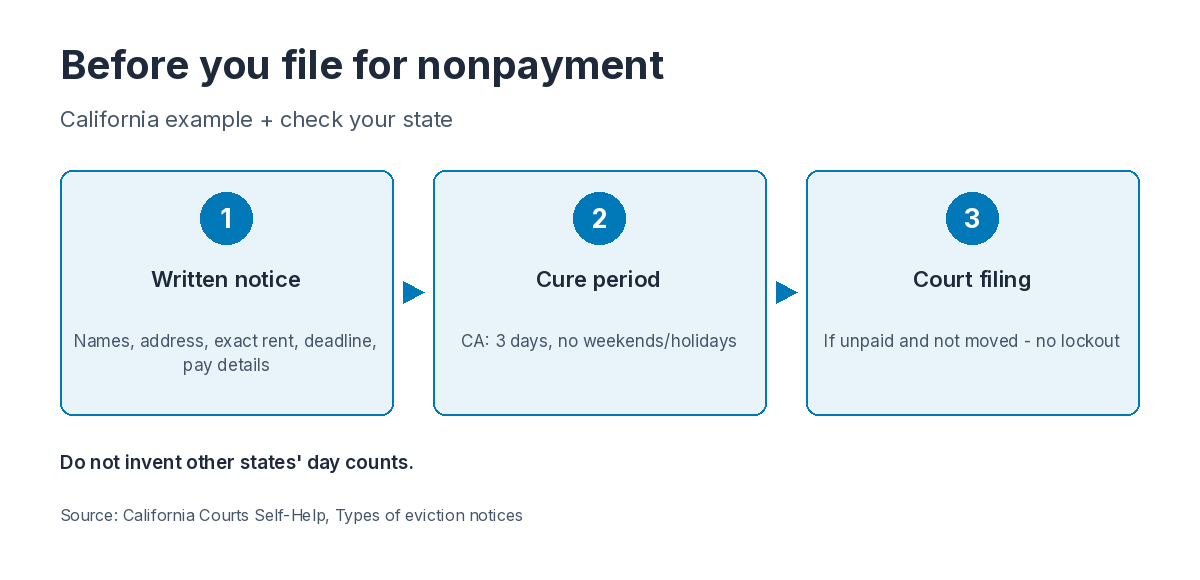
According to the California Courts Self-Help page on types of eviction notices, before a landlord can start an eviction court case, the landlord must give the tenant a written notice. For unpaid rent, California uses a “3-day notice to pay rent or quit.”
The same California Courts page warns that eviction notices are not court forms, and that if the notice has mistakes or is missing information, you could lose your case.
When do landlords use a pay-or-quit notice?
Use it when rent is unpaid and your state requires a written nonpayment notice before an eviction filing. Other lease problems use different notice types.
The California Courts notice-types page lists several notice types, including a 3-day notice to pay rent or quit for unpaid rent, notices to perform covenants or quit for fixable lease violations, and unconditional quit notices for serious problems. This post sticks to nonpayment.
What must a California 3-day notice to pay rent or quit include?
Under California Courts guidance, the notice must name the tenant(s), list the rental address, state the exact rent owed, give the deadline to pay or move, and spell out how, where and when to pay. It cannot add late fees, utilities or damages to that notice type, and the 3 days do not count weekends or court holidays.
According to the California Courts Self-Help guide, a 3-day notice to pay rent or quit must include:
- Tenant’s full name(s)
- Rental home address
- Exact amount of rent owed
- That rent must be paid within 3 days or the tenant must move out
- How and where to pay (in person or by mail, with address, days and hours)
The same California Courts page states that the 3 days do not include Saturdays, Sundays and court holidays, and that you cannot ask for other money such as late fees, utilities or damages in this notice type.
Late fees are a separate topic from what belongs on a California pay-or-quit notice. Confirm your state’s late-fee rules before you charge them, and do not copy California’s day count into another state.
| Checklist item (California example) | Required on CA pay-or-quit? | Source note |
|---|---|---|
| Tenant full name(s) | Yes | CA Courts Self-Help |
| Rental address | Yes | CA Courts Self-Help |
| Exact rent owed only | Yes – no late fees, utilities or damages on this notice type | CA Courts Self-Help |
| Deadline to pay or move | Yes; 3 days not counting weekends/court holidays | CA Courts Self-Help |
| Payment details (how, where, when) | Yes | CA Courts Self-Help |
| Proof of proper service | Follow your state’s service rules | Check state law; CA page focuses on written contents |
Your state may differ. Do not copy California’s 3-day rule elsewhere.
What happens after the notice period ends?
If the tenant still has not paid and has not moved, the landlord may start an eviction court case. Mistakes on the notice can lose the case, and self-help lockouts or utility shutoffs are not a lawful shortcut.
The California Courts Self-Help guide is clear that you must give the correct written notice before starting an eviction court case, and that a flawed notice can cost you the case. Eviction after a proper notice period is a court process.
Do not change locks, remove doors, shut off utilities or otherwise force a move-out outside of court. Those self-help tactics create separate legal risk.
Common notice mistakes drawn from the California Courts page include wrong rent amounts, adding late fees or utilities to a pay-or-quit, and miscounting the 3 days by including a weekend or court holiday. Fix the notice before you file.
Keep a copy of the notice you served, the exact rent ledger that supports the amount claimed, and a dated record of how and when you delivered the notice. If a judge later asks how the tenant received it, you will need that proof.
How do rules differ by state?
Day counts, required wording, service methods and what money can appear on the notice all vary. Verify your state’s official self-help materials or statutes instead of exporting California’s 3-day example.
Notice periods vary by state, so check your state’s statute before serving one. If you operate outside California, open your state court self-help site or landlord-tenant statute and confirm the nonpayment notice rules that apply to your address.
For rent increases, which use different notice rules, see rent increase notice. For deposits at the start of a tenancy, see security deposit laws.
How can landlords reduce unpaid-rent risk before it starts?
Clear lease terms, consistent screening and written criteria reduce how often nonpayment notices are needed. They do not eliminate every missed payment.
Write the rent due date, grace period and accepted payment methods into the lease. Use the lease agreement checklist before you renew forms. Keep screening criteria written and applied the same way with tenant screening criteria, and see how to find good tenants for sourcing applicants.
Screen for ability to pay using the same written income and credit standards for every applicant. Pair that with a clear late-payment conversation in the lease so tenants know the due date, any grace period and what happens next if rent is unpaid.
When rent first goes late, document reminders in writing before you escalate to a statutory notice. A calm paper trail helps if you later need a court filing, and it gives a good tenant a chance to catch up when a one-time issue is involved.
How does Apartment One fit in for landlords?
Apartment One helps you list free and receive pre-screened applicants while you keep written payment and screening rules. You still decide every lease and every notice.
Apartment One is an online platform where renters complete a verified background and credit screening once, then get matched to rental properties they qualify for, while landlords list properties for free and receive pre-screened applicants.
Screening covers credit (FICO 9 from Experian), eviction and criminal records. Landlords receive pre-screened applicants and can message in-app.
The Tenant Fit Index (TFI) is Apartment One’s 0-100 score matching a renter to a property based on credit, income-to-rent ratio, eviction history, criminal history, and lifestyle preferences. The TFI is a tool used alongside written criteria, not a ranking or a decision-maker.
Apartment One is FCRA-compliant and follows GLBA and CCPA data handling. Data is encrypted, and payments are processed through Stripe.
Prevent unpaid-rent problems with clear criteria and pre-screened applicants.
Frequently asked questions
Can I include late fees on a California pay-or-quit notice?
No. California Courts Self-Help says you cannot ask for other money such as late fees, utilities or damages on a 3-day notice to pay rent or quit.
Can I change the locks if rent is late?
No. After a proper notice period, eviction is a court process. Do not use self-help lockouts or utility shutoffs.
Is a text message enough notice?
The California Courts page focuses on written notices with required contents. Follow your state’s service rules for how the notice must be delivered.
Does a pay-or-quit end the lease automatically?
It starts a cure-or-quit clock. If the tenant neither pays nor moves, you usually still need a court eviction case.
Where do I find the right form?
California Courts says eviction notices are not court forms. Blank notices may come from self-help books, online sources, a lawyer or some court self-help centers.