

Rental scams are fake or hijacked listings used to take your money or personal information before you ever see a home. Common signs include rent far below market, pressure to pay before a tour, and requests for wire transfers, gift cards or crypto. Search the address, see the unit, and never pay until you’ve confirmed who owns it.
Rental scams cost renters millions every year, and they often start online. Here’s how they work, the red flags to watch for, and what to do if you’ve already paid.
How common are rental scams?
Very common. The Federal Trade Commission tracks tens of thousands of reports, and the losses are large.
The FTC reported on December 22, 2025 that people have reported nearly 65,000 rental scams since 2020, with about $65 million in losses.
In the same analysis, about half of people who reported a rental scam in the year ending June 2025 said it started with a fake ad on Facebook.
Younger renters are hit hardest. The FTC found that people ages 18 to 29 were three times more likely than other adults to report losing money to a rental scam.
Renting for the first time? See our guide to renting your first apartment.
How do rental scams work?
Most rental scams use one of two tricks. Scammers either copy a real listing or invent one from scratch.
The FTC’s rental listing scams page describes both methods.
- Hijacked listings: scammers take over a real listing and swap in their own email or phone number.
- Fake listings: scammers post places that aren’t for rent, or that don’t exist, often at a very low price.
Either way, the goal is the same. The scammer wants a deposit, “first month’s rent” or your personal details before you notice anything is wrong.
Some scams target your data instead of your cash. The FTC’s December 2025 analysis says fake landlords may ask for your Social Security number, driver’s license or pay stubs.
What are the red flags of a rental scam?
The biggest red flag is a request for money before you’ve seen the unit. Watch for these seven warning signs:
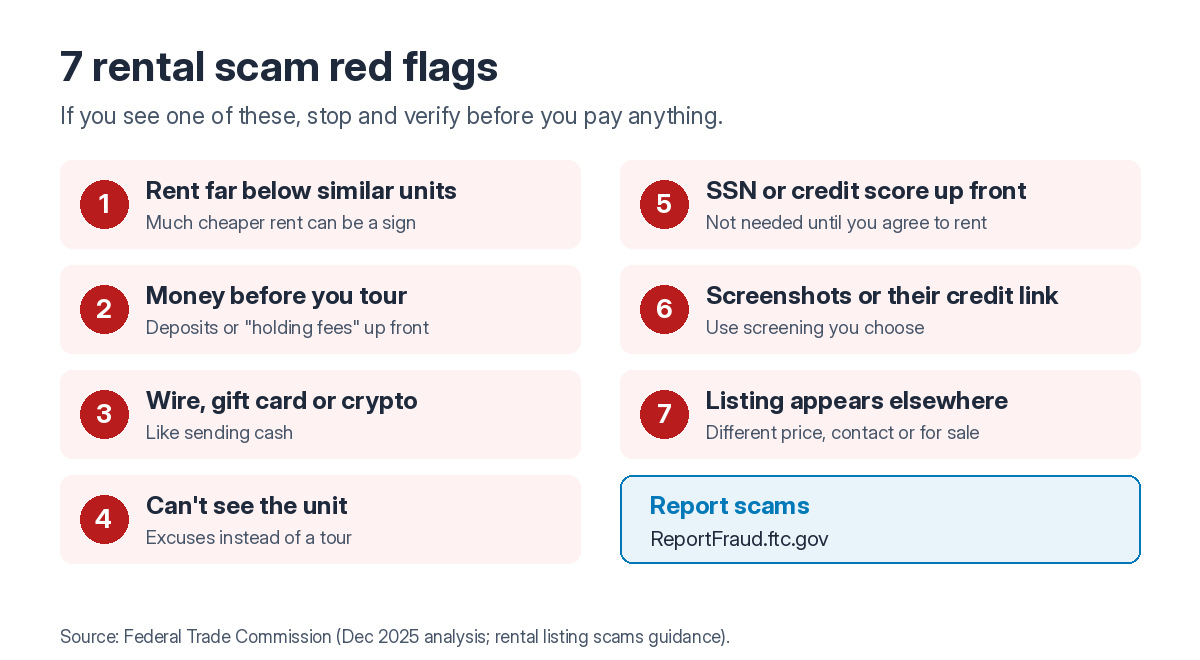
- The rent is far below similar units. The FTC says much cheaper rent can be a sign of a scam.
- They want money before you tour. A deposit or “holding fee” for a place you haven’t seen is a classic setup.
- They ask for a wire, gift card or crypto. These payments are hard to trace or reverse.
- They can’t show you the unit. Excuses like “I’m out of the country” or “just drive by” are common.
- They want your SSN or credit score up front. A real landlord can wait until you’ve agreed to rent.
- They send a screenshot or “credit check” link request. They ask for a credit score screenshot or push you to a link they chose.
- The same listing shows up elsewhere. A different price, contact or a for-sale listing for the same address is a warning.
Pressure is another tell. A scammer may claim other people are about to grab the unit, so you have to pay today.
How do you verify a rental listing is real?
Check the property, the owner and the person you’re talking to. Each step takes a few minutes and can save you thousands.
These steps come from the FTC’s rental listing scams page:
- Search the address with the owner’s name. See whether the same unit appears with a different contact or price.
- Check the rental company’s own website. Make sure the listing is posted there too.
- Search the owner or company name. Add words like “complaint,” “review” and “scam.”
- See it in person. Visit, ask a friend to go, or watch a live video tour. The FTC warns that self-guided tours can be faked too.
- Confirm the agent. Ask for a business card and check their ID.
- Confirm the owner. For a private landlord, look up the property on your city or county tax assessment site, then check their ID.
Want to know what real rent looks like? Our guide on how much rent you can afford shows how to check prices against your budget.
Should you pay a deposit before seeing an apartment?
No. Don’t pay a deposit, application fee or first month’s rent until you’ve seen the unit and confirmed the landlord is real.
The FTC’s December 2025 analysis lists asking for money before you see the unit as a common scam tactic.
Payment method matters too. The FTC’s rental listing scams page says paying by wire transfer, gift card or cryptocurrency “is the same as sending cash — once you send it, you probably can’t get it back.”
When you’re ready to pay, use a traceable method and get a written receipt. Also make sure you have a signed lease that names the landlord.
Application fees are normal with real landlords, but they should be clear. Our guide to rental application fees explains typical costs and state caps.
Should you send a landlord your credit score or SSN?
Not until you’ve seen the place and agreed to rent it. Real landlords usually run their own checks once you apply.
The FTC’s rental listing scams page says, “Until you’ve agreed to rent a place, a landlord doesn’t need your Social Security number, credit score, or other sensitive information.”
That page adds that most landlords normally pull your credit score themselves.
Be careful with credit check links too. The FTC’s December 2025 analysis warns that some fake landlords send affiliate links that may sign you up for a paid membership with recurring fees.
Not every screening link is a scam. Real landlords and platforms use online screening all the time.
The difference is control. Legitimate screening happens on a platform you choose and can check yourself, not through a link from an unverified “landlord” who won’t show you the unit.
What should you do if you’ve been scammed?
Act fast. Contact your payment provider right away, then report the scam so others can be warned.
The FTC’s rental listing scams page recommends reporting rental scams to these places:
- Your local law enforcement
- The website where you found the listing
- The FTC at ReportFraud.ftc.gov
- Your state attorney general
Next, call your bank, card issuer, wire service or gift card company. Ask whether they can stop or reverse the payment. Results vary, but speed helps.
If you shared your SSN or ID, watch your credit closely. You can get free credit reports from each bureau at AnnualCreditReport.com, according to the FTC’s free credit reports page.
How do you avoid rental scams during a military or out-of-state move?
Ask someone you trust to see the unit, and lean on official relocation help. Long-distance renters can’t drop by, so scammers target them.
The FTC’s July 13, 2026 consumer alert on military moves suggests asking someone you trust to tour the unit or drive by.
The alert also says the relocation or housing referral office at your new base may be able to help. Search the address online before you commit, too.
The same tips work for any out-of-state move. Ask for a live video tour, confirm the owner through public records, and never wire money to someone you haven’t met.
How does Apartment One help renters share screening safely?
With Apartment One, you screen once on a platform you chose. Then you decide which landlords see your report, instead of sending credit screenshots to strangers.
Apartment One is an online platform where renters complete a verified background and credit screening once, then get matched to rental properties they qualify for, while landlords list properties for free and receive pre-screened applicants.
The Tenant Fit Index (TFI) is Apartment One’s 0-100 score matching a renter to a property based on credit, income-to-rent ratio, eviction history, criminal history, and lifestyle preferences.
Your tenant screening covers FICO 9 credit from Experian, eviction records and criminal records. Quick Screen costs $35 one time and gives you a shareable report. Tenant Plus costs $60 one time and adds matched rentals and in-app messaging.
Your data is encrypted, and payments run through Stripe. Screening doesn’t replace your own checks, so still confirm every listing and landlord before you pay. Learn more on our renters page.
Share your screening on your terms. Screen once with Apartment One and send landlords a report you choose to share, instead of screenshots of your credit score.
Get started with Apartment One →See the $35 screening report
Frequently asked questions
What is the most common rental scam?
Fake and hijacked listings are among the most common. The FTC says about half of people who reported a rental scam in the year ending June 2025 said it started with a fake Facebook ad.
Should I give a landlord my Social Security number?
Not until you’ve seen the unit and agreed to rent it. The FTC says a landlord doesn’t need your SSN or credit score before then, and most landlords pull credit themselves.
Are Facebook rentals safe?
Some are real, but Facebook is a common starting point for scams. Search the address, confirm the owner through public records, and see the unit before you pay anything.
How do I report a rental scam?
Report it to the FTC at ReportFraud.ftc.gov, your local police, your state attorney general and the website where you found the listing.
Can I get my money back after a rental scam?
Sometimes, but not often. Contact your bank or payment service right away. The FTC says money sent by wire, gift card or crypto usually can’t be recovered.
2 Responses