

A pet policy for rental property states which pets you allow, any limits, and what you charge, such as pet rent, a pet fee or a pet deposit within your state’s deposit cap. Zillow reports 59% of renter households have a pet. Assistance animals for people with disabilities follow separate fair housing rules, not your pet policy.
Should you allow pets in your rental?
Allowing pets can widen your applicant pool and shorten vacancy, though it adds some risk. Zillow reports that 59% of renter households have a pet, including 40% with a dog and 31% with a cat. The same Zillow report says 65% of renters call pet-friendly housing “essential.”
Pet-friendly units also draw more attention. Zillow Research found that pet-friendly listings were typically leased eight days faster, based on more than 11 million listings. Zillow’s pet-friendly markets report adds that pet-friendly listings got 9% more views, 12% more saves and 11% more shares. Zillow also found that 62% of renters who didn’t move say pet-friendly policies were a factor in staying.
The trade-off is real. In a January 2026 survey by PetScreening, a pet-screening vendor, 81% of 673 property management and leasing professionals reported growth in pet ownership. The same survey named unauthorized pets and pet-related damage as leading issues. For more ways to fill units, see our guide on how to reduce rental vacancy.
What should a pet policy for rental property include?
A good policy is written, specific and applied the same way to every applicant. These are best practices, not legal requirements:
- Allowed pets: species, number and any size or weight limits.
- Local requirements: vaccination or licensing, if your city or county requires it.
- Charges: pet rent, a one-time pet fee or a refundable pet deposit, stated as separate items.
- Damage: who pays for pet damage beyond normal wear and tear.
- House rules: waste cleanup, noise, leashes and common areas.
- Unauthorized pets: what happens if a tenant adds a pet without approval.
- Assistance animals: a separate accommodation process that doesn’t run through your pet policy.
If you use a written screening template, add your pet rules to the matching row in our tenant screening criteria guide.
What’s the difference between pet rent, a pet fee and a pet deposit?
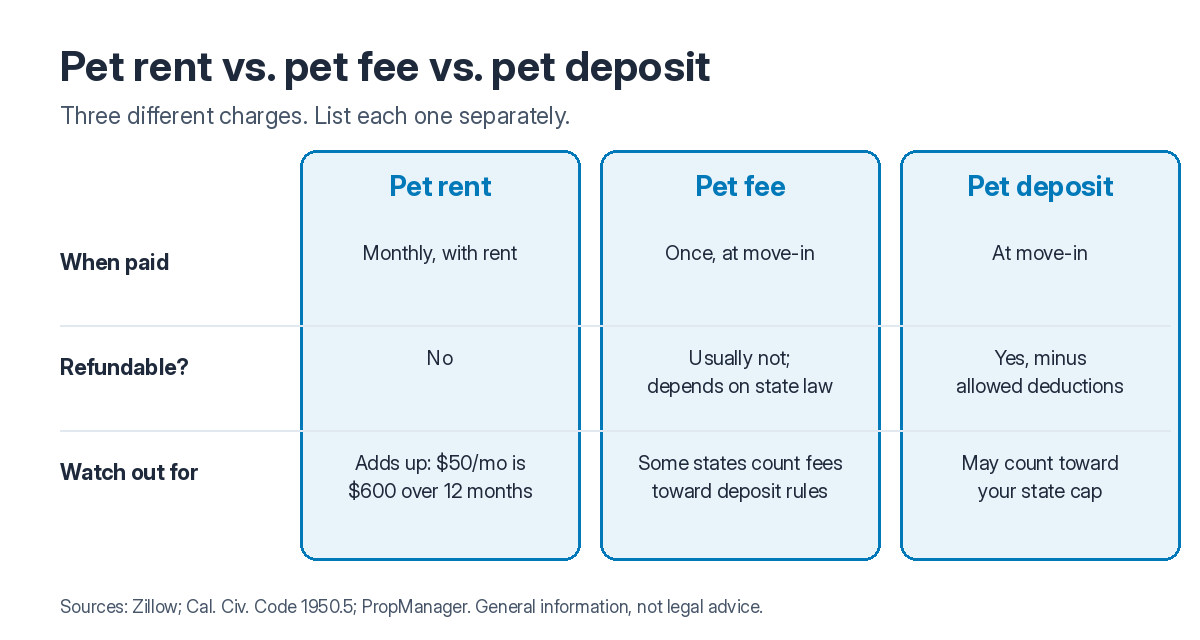
Pet rent is a monthly charge, a pet fee is a one-time charge and a pet deposit is refundable. Zillow advises itemizing each one, noting that they are three different costs.
| Type | When paid | Refundable? | Watch out for |
|---|---|---|---|
| Pet rent | Monthly, with rent | No | It adds up over the lease |
| Pet fee | Once, usually at move-in | Usually not, but it depends on state law and lease wording | Some states treat fees as part of the security deposit |
| Pet deposit | At move-in | Yes, minus allowed deductions | It may count toward your state’s deposit cap |
Sources: Zillow; California Civil Code § 1950.5; Michigan MCL 554.602. Check your state’s law.
Deposit caps matter here. California’s Civil Code § 1950.5(b) defines security broadly as any payment, fee, deposit or charge for the purposes the statute lists. In Michigan, MCL 554.602 caps the total security deposit at 1.5 months’ rent, so a pet deposit may count toward that cap. Always confirm with your state’s current statute. Our guide to security deposit laws covers state deposit rules in more detail.
How much can you charge for pet rent?
No national rule sets pet rent, so look at your local market and your state’s law. Among recent renters who pay pet rent or a pet fee, 45% pay $40 to $59 and 12% pay $100 or more, according to Zillow. Zillow’s 2025 renters report found that 31% of recent renters paid a pet fee or pet rent, including 49% of those with a pet.
Keep the total cost in view. Zillow notes that $50 a month in pet rent adds $600 over a 12-month lease. To price pet rent alongside your base rent, see how much rent should I charge.
This is general information, not legal advice. Assistance-animal rules depend on federal, state and local law.
Are service animals and emotional support animals pets?
No. Assistance animals for people with disabilities are a reasonable-accommodation question under the Fair Housing Act, not a pet-policy question. HUD’s regulation at 24 CFR 100.204 makes it unlawful “to refuse to make reasonable accommodations in rules, policies, practices, or services” when they may be necessary for equal opportunity to use and enjoy a dwelling. One example in that regulation describes a building with a “no pets” policy that must allow a blind applicant’s seeing eye dog.
The HUD and DOJ Joint Statement on reasonable accommodations gives a similar example: a deaf tenant’s assistance dog requires an exception to a “no pets” policy.
HUD changed how it handles animal complaints in 2026. According to the Texas Department of Housing and Community Affairs (TDHCA), HUD issued the Trainor memo on May 22, 2026, rescinding its prior federal guidance on emotional support animals. TDHCA’s FAQ says HUD will now apply a training standard: the animal must be individually trained to do work or perform tasks related to the person’s disability. Under that standard, TDHCA says, HUD won’t pursue complaints about untrained animals, as most emotional support animals are. That change in enforcement isn’t permission to charge for an emotional support animal or turn one down.
TDHCA also says the memo doesn’t change any current rules or statute and doesn’t address Section 504 or the ADA. According to TDHCA, it also doesn’t stop private lawsuits, so a court may still find that an animal is a reasonable accommodation.
Can you charge pet fees for an assistance animal?
Don’t assume you can. TDHCA’s FAQ recommends no pet fees, pet rent or pet deposits for an animal documented as trained, for properties in its programs.
TDHCA adds that properties covered by Section 504 must allow support animals without charge when the accommodation requirements are met. It also notes that state or local law may give tenants more protection. Those recommendations come from one state agency, but they show why a blanket rule is risky. Before you change how you treat any assistance animal, check your state and local law and get legal advice.
What can you ask about an assistance animal?
Keep questions narrow. TDHCA lists two questions: “Is the animal required because of a disability?” and “What work or task is the animal trained to do in relation to the disability?” TDHCA strongly recommends not asking more, and never asking about a diagnosis or the severity of a disability.
As a best practice, keep a written accommodation process separate from your pet policy, and handle each request the same way. Our guide to questions landlords can’t ask covers broader fair housing rules.
How do you screen applicants with pets fairly?
Use one written pet policy for every applicant and keep the assistance-animal process separate. Ask every applicant the same pet questions, such as the type and number of pets, and apply the same charges and limits.
Screening tools can help you organize your review, but they shouldn’t make the decision. On Apartment One, the Tenant Fit Index includes lifestyle preferences and helps you review fit. Your written criteria and pet policy should still drive the decision for each applicant.
How does Apartment One help pet-friendly landlords?
Apartment One is an online platform where renters complete a verified background and credit screening once, then get matched to rental properties they qualify for, while landlords list properties for free and receive pre-screened applicants.
The Tenant Fit Index (TFI) is Apartment One’s 0-100 score matching a renter to a property based on credit, income-to-rent ratio, eviction history, criminal history, and lifestyle preferences.
As a Property Partner, you list for free and receive pre-screened applicants. Their screening covers FICO 9 credit from Experian, eviction records and criminal records. You review each one against your own written criteria. Apartment One doesn’t screen pets or verify assistance animals, so use in-app messaging to confirm pet details before a showing.
Most renters have pets. A clear, written pet policy helps you reach them and apply the same rules to everyone. List your pet-friendly rental free on Apartment One and review pre-screened applicants against your own criteria.
Frequently asked questions
Can I have a no-pets policy?
A no-pets rule can’t be used to refuse a reasonable accommodation for an assistance animal. HUD’s regulation at 24 CFR 100.204 gives the example of a “no pets” building that must allow a blind applicant’s seeing eye dog. Check your state and local law for other limits.
Can I charge both pet rent and a pet deposit?
It depends on your state’s law, so list each charge separately, as Zillow advises. A pet deposit may count toward your state’s deposit cap. Michigan’s MCL 554.602, for example, caps the total security deposit at 1.5 months’ rent, so a pet deposit may count toward it. Check your state’s statute.
Should my listing show the pet policy?
Yes. Zillow advises itemizing pet rent, deposits and one-time fees so renters can see the full cost. A clear listing also helps you apply the same rules to every applicant.
Did HUD change the emotional support animal rules in 2026?
HUD changed how it evaluates complaints, according to TDHCA’s summary of HUD’s May 22, 2026 memo. TDHCA says the memo doesn’t change the statute, and state and local law, Section 504 and the courts still apply. Get legal advice before changing your process.
Does it cost anything to list on Apartment One?
No. Listing your rental as a Property Partner on Apartment One is free for landlords.
3 Responses