

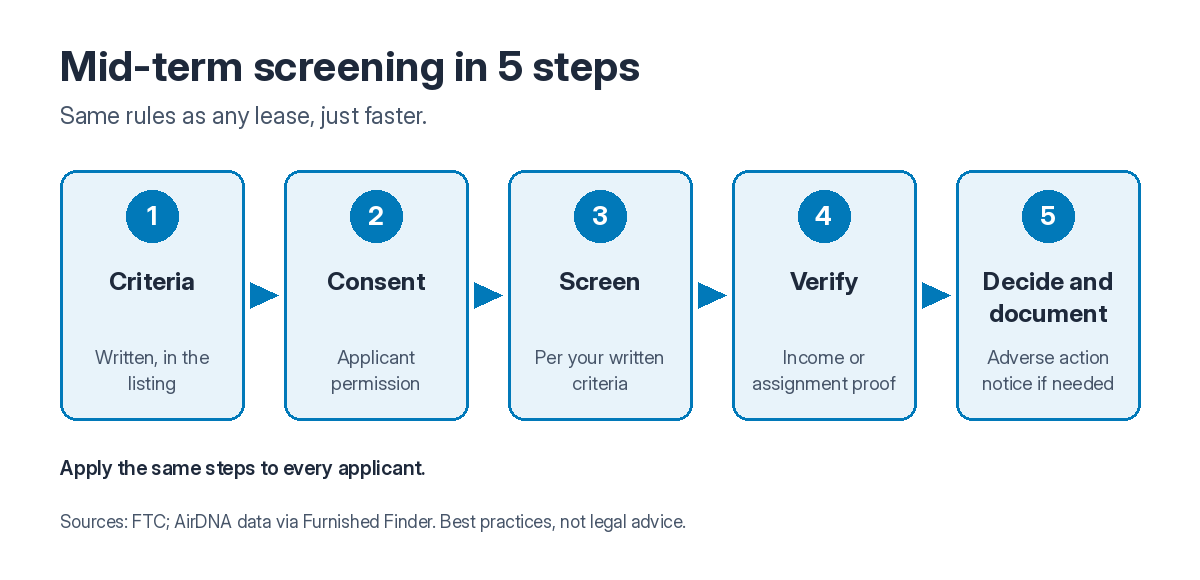
Here’s how to screen tenants for a mid-term rental: use your usual written criteria, just faster. Get the applicant’s permission, run an FCRA-compliant consumer report, verify income or assignment details, and send an adverse action notice when a report affects your decision. Per AirDNA data from Furnished Finder, over 40% of monthly renters secure housing within two weeks of move-in.
What is a mid-term rental, and who rents one?
A mid-term rental is a furnished stay of about one to several months, longer than a vacation rental and shorter than a typical annual lease. For a broader look at flexible leases, see our guide to month-to-month rentals.
Mid-term renters aren’t one group. According to Furnished Finder, a monthly rental platform, demand on its site comes from business travelers, healthcare professionals, relocating families and insurance placements, academics and digital nomads. Travel nurses are a well-known example. Furnished Finder’s March 2026 guide says many travel-nurse assignments run about 13 weeks, with frequent extensions and short decision windows near the end of an assignment.
Why is mid-term demand growing in 2026?
More renters are booking longer furnished stays. According to AirDNA data published by Furnished Finder, nights booked for stays of 28 days or more grew from about 20 million in 2019 to 46 million by the end of 2025. The same report says monthly rentals make up nearly one in five rental bookings nationwide, and the average stay on Furnished Finder is 102 days.
Do mid-term renters need a background check?
If you screen, federal rules apply the same way they do for an annual lease. The FTC says tenant background checks are consumer reports under the Fair Credit Reporting Act. You need a permissible purpose, and you must certify that you’ll use the report only for housing.
The FTC also says you must give an adverse action notice if a report plays any part in denying an applicant, requiring a co-signer, or charging a higher deposit or rent. A short stay doesn’t change that. Our guide to tenant background checks for landlords covers the steps in more detail.
What should you check for a travel nurse or corporate renter?
Check the same core items you check for any renter, plus the details of the stay. These are best practices, applied the same way to every applicant:
| What to check | Why | Source or link |
|---|---|---|
| Photo ID | Confirms you’re dealing with the applicant named on the report | Rental scams guide |
| Written consent for screening | Shows a permissible purpose for the consumer report | FTC |
| Credit, eviction and criminal history | Applied only as your written criteria allow | Tenant screening criteria |
| Income, or an assignment or offer letter | Shows the applicant can pay for the full stay | How to verify tenant income |
| Prior landlord reference | Adds rental history context | Your written criteria |
| Stay dates and extension terms | Assignments often extend, so plan for it | Furnished Finder |
Best practices, not legal requirements. Check your state and local rules.
When you ask for an assignment or offer letter, make it a written criterion and ask every applicant for the same kind of proof. Check documents for signs of editing, as our guide on verifying tenant income explains.
How to screen tenants for a mid-term rental fast without cutting corners?
Speed comes from preparation, not shortcuts. AirDNA data published by Furnished Finder shows more than 40% of tenants secure housing within two weeks of their move-in date. These practical steps help you keep up:
- Publish your criteria. Put your written screening criteria in the listing, using our tenant screening criteria template.
- Accept a current report when your policy allows it. A recent, shareable screening report can save days.
- Respond the same day. A slow reply can cost you a booking when move-in is close.
- Use one standard lease addendum. Cover furnishings, utilities and extension terms the same way every time. If you allow pets, see our guide to a pet policy for rental property.
- Document every decision. Keep notes on which criteria you applied and any adverse action notice you sent.
Should you rely on a screening score?
Use a score as one input, not the decision. The FTC lists a “risk score or recommendation from a tenant screening company” as a type of consumer report. So the same FCRA duties apply when a score affects your decision.
A 2026 study in Housing Policy Debate by Wonyoung So and colleagues surveyed 591 landlords in California, Georgia and North Carolina. It found that 62.5% receive algorithmic recommendations and about one in five defer to them entirely. More than 40% reported blanket denial rules.
The FTC also warns that a blanket policy of refusing to rent to anyone with a criminal record “may violate the Fair Housing Act.” On Apartment One, the Tenant Fit Index is a tool that can help you prioritize which applications to review first. Your written criteria, applied the same way to every applicant, should make the decision.
Apartment One doesn’t verify employment, travel assignments or income. Review those documents yourself, using the same standard for every applicant.
How do you avoid fraud and scams with mid-term bookings?
Verify identity and payment before you hand over keys or door codes. Keep all communication and payments in one channel so you have a record. Be cautious with requests to move the conversation elsewhere or to change payment details at the last minute. Our rental scams guide covers common patterns from the renter’s side.
Before move-in, confirm that the person signing the lease matches the photo ID and the name on the screening report. If someone else will pay, such as an employer or staffing agency, get that in writing and keep a copy with the lease.
What lease and local rules apply to 30-day-plus stays?
It depends on your city and state. In New York City, for example, the Office of Special Enforcement says hosts can’t rent out an entire apartment or home for fewer than 30 days. Other cities set different limits.
Check your local short-term rental rules and your state’s landlord-tenant law before you set a minimum stay. State law may also affect how a 30-day-plus stay is treated, so ask a local attorney if you’re unsure. If you’re setting a monthly price, our guide on how much rent to charge can help.
How does Apartment One help mid-term landlords?
Apartment One is an online platform where renters complete a verified background and credit screening once, then get matched to rental properties they qualify for, while landlords list properties for free and receive pre-screened applicants.
The Tenant Fit Index (TFI) is Apartment One’s 0-100 score matching a renter to a property based on credit, income-to-rent ratio, eviction history, criminal history, and lifestyle preferences.
As a Property Partner, you can list standard and short-term rentals for free. You receive pre-screened applicants whose screening covers FICO 9 credit from Experian, eviction records and criminal records. Renters on our Short-Term Rentals plan pay $35 per month and are re-screened monthly, so their reports stay current.
Apartment One includes shareable reports and in-app messaging. Apartment One is FCRA-compliant and follows GLBA and CCPA data handling, encrypts data and processes payments through Stripe. Comparing places to advertise? See our list of free rental listing sites for landlords.
Mid-term renters book fast. Be ready with clear criteria and pre-screened applicants. List your furnished or short-term rental free on Apartment One, review pre-screened applicants against your written criteria, and message them in the app.
Frequently asked questions
Is a mid-term rental the same as a short-term rental?
Not usually. Mid-term often means stays of 30 days or more, and many cities regulate shorter stays differently. In New York City, hosts can’t rent out an entire apartment or home for fewer than 30 days, so check your city’s rules.
Can I require an employment or assignment letter?
As a best practice, you can make it a documented criterion, as long as you apply the same rule to every applicant. Accept equivalent proof, such as an offer letter, when your written policy allows it.
Do I need to send an adverse action notice for a one-month stay?
Yes, if a consumer report played any part in an unfavorable decision, according to the FTC. The length of the lease doesn’t change that rule.
How far ahead do mid-term renters book?
Often not far. AirDNA data published by Furnished Finder shows more than 40% of tenants secure housing within two weeks of their move-in date.
Does it cost anything to list on Apartment One?
No. Listing your rental as a Property Partner on Apartment One is free for landlords.
One Response