

Can a landlord require renters insurance? Often, yes, if the requirement is written into the lease, but state law can set limits. Va. Code 55.1-1206 lets Virginia landlords require it and caps prepaid premiums plus deposits at two months’ rent. The Oregon Division of Financial Regulation says Oregon exempts some tenants based on income or subsidy.
General information, not legal or insurance advice. Check your state and local law before you add or change a requirement.
Can a landlord require renters insurance?
Yes, where state law allows it and the requirement is written into the lease. Virginia and Oregon both allow it, with limits, and other states may have their own rules.
Virginia spells this out. Under Va. Code 55.1-1206(B), “A landlord may require as a condition of tenancy that a tenant have renter’s insurance as specified in the rental agreement.” Oregon also allows it: the Oregon Division of Financial Regulation says ORS 90.222 “allows a landlord to require you to have a renters insurance policy, unless you meet specific income or subsidy specifications.”
Many renters aren’t covered yet. Zillow reports that about half of renters (48%) said in a 2024 Zillow survey that they have renters insurance. In the same Zillow survey, only 32% said their landlord or property manager requires it.
Which states limit renters insurance requirements?
Some states set rules on how you can require renters insurance and what you can charge. Here are two examples verified on official state websites.
| State | Rule | Source |
|---|---|---|
| Virginia | You may require renter’s insurance as specified in the lease, but must tell the tenant in writing they can get a separate policy. If premiums are paid to you before the tenancy starts, deposits and premiums together can’t exceed two months’ rent. | Va. Code 55.1-1206 |
| Oregon | You may require renters insurance unless the tenant meets specific income or subsidy criteria. You can’t require being named an additional insured, and the law limits how much liability coverage you can require. | Oregon DFR (ORS 90.222) |
Virginia has one more rule worth knowing. Under Va. Code 55.1-1206(D), if the lease doesn’t require renter’s insurance, the landlord must give written notice before signing that the landlord “is not responsible for the tenant’s personal property.”
Other states may have their own rules, so check your state’s landlord-tenant law before you finalize a requirement.
What does renters insurance cover, and why does it help landlords?
Renters insurance covers the tenant’s belongings and liability, not your building. The Insurance Information Institute says a landlord’s policy “won’t replace your personal possessions” for a tenant.
According to the Insurance Information Institute, renters insurance includes three basic protections: personal possessions, liability and additional living expenses. III says liability coverage protects against lawsuits for bodily injury or property damage the tenant causes to other people.
For landlords, that matters in practical ways. A tenant with coverage has a way to replace belongings after a fire or theft and to pay for a place to stay during repairs. That can mean fewer disputes and a smoother recovery for everyone.
Renters insurance doesn’t replace a security deposit. Our guide to security deposit laws covers deposit limits by state.
How do you add a renters insurance requirement to your lease?
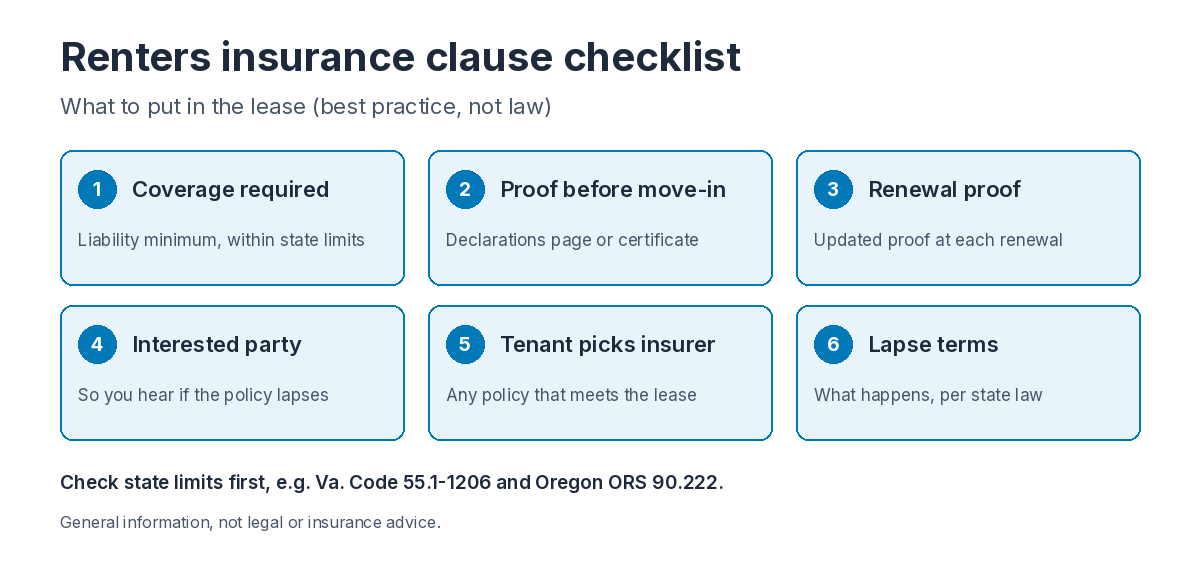
Put the requirement in the written lease with clear terms for coverage, proof and renewals. The checklist below is best practice, not a legal requirement. For the rest of the lease, see our lease agreement checklist.
- Coverage required. State the minimum liability coverage, within any state limits.
- Proof before move-in. Ask for a declarations page or certificate before you hand over keys.
- Renewal proof. Ask for updated proof each time the policy renews.
- Interested party. Ask to be listed as an interested party so you’re told if the policy lapses.
- Tenant’s choice of insurer. Let tenants pick their own company and policy that meets the lease terms.
- Lapse terms. Say what happens if coverage ends, consistent with state law.
Apply the same requirement to every tenant. The Fair Housing Act, at 42 U.S.C. 3604(b), bars different rental terms or conditions because of race, color, religion, sex, familial status or national origin. It also bars discrimination because of disability under 42 U.S.C. 3604(f).
If you rent to voucher holders, check program and state rules before adding a requirement; Oregon’s exemption is one example. Our guide on how to become a Section 8 landlord covers program basics.
How much coverage can you require?
The liability minimum is your policy choice, but some states limit it. Set a level that’s reasonable, and check your state’s rules first.
The Insurance Information Institute says renters liability limits “generally start at about $100,000.” In Oregon, the Oregon Division of Financial Regulation says ORS 90.222 “does limit the amount of liability coverage the landlord can require.”
Write the minimum into the lease as a dollar amount, not a vague term like “adequate coverage.” Use the same minimum for every unit of the same type.
What if a tenant’s policy lapses?
Your lease should say what happens, and state law may give you specific options. Being listed as an interested party helps you find out quickly.
The Oregon Division of Financial Regulation says landlords can be named as having an interest in the policy “so that they are informed if you let the policy lapse.” In Virginia, Va. Code 55.1-1206(B) says that if a required policy lapses, “the landlord may provide any landlord’s renter’s insurance coverage to such tenant.” The same section says the tenant then pays the premiums as rent until they show written proof of reinstated coverage.
Elsewhere, treat a lapse like any other lease issue. Send a written notice with a deadline to show proof, and follow your state’s rules for lease violations.
How does renters insurance fit with tenant screening?
Renters insurance is a lease term, not a screening criterion. Screen applicants against your written criteria first, then require insurance in the lease of whoever you choose.
Our guides to tenant screening criteria and how to find good tenants cover the screening side.
Apartment One is an online platform where renters complete a verified background and credit screening once, then get matched to rental properties they qualify for, while landlords list properties for free and receive pre-screened applicants. The Tenant Fit Index (TFI) is Apartment One’s 0-100 score matching a renter to a property based on credit, income-to-rent ratio, eviction history, criminal history, and lifestyle preferences. The TFI is a tool used alongside your written criteria, not a ranking or a decision-maker.
Apartment One is FCRA-compliant and follows GLBA and CCPA data handling. Data is encrypted, and payments are processed through Stripe. As a Property Partner, you list free and make your own decision on every applicant.
Set clear lease terms and start with pre-screened renters. List your rental free on Apartment One and review applicants against your written criteria.
Frequently asked questions
Can I require tenants to use a specific insurer?
It’s safer not to. In Virginia, Va. Code 55.1-1206(B) requires landlords to tell tenants in writing that they have the right to obtain a separate policy from the landlord’s policy. Set coverage terms and let tenants choose the insurer.
Can I be named as an additional insured?
Not in Oregon. The Oregon Division of Financial Regulation says landlords can’t require being named an additional insured, but can be named as having an interest so they’re told if the policy lapses. Elsewhere, check your state’s rules.
Can I charge for a landlord-provided policy?
In Virginia, yes, within limits. Va. Code 55.1-1206(D) says the landlord shall recover from the tenant the actual costs of the coverage and may recover administrative fees. The landlord must also give the tenant a summary of the policy before signing.
Is renters insurance required by law?
We didn’t find a state law requiring every tenant to carry renters insurance. It’s usually a lease requirement set by the landlord, within any limits in state law.
Does renters insurance cover a tenant’s damage to my unit?
It depends on the policy. The Insurance Information Institute says liability coverage protects against property damage the tenant causes to other people. Ask to see the tenant’s policy terms, and keep your own landlord policy for the building.
One Response