

Here is how to write a rental listing that attracts qualified tenants: lead with the rent, location, size and move-in date. Then describe the property in plain words, add clear photos, and state your screening criteria. Describe the home, not the person you want, so your ad stays within fair housing advertising rules.
General information, not legal advice.
What makes a good rental listing?
A good rental listing is complete, accurate and specific about the property. It answers a renter’s first questions up front, so the people who reach out already know the place fits their budget and needs.
Clear listings save time on both sides. When the rent, deposit, pet policy and screening criteria are in the ad, renters who can’t meet them can move on, and the ones who contact you are better matches.
The listing is only one step in finding a tenant. Our guide on how to find good tenants covers the full process.
What should a rental listing include?
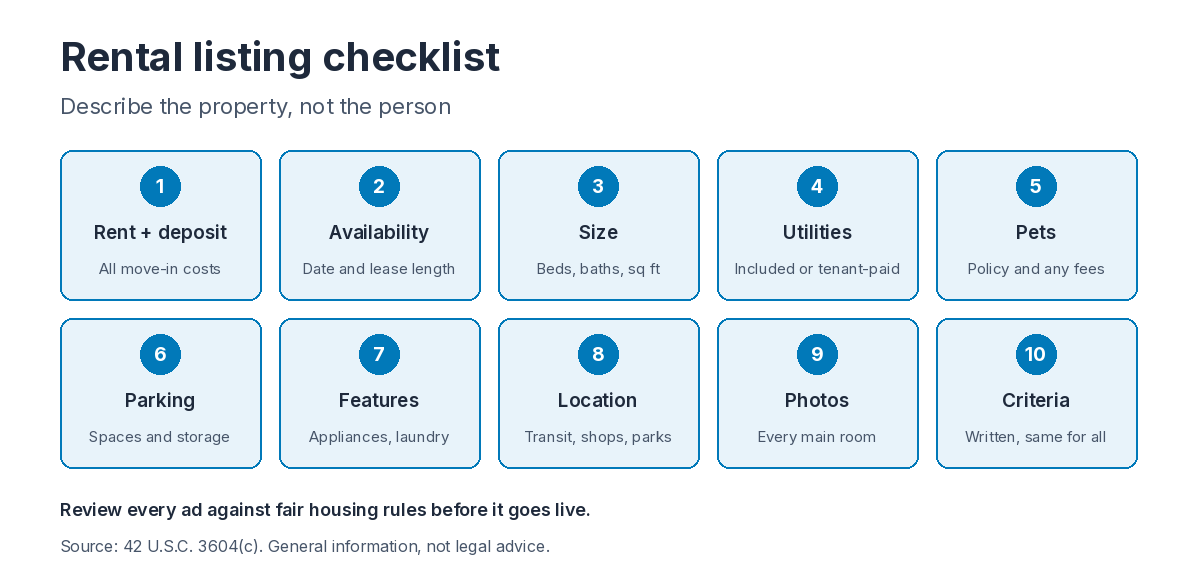
A rental listing should include the rent, deposit, availability date, size, utilities, pet and parking details, photos and your screening criteria. Missing details lead to repeat questions and wasted showings.
- Rent and deposit: Monthly rent, security deposit and any other move-in costs
- Availability: Move-in date and lease length
- Size: Bedrooms, bathrooms and approximate square footage
- Utilities: Which ones are included and which the tenant pays
- Pets: Your pet policy, including any pet fees or limits
- Parking and storage: Spaces, garage, street parking, storage units
- Features: Appliances, laundry, heating and cooling, outdoor space
- Location: Neighborhood, nearby transit, shopping and parks
- Photos: Clear, current pictures of every main room
- Screening criteria: What you check and where applicants can read your written criteria
For help setting the pet section, see our guide to writing a pet policy for rental property.
How to write a rental listing description: what goes in it?
A good description uses short, plain sentences that describe the property, its features and its location. Fill in a simple template so nothing important gets left out.
Here is a fill-in template you can adapt. Replace each bracket with your own details, and delete any line that doesn’t apply to your unit:
[Number]-bedroom, [number]-bath [apartment/house] in [neighborhood], available [date]. Rent is $[amount] per month with a $[amount] security deposit. [Utilities included or tenant-paid].
The unit has [key features: updated kitchen, in-unit laundry, central air, balcony]. [Parking details]. [Pet policy].
Located [distance] from [transit, shopping, parks]. Lease term: [length]. Screening includes [credit, income, rental history, background]; full written criteria are available on request.
To schedule a showing, [contact method].
Stick to facts a renter can verify on a tour. Words like “cozy” or “charming” say less than “new flooring” or “south-facing windows.”
Be honest about trade-offs, too. If the unit is on a busy street or a third-floor walk-up, say so. Renters who still apply are less likely to back out after a showing.
What words should you avoid in a rental ad?
Avoid any words that describe who you want as a tenant instead of what the property offers. Under 42 U.S.C. 3604(c), it is unlawful to publish any advertisement for the rental of a dwelling “that indicates any preference, limitation, or discrimination based on race, color, religion, sex, handicap, familial status, or national origin.”
The safest rule is simple: describe the property, not the person.
| Instead of | Write |
|---|---|
| “Great for families” or “No kids” | “Three bedrooms, fenced yard, near a park” |
| “Perfect for a single professional” | “One-bedroom with a home office nook” |
| “Christian home” or “near the church” | “Quiet street, walking distance to shops” |
| “Able-bodied tenants only” | “Third-floor unit, no elevator” |
| “Mature couple preferred” | “Quiet building with posted quiet hours” |
| “English speakers only” | “Contact by phone or email to schedule a tour” |
Many states and cities protect more groups than federal law does. Check your state and local rules, and review your ad before it goes live.
The same care applies after someone responds. Our guide to questions landlords can’t ask covers what to avoid in calls and showings.
How do you state your screening criteria in the listing?
State your screening criteria briefly in the listing and point applicants to your full written criteria. Then apply those same criteria to every applicant.
A short line works well, such as: “Screening includes credit, income, rental history and background. Full written criteria available on request.” Avoid wording that targets a group of people, and keep it about what you check.
If you haven’t written your standards down yet, our guide to tenant screening criteria explains how to build a fair, consistent policy.
The Tenant Fit Index (TFI) is Apartment One’s 0-100 score matching a renter to a property based on credit, income-to-rent ratio, eviction history, criminal history, and lifestyle preferences. The TFI is a tool used alongside each landlord’s written criteria, not a ranking or a decision-maker.
Which photos should a rental listing have?
A rental listing should have clear, current, well-lit photos of every main room plus the exterior. Photos should show the unit as it is today, not as it looked years ago.
- Living room and kitchen, shot from the corners to show the full space
- Each bedroom and bathroom
- Laundry, storage and parking
- Outdoor space such as a patio, balcony or yard
- The building exterior and entrance
Shoot in daylight with lights on, clear away clutter, and keep personal items and other people out of the frame. Put the best photo first, since it is often what renters see in search results.
Where should you post your rental listing?
Post your rental listing on several sites where renters in your area search, starting with free options. Our roundup of free rental listing sites for landlords compares where to list.
Apartment One is an online platform where renters complete a verified background and credit screening once, then get matched to rental properties they qualify for, while landlords list properties for free and receive pre-screened applicants.
As a Property Partner, you list for free and receive pre-screened applicants with credit (FICO 9 from Experian), eviction and criminal screening, and you can message them in the app. Apartment One also supports VASH and Section 8 rentals.
If the unit was built before 1978, remember the lease step too: under 40 CFR 745.113, the lease must include the lead warning statement and lead-based paint disclosure. Our lease agreement checklist covers it.
Apartment One is FCRA-compliant and follows GLBA and CCPA data handling. Data is encrypted, and payments are processed through Stripe.
List your rental free and receive pre-screened applicants.
Frequently asked questions
Can I say “no Section 8” in a rental ad?
It depends on where your rental is. Some states and cities have source-of-income laws that cover vouchers, so check your state and local rules first. Our guide on how to become a Section 8 landlord explains how vouchers work.
Can I say “students welcome” in a rental ad?
Student status isn’t on the federal list in 42 U.S.C. 3604(c), but state or local rules may differ. It’s safer to describe the property, such as distance to campus, than the tenant you want.
Do small landlords have to follow fair housing ad rules?
Yes for advertising. The exemptions in 42 U.S.C. 3603(b) apply to section 3604 “other than subsection (c),” so the advertising rule still applies. State and local rules may add more.
Should I list the rent in my ad?
Yes. Listing the rent up front helps renters decide quickly whether the unit fits their budget, which means fewer inquiries from people it won’t work for.
How do I stop scammers from copying my listing?
Search for your own photos and address after posting, watermark images if you like, and tell renters you’ll only collect money after a showing. Our guide to rental scams shows what renters look out for.
One Response