

How much notice you must give before a rent increase depends on your state, your city and your lease. Give the rent increase notice in writing and check your local law first. For most monthly tenancies, notice periods in the states below range from 30 to 90 days, and some states and cities also cap increases.
General information, not legal advice. Check your state and local law.
How much notice do you need to give for a rent increase?
It depends on where your rental is and what kind of tenancy you have. There is no single national rule, so the notice period comes from your state law, any city or county rules and the terms of your lease.
Start with three questions before you set a date:
- What kind of tenancy is it? Month-to-month, week-to-week and fixed-term leases are often treated differently.
- What does the lease say? Your lease may set its own notice terms or limit increases during the term.
- What do your state and city require? Local rent rules can be stricter than state law.
Work backward from the date you want the new rent to start. Count the required notice period, add a few days for delivery, and put the date on your calendar so the notice goes out on time.
When in doubt, give more notice than you think you need and put it in writing. A longer runway also gives your tenant time to plan, which can make the conversation easier.
If your tenant is on a month-to-month agreement, our guide to month-to-month rentals explains how those tenancies work.
What are the rent increase notice rules in New Mexico, California and Oregon?
All three states require written notice, but the periods differ: 30 days in New Mexico, 30 or 90 days in California depending on the size of the increase, and 90 days for most Oregon tenancies. The table summarizes each state’s rule.
| State | Notice | Other rules | Source |
|---|---|---|---|
| New Mexico | Written notice at least 30 days before the periodic rental date (month-to-month) or before the end of a fixed term; one rental period for periods under a month | Fixed-term increases take effect at the end of the term | NMSA 47-8-15(F) |
| California | Written notice: 30 days if the increase is 10% or less, 90 days if more than 10% (week-to-week, month-to-month or shorter) | Delivered personally or by mail; a longer required period controls | Cal. Civ. Code 827 |
| Oregon | At least 90 days’ written notice for most tenancies; 7 days for week-to-week | No increase in year one; once per 12 months; yearly cap | ORS 90.323 |
In New Mexico, NMSA 47-8-15(F) says an owner may increase rent in a month-to-month residency “by providing written notice to the resident of the proposed increase at least thirty days prior to the periodic rental date specified in the rental agreement or, in the case of a fixed term residency, at least thirty days prior to the end of the term.”
The same New Mexico statute says that for a periodic residency of less than one month, written notice must be given at least one rental period before the first increased payment.
In California, Civil Code section 827 requires written notice for week-to-week, month-to-month and shorter tenancies: 30 days if the increase is 10% or less of the rent charged in the prior 12 months, counting all increases together, and 90 days if it is more than 10%.
Section 827 also allows 30 days’ notice when the increase results from an income or family recertification required by statute or regulation, and says a longer notice period required by statute, regulation or contract controls.
For most Oregon tenancies, ORS 90.323 requires at least 90 days’ written notice before a rent increase takes effect, bars increases during the first year of the tenancy and limits increases to once in any 12-month period. Week-to-week tenancies need 7 days’ written notice.
The Oregon Department of Administrative Services says the maximum allowable rent increase for 2026 was 9.5%. The same DAS rent stabilization page says the maximum for 2027 is 10%.
Under ORS 90.323(5), the cap does not apply if the unit’s first certificate of occupancy was issued less than 15 years before the notice date, or in certain regulated affordable housing.
The same statute makes a landlord who raises rent above the cap without an exemption liable for three months’ rent plus the tenant’s actual damages.
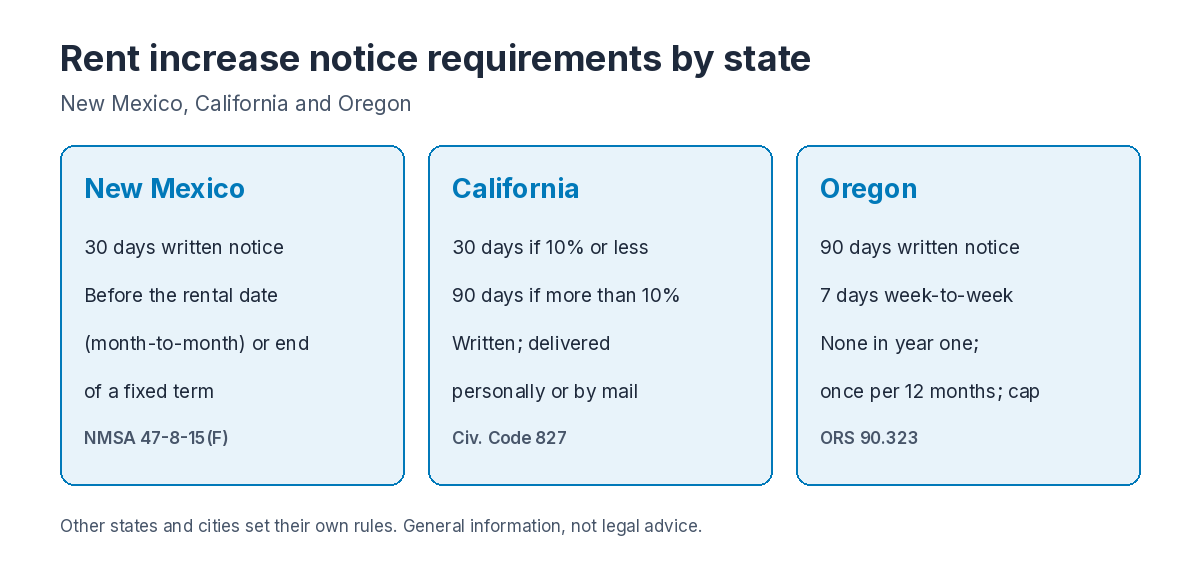
Other states set their own notice periods and limits, and some cities add more. Check your state and city; local rent rules can be stricter.
Can you raise rent during a fixed-term lease?
Generally, only if the lease allows it. A fixed-term lease sets the rent for the term, so most landlords wait until the term ends and give notice in time for the new rent to start at renewal.
Read your lease before you plan an increase. If it says nothing about mid-term increases, assume the rent stays the same until the term ends and check your state law.
In Oregon, ORS 90.323 also bars any increase during the first year of most tenancies, whatever the lease says.
When you write your next lease, decide how renewals and increases will work and put it in writing. Our lease agreement checklist covers the clauses to review.
What should a rent increase notice include?
A rent increase notice should clearly state who it is for, the current rent, the new rent, the amount of the increase and the date it takes effect. Some states require specific contents, so check yours.
Oregon is a good example: under ORS 90.323(3), the notice must state the amount of the increase, the new rent, the effective date and, if the increase is above the cap, the facts supporting the exemption.
- Tenant name and rental address
- Current monthly rent
- New monthly rent
- Amount of the increase
- Effective date
- How and when the notice was delivered
- Your name and contact information
Here is a plain-text sample you can adapt. Have it checked against your state and local law before you use it.
Dear [Tenant name],
This is written notice that the monthly rent for [rental address] will increase from $[current rent] to $[new rent], an increase of $[amount]. The new rent takes effect on [effective date]. All other terms of your rental agreement stay the same. If you have questions, contact me at [phone or email].
[Landlord name], [date delivered], delivered by [method]
Keep a dated copy of every notice in the tenant’s file, along with proof of how and when you delivered it. If a question comes up later, that record shows exactly what you sent and when the new rent took effect.
How should you deliver the notice?
Deliver it in writing and follow your state’s rules for serving notices. All three states covered here require written notice.
In Oregon, ORS 90.323 requires written notice for rent increases. In California, Civil Code section 827 says the written notice must be delivered personally or by mail under Code of Civil Procedure section 1013. Other states have their own service rules, so check how notices must be served where your rental is.
- Use a method you can prove: Keep a delivery record, such as a mailing receipt or signed acknowledgment.
- Count days carefully: Some states add days for mailed notices. Build in a buffer.
- Follow up: A short conversation after the notice arrives can answer questions early.
How do you decide how much to raise rent?
Compare your current rent with similar nearby units, stay within any legal cap and weigh the increase against the cost of turnover. Our guide to how much rent you should charge walks through pricing a unit.
A tenant who leaves can mean lost rent plus cleaning, repairs and marketing. Our guide on how to reduce rental vacancy covers ways to keep good tenants and fill units faster.
How does Apartment One help when a tenant moves out?
If a tenant moves on after a rent increase, Apartment One lets you list the unit free and receive pre-screened applicants. You set the criteria and make every decision.
Apartment One is an online platform where renters complete a verified background and credit screening once, then get matched to rental properties they qualify for, while landlords list properties for free and receive pre-screened applicants.
Screening covers credit (FICO 9 from Experian), eviction and criminal records, and you can message applicants in the app.
Quick Screen is $35 one-time for a screening report only, and Tenant Plus is $60 one-time for screening plus access to matched property listings. Pricing can vary by state.
The Tenant Fit Index (TFI) is Apartment One’s 0-100 score matching a renter to a property based on credit, income-to-rent ratio, eviction history, criminal history, and lifestyle preferences. The TFI is a tool used alongside each landlord’s written criteria, not a ranking or a decision-maker.
Apartment One is FCRA-compliant and follows GLBA and CCPA data handling. Data is encrypted, and payments are processed through Stripe.
If a tenant moves on, list free on Apartment One and get pre-screened applicants.
Frequently asked questions
Is 30 days’ notice enough for a rent increase?
It depends on your state, city and lease. New Mexico requires at least 30 days’ written notice, California requires 30 or 90 days depending on the size of the increase, and most Oregon tenancies need 90 days. Check your local law.
Can a landlord raise rent by text or email?
New Mexico, California and Oregon all require written notice, and California requires personal delivery or mail. Follow your state’s rules for serving notices and keep proof of delivery.
How often can a landlord raise rent?
In Oregon, no more than once in any 12-month period for most tenancies, and not during the first year. Elsewhere, check your state and local law and your lease.
Is there a limit on how much rent can go up?
Some places cap increases. Oregon’s maximum was 9.5% for 2026 and is 10% for 2027, with some exemptions. Elsewhere, check your state and local law.
Does a rent increase notice need to be signed?
Requirements vary. Including your name, contact details and the delivery date makes the notice clear, so check your state’s rules on notice contents.
4 Responses