

Offer a written lease renewal 60 to 90 days before the current lease ends, with the new rent, term length and a clear reply deadline. Use payment history and written screening criteria to decide renew versus remarket. If you raise rent, follow your state notice rules. Keeping a reliable payer often beats turning the unit.
General information, not legal advice. Renewal and rent-increase notice rules vary by state and by your lease.
Why does a lease renewal offer matter in 2026?
Because vacant days are expensive, and national rental vacancy was higher in late 2026 than a year earlier, so keeping a good paying tenant often beats turning the unit.
According to the U.S. Census Bureau Housing Vacancies and Homeownership release for Third Quarter 2026 (released October 28, 2026), the national rental vacancy rate was 7.6%, higher than 7.1% in the third quarter of 2025 and higher than 7.3% in the second quarter of 2026.
A renewal conversation is also your chance to fix small lease problems, update insurance or pet terms, and set expectations for the next term before anyone is under move-out pressure.
Turnover also means cleaning, repairs, listing time, showings and the risk that the next applicant fails screening. Those steps explain why a solid payer is worth a renewal conversation before you post the unit.
When should landlords send a lease renewal offer?
As a practical suggestion, start 60 to 90 days before the lease ends, and confirm any notice deadlines in the lease and in state law if the renewal includes a rent change.
- About 90 days out: pull the tenant file, payment history and local rent comps.
- About 60 to 75 days out: send a written renewal offer with a reply deadline.
- After the deadline: execute the renewal or start listing while you still have time to fill the unit.
If the new rent is higher, send whatever rent-increase notice your state requires in addition to the friendly renewal conversation. Use our verified examples in rent increase notice.
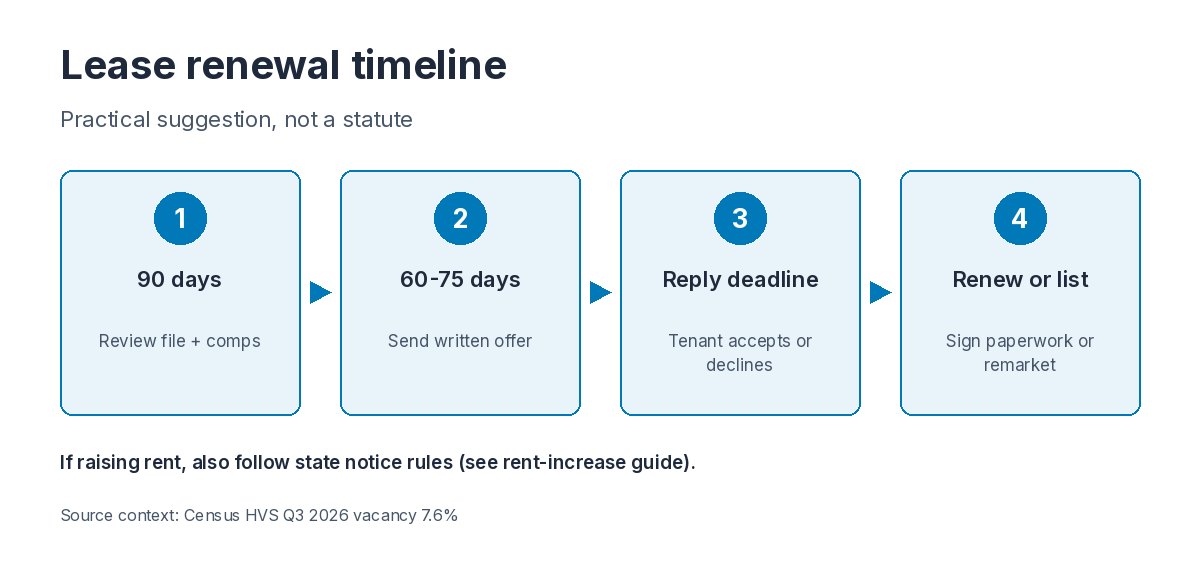
Some leases already require a fixed amount of advance notice to renew or terminate. Read that clause first so your outreach calendar matches the contract, then layer on the 60 to 90 day suggestion if the lease is silent.
What should a lease renewal offer include?
Put the offer in writing: new rent, lease length, response deadline, any changes to pets, utilities or house rules, and how the tenant accepts.
| Offer element | Why it matters | Suggestion |
|---|---|---|
| New monthly rent | Avoids sticker shock later | Show current rent and proposed rent side by side |
| Lease term length | Sets the next end date | 12 months is common; month-to-month is a policy choice |
| Reply deadline | Creates a clean renew-or-list decision | Give enough days to respond in writing |
| Term changes | Surfaces pets, parking, utilities, insurance | List only real changes; do not bury them |
| How to accept | Prevents he-said/she-said | Email confirmation or signed renewal form |
These are practical suggestions, not a statutory form. Follow your lease and state rules for what must be signed.
A short written note after a phone call still counts as documentation: summarize the rent, term and deadline you discussed so both sides share the same record.
Send the offer by a method you can prove later (email with read confirmation, certified mail, or hand delivery with a signed receipt). Oral “we’ll renew you” conversations create disputes when memories differ.
How much can you raise rent on renewal?
There is no single national cap in this article. Check the notice periods and local limits already covered in our rent-increase guide, and price against current comps.
Reuse the verified examples in rent increase notice. For setting the number itself, see how much rent you should charge.
Weigh a modest increase that keeps a reliable tenant against a larger jump that pushes them to leave.
If local rent control or a Tenant Protection Act style rule applies to your property, those rules can limit how much you may raise rent even when the tenant is willing to stay. Confirm local coverage before you put a number in the letter.
How do you decide to renew vs. find a new tenant?
Use payment reliability, care of the unit, communication and fit with your written screening criteria. If you remarket, start listing early enough to avoid a gap.
- Renew when rent arrives on time, the unit is cared for, and the tenant still meets your written criteria.
- Remarket when late payments, lease violations or criteria problems outweigh the cost of a vacancy.
- If you list, refresh photos and criteria first so you are not improvising under deadline pressure.
For attracting applicants, see how to find good tenants, how to write a rental listing and how to reduce rental vacancy. Keep screening consistent with tenant screening criteria. Free listing options are covered in free rental listing sites for landlords.
Qualitative renew-versus-remarket signals include on-time rent, responsive communication, care of the unit, neighbor complaints, and whether the household still matches your written occupancy and screening rules. Skip gut feel that you cannot explain in notes.
What happens after the tenant accepts or declines?
If they accept, sign the renewal or a new lease before the old term ends. If they decline or miss the deadline, start listing and plan move-out logistics early.
- Accepted: execute documents, confirm the new rent start date, and note any term changes in writing.
- Declined or no reply: treat the deadline as firm, begin showings, and schedule a move-out inspection.
- Deposit and move-out: follow your state deposit rules; see security deposit laws only as a light cross-check.
If a tenant wants to negotiate the number, our renter-side guide on how to negotiate rent shows what they may ask for so you can prepare a clear answer.
How does Apartment One fit in for landlords?
Renew your best tenants when you can. When you need a new one, Apartment One lets you list free and receive pre-screened applicants while you keep written criteria. You still decide every lease.
Apartment One is an online platform where renters complete a verified background and credit screening once, then get matched to rental properties they qualify for, while landlords list properties for free and receive pre-screened applicants.
Screening covers credit (FICO 9 from Experian), eviction and criminal records. Landlords receive pre-screened applicants and can message in-app.
The Tenant Fit Index (TFI) is Apartment One’s 0-100 score matching a renter to a property based on credit, income-to-rent ratio, eviction history, criminal history, and lifestyle preferences. The TFI is a tool used alongside written criteria, not a ranking or a decision-maker.
Apartment One is FCRA-compliant and follows GLBA and CCPA data handling. Data is encrypted, and payments are processed through Stripe.
Renew your best tenants when you can – and when you need a new one, list free and get pre-screened applicants.
Frequently asked questions
How early should I send a renewal letter?
A practical suggestion is 60 to 90 days before the lease ends. Check your lease and any state notice rules if rent will change.
Do I need a special form?
A written offer with rent, term, reply deadline and any term changes is the key. Follow your state and lease for what must be signed.
Should every renewal include a rent increase?
Not always. Weigh turnover risk, local comps and your state’s notice rules before deciding.
What if the tenant wants a month-to-month?
That is a policy choice. If you agree, put the new term, rent and notice rules in writing.
What if they don’t reply?
Set a clear deadline in the offer and be ready to list when it passes.