

Rent late fee laws set how much a landlord can charge, when the fee can start, and whether it must be in the lease. State examples range from about 5% of past-due rent to 12% of rent, and some add grace periods. Write one clear clause, apply it evenly, and check your state before you collect.
General information, not legal advice. Check your state and local law.
How much can a landlord charge for late rent?
It depends on your state: some caps are a flat dollar amount or a percent of past-due rent, others use a percent of periodic rent, and a few add a waiting period before any fee is allowed.
There is no single federal late fee cap for ordinary private rentals. Your lease and state (and sometimes city) rules control the amount, timing and disclosure.
Examples in this guide include Colorado’s greater-of-$50-or-5% rule in Senate Bill 21-173 (C.R.S. 38-12-105), Minnesota’s 8% cap in Minnesota Statutes section 504B.177, Virginia’s lesser-of-10% rule in Virginia Code section 55.1-1204(E), and Texas reasonableness bands in Texas Property Code section 92.019.
Under NMSA 47-8-15(D), if the rental agreement provides for a late fee and the resident does not pay rent as agreed, the owner may charge a late fee of not more than five percent of the rent for each rental period in default, calculated on rent only (not deposits, additional fees or utilities), with notice of the fee no later than the last day of the next rental period. A 2025 amendment, effective June 20, 2025, set that five percent cap.
What do rent late fee laws allow in Colorado, Minnesota, Virginia, Texas and New Mexico?
Colorado, Minnesota, Virginia and Texas publish clear statutory caps or reasonableness tests, and New Mexico’s current cap is 5% of rent; if your state is not listed, check your statute and any city rules.
Under Colorado SB21-173 / C.R.S. 38-12-105, a landlord may not charge a late fee unless rent is at least seven calendar days late, and the fee may not exceed the greater of $50 or 5% of the past-due rent payment. The late fee must be disclosed in the rental agreement.
The same Colorado act also bars charging a late fee on the portion of rent a rent subsidy provider pays, charging interest on a late fee, taking a late fee out of a rent payment, and removing or terminating a tenant because of unpaid late fees alone.
Under Minnesota Statutes section 504B.177, a late fee requires a written agreement that says when it will be imposed, and the fee may not exceed eight percent of the overdue rent payment.
Under Virginia Code section 55.1-1204(E), a landlord may not charge for late payment of rent unless the charge is in the written rental agreement, and the late charge may not exceed the lesser of 10% of the periodic rent or 10% of the remaining balance due.
Under Texas Property Code section 92.019, a late fee requires notice in a written lease, must be reasonable, and may be charged only after any portion of rent has remained unpaid two full days after the original due date. A fee is considered reasonable if it is not more than 12% of the rent for a dwelling in a structure with four or fewer units, or 10% for a structure with more than four units (or not more than the landlord’s uncertain damages tied to the late payment).
The same Texas section 92.019 says a violating landlord is liable for $100, three times the improper late fee collected, and the tenant’s reasonable attorney’s fees.
| State | Max late fee (examples) | When it can be charged | Must be in lease? |
|---|---|---|---|
| Colorado | Greater of $50 or 5% of past-due rent | Rent at least 7 calendar days late | Yes |
| Minnesota | 8% of the overdue rent payment | When the written agreement says | Yes (written agreement) |
| Virginia | Lesser of 10% of periodic rent or 10% of remaining balance | Per the written rental agreement | Yes |
| Texas | Reasonable; often ≤12% (≤4 units) or ≤10% (>4 units) | After rent unpaid two full days | Yes (written lease notice) |
| New Mexico | Five percent of rent per rental period in default | After default; notice by last day of next rental period | Yes (if lease provides for it) |
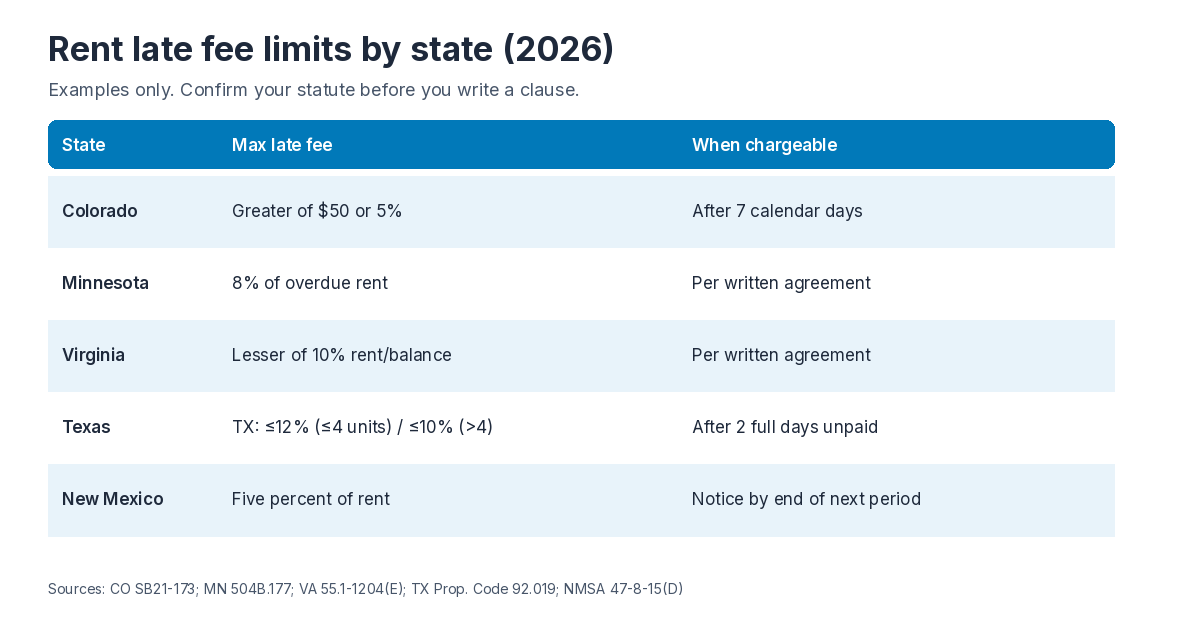
This table is not a fifty-state survey. Cross-check rent timing with our guide to rent increase notice when you update related lease terms.
Is there a grace period before a late fee?
Sometimes: Colorado waits at least seven calendar days, Texas waits two full days after the due date, and other states leave timing to the lease and statute language.
Colorado C.R.S. 38-12-105 forbids a late fee unless the rent payment is late by at least seven calendar days.
Texas Property Code section 92.019 allows a late fee only after any portion of the tenant’s rent has remained unpaid two full days after the date the rent was originally due.
Minnesota Statutes section 504B.177 requires the written agreement to specify when the late fee will be imposed, but does not set a statewide seven-day grace period in the text we cite.
Virginia Code section 55.1-1204(E) ties the charge to the written rental agreement and the percentage caps, without a separate statutory multi-day grace period in that subsection.
Can you charge a late fee to a Section 8 or subsidized tenant?
Yes in many places, but only on the tenant’s share where the statute says so, and never as a different policy used only against voucher holders.
Under Minnesota Statutes section 504B.177(c), a late fee charged by a landlord with a housing assistance payments contract must be calculated and assessed only on the portion of rent payable by the tenant.
Under Colorado SB21-173, a landlord may not impose a late fee for late payment or nonpayment of any portion of the rent that a rent subsidy provider, rather than the tenant, is responsible for paying.
Apply the same written late fee policy to every tenant. Do not invent a higher fee only for voucher holders.
For program setup, see how to become a Section 8 landlord, HUD-VASH for landlords, source of income discrimination, and apartment junk fees. For income paperwork, see how to verify tenant income.
How do you write a late fee clause that holds up?
Put the amount or formula, the day it starts, how you calculate subsidized rent, and how you give notice in the written lease, then use that same clause for every tenancy.
- State the fee as a dollar amount, a percent, or the greater/lesser formula your state allows.
- Say which day the fee starts (for example, after seven calendar days or after two full days).
- Say whether the percent applies to full rent or only the tenant’s portion when a subsidy pays the rest.
- Say how and when you will give written notice of the fee.
- Keep late fees separate from rent in your ledgers where your state requires that distinction.
Use our lease agreement checklist so the late fee row matches the rest of the lease. Do not rely on a verbal side deal.
Under Texas Property Code section 92.019(b), an initial fee plus daily fees count as one late fee under the cap. Under Colorado C.R.S. 38-12-105, a landlord may impose a late fee more than once for a late payment only if the total does not exceed the greater of $50 or 5% of the past-due rent.
How does Apartment One fit in?
Apartment One helps you list free and receive pre-screened applicants while you keep one written late fee policy for every tenant. You still set the lease terms and make every leasing decision.
Apartment One is an online platform where renters complete a verified background and credit screening once, then get matched to rental properties they qualify for, while landlords list properties for free and receive pre-screened applicants.
Screening covers credit (FICO 9 from Experian), eviction and criminal records. Apartment One supports Section 8 rentals and VASH rentals.
The Tenant Fit Index (TFI) is Apartment One’s 0-100 score matching a renter to a property based on credit, income-to-rent ratio, eviction history, criminal history, and lifestyle preferences. The TFI is a tool used alongside written criteria, not a ranking or a decision-maker.
Apartment One is FCRA-compliant and follows GLBA and CCPA data handling. Data is encrypted, and payments are processed through Stripe.
List your rental free and get pre-screened applicants, then apply the same written lease terms to everyone.
Frequently asked questions
Is a 10% late fee legal?
It depends on your state. Virginia caps a late charge at the lesser of 10% of periodic rent or 10% of the remaining balance. Minnesota caps late fees at 8% of overdue rent. New Mexico caps late fees at five percent of rent under NMSA 47-8-15(D). In Texas, up to 10% can be treated as reasonable for a structure with more than four units (or 12% for four or fewer).
Can I evict for unpaid late fees?
Not in Colorado under C.R.S. 38-12-105, which bars removing or terminating a tenant because of unpaid late fees alone. Other states differ, so check yours before you serve a notice.
Can I charge a daily late fee?
Sometimes, within the total cap. Texas Property Code section 92.019 treats an initial fee plus daily fees as one late fee under the reasonableness cap. Colorado allows more than one late fee on a late payment only if the total stays within the greater of $50 or 5% of past-due rent.
Do I need the late fee in the lease?
Yes in the examples in this guide. Colorado, Minnesota, Virginia and Texas all require the fee to be disclosed in a written rental agreement or lease before you charge it.
What changed in New Mexico in 2025?
A 2025 amendment to NMSA 47-8-15(D), effective June 20, 2025, set the late fee cap at five percent of the rent for each rental period in default, calculated on rent only. Update existing leases to match.