

Whether landlords should allow subletting depends on your lease, your state and city, and your appetite for risk. Many landlords do not ban sublets outright; instead they require written consent and screen the proposed subtenant with the same written criteria used for any applicant. A few states and cities limit refusals.
General information, not legal advice. Sublet and assignment rules vary by state, city, and lease. Confirm your documents and talk to counsel before you change a policy.
What is the difference between a sublease and an assignment?
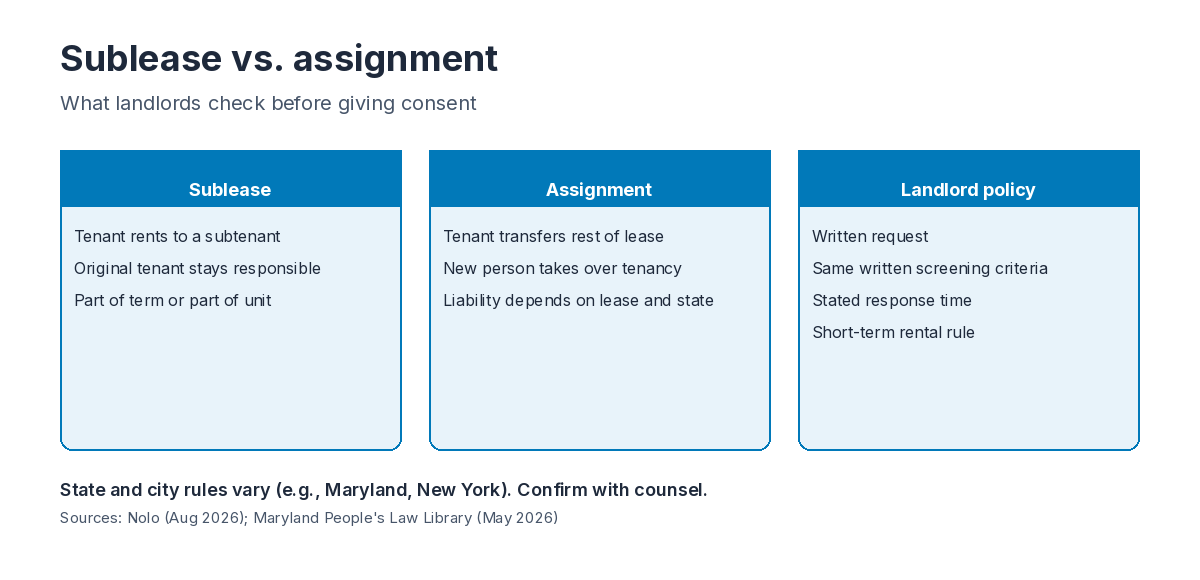
In a sublease, the original tenant rents some or all of the unit to someone else for part of the term and stays responsible to you. In an assignment, the tenant transfers the rest of the lease to a new person who takes over the tenancy.
According to Nolo’s guide to subletting (updated August 2026), a sublet happens when a tenant rents all or part of the unit to a new tenant, often called a subtenant, while the original tenant, sometimes called the master tenant, remains responsible to the landlord for rent and damage. Nolo explains that an assignment instead transfers the original tenant’s remaining rights under the lease to someone else.
The Maryland People’s Law Library, a Maryland-specific resource, describes the same core idea: under a sublease, the original tenant remains responsible to the landlord, and the subtenant must generally comply with the terms of the original lease.
| Sublease | Assignment | |
|---|---|---|
| Who stays on the hook | Original tenant remains responsible | Depends on the lease and state; ask counsel |
| Term transferred | Part of the remaining term, or part of the unit | Generally the rest of the term |
| Landlord tool | Written consent + same screening criteria | Written consent + same screening criteria |
Can a landlord prohibit subletting?
Often yes, through the lease, but not everywhere. The default rule, and any limits on refusing consent, depend on state and local law.
Nolo’s guide to subletting notes that most leases restrict or prohibit sublets without the landlord’s express written consent. Without a lease clause, the default varies by state.
Maryland example (state-specific): The Maryland People’s Law Library says that unless the lease says otherwise, a Maryland tenant may sublet without the landlord’s permission, and that a lease may require written consent. It also says that if the landlord knowingly permits a sublet, restrictions in the lease may be waived.
New York example (state-specific): According to Nolo’s guide to subletting, New York landlords of buildings with four or more units must allow tenants to sublet and cannot unreasonably withhold consent. Check the current New York statute and any rent-regulation rules before relying on this.
City rules: Nolo’s guide to subletting also notes that some cities, such as San Francisco, Oakland and Chicago, restrict when landlords can refuse a sublet. If you own in a regulated city, check local ordinances.
When can a landlord reasonably refuse a sublet request?
Where consent cannot be unreasonably withheld, landlords generally can still refuse for legitimate business reasons tied to the proposed subtenant, such as inability to pay rent, but not for discriminatory reasons.
Nolo’s guide to subletting lists reasons that are typically legitimate, such as a history of unpaid rent, prior evictions, poor credit, or insufficient income. Nolo warns that refusing based on a protected characteristic may violate fair housing law.
Maryland example: The Maryland People’s Law Library says that if a lease requires consent, the landlord cannot unreasonably withhold it, and that valid objections can include the proposed subtenant’s ability to pay rent and the intended use of the property. It cites Julian v. Christopher, 320 Md. 1 (1990).
A simple way to stay consistent is to run every proposed subtenant through your existing written criteria. See tenant screening criteria and tenant background checks for landlords. If your area has fair chance rules on criminal history, those apply to subtenant screening too; see fair chance housing laws.
What should a written sublet policy include?
A good written policy explains how to ask, what you review, how fast you respond, and who stays responsible, so every request is handled the same way.
Consider covering these points in the lease or an addendum (have counsel review the wording for your state):
- Request process: written request with the proposed subtenant’s name, dates and contact details.
- Screening: the subtenant applies and is screened with the same written criteria as other applicants.
- Response time: a stated target for replying.
- Responsibility: the original tenant remains responsible for rent and damage during a sublease.
- Occupancy and use: occupancy limits and building rules still apply.
- Short-term rentals: whether nightly or vacation rentals are prohibited.
- Fees: any administrative fee only if allowed in your state and city.
Our lease agreement checklist covers other clauses to put in writing.
What happens if a tenant sublets without permission?
An unauthorized sublet can be a lease breach, which may lead to a notice, eviction or a damages claim depending on state law and the lease.
Nolo’s guide to subletting says that when a lease requires consent, an unauthorized sublet is a breach that may lead to a notice to cure or quit (depending on the state), eviction, and a claim for damages.
Short-term platforms are a common trigger. Nolo’s guide to subletting says listing a rental on Airbnb or similar sites almost always violates lease prohibitions against unauthorized subletting. Stating your short-term rental rule plainly in the lease reduces disputes, and a listing for your unit you did not post can also be a sign of a scam; see rental scams.
Is a roomer or roommate the same as a subtenant?
Not always. A roommate added to the lease is a co-tenant, while a subtenant rents from the original tenant. Some states also have a separate category for roomers or lodgers.
Maryland example: The Maryland People’s Law Library describes a roomer as a person who receives lodging but not meals for compensation (citing COMAR 07.03.21.02) and says there is generally no landlord-tenant relationship and no exclusive possession, though local laws may add rules.
If a tenant needs to leave early instead of subletting, a lease break or assignment may be the cleaner path. See how to break a lease.
Should you allow subletting as a landlord?
Many landlords find that a clear consent-and-screening policy works better than a flat ban, especially where local law limits refusals anyway. A sublet can keep rent coming in when a tenant must be away, while screening protects the property.
The tradeoffs:
- Possible upside: fewer early move-outs and vacancies, and a known path instead of hidden sublets.
- Possible downside: more administration, and risk if the subtenant is not screened.
- Legal backdrop: in places like New York and some cities, you may not have the option to refuse without a reason.
How does Apartment One help landlords screen subtenants?
You can list your rental for free and receive pre-screened applicants, and you still make every leasing decision.
Apartment One is an online platform where renters complete a verified background and credit screening once, then get matched to rental properties they qualify for, while landlords list properties for free and receive pre-screened applicants.
Screening covers credit (FICO 9 from Experian), eviction and criminal records, and landlords can message applicants in-app.
The Tenant Fit Index (TFI) is Apartment One’s 0-100 score matching a renter to a property based on credit, income-to-rent ratio, eviction history, criminal history, and lifestyle preferences. The TFI is a tool used alongside written criteria, not a ranking or a decision-maker.
Apartment One is FCRA-compliant and follows GLBA and CCPA data handling. Data is encrypted, and payments are processed through Stripe.
List your rental for free and get pre-screened applicants.
Frequently asked questions
Is the original tenant still responsible during a sublease?
Generally yes. In a sublease, the original tenant usually stays responsible to the landlord for rent and damage, as Nolo and the Maryland People’s Law Library both describe.
Can a lease require landlord consent to sublet?
Yes, many leases do. In some places, such as New York for buildings with four or more units, a landlord cannot unreasonably withhold consent.
What are valid reasons to refuse a subtenant?
Legitimate business reasons tied to the subtenant, such as unpaid rent history, prior evictions, poor credit, or insufficient income. Refusals based on protected characteristics may violate fair housing law.
Does Airbnb count as subletting?
Often. Nolo says listing a rental on Airbnb or similar sites almost always violates lease prohibitions against unauthorized subletting.
Should I screen a subtenant like any other applicant?
Using the same written criteria for every applicant, including subtenants, helps keep decisions consistent.